
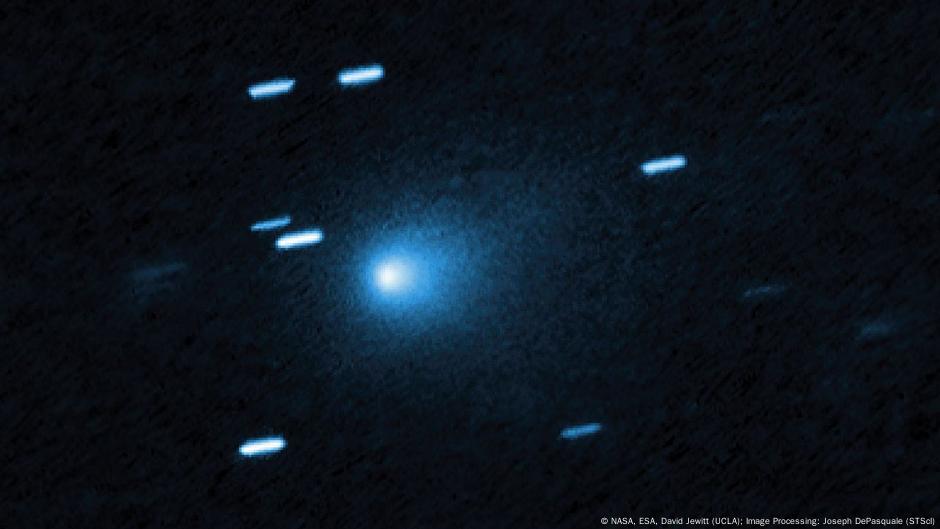
Interstellar comet 3I/ATLAS may have formed in a distant, cold region of the Milky Way as far back as 10 to 12 billion years ago, according to preliminary findings from a study posted to the Research Square preprint server and currently under peer review. The discovery, based on observations from the James Webb Space Telescope, suggests the comet is more than twice as old as Earth and our solar system, and could rival the age of the galaxy itself. First detected on July 1, 2025, by the ATLAS survey telescope in Chile, 3I/ATLAS was quickly identified as an interstellar visitor due to its hyperbolic trajectory and extreme speed—exceeding 130,000 miles per hour. Unlike periodic comets bound to the Sun, this object is passing through our solar system only once, making each observation a rare opportunity to study material from another star system. NASA’s James Webb Space Telescope observed 3I/ATLAS on August 6, 2025, using its Near-Infrared Spectrograph instrument. The data revealed signs of carbon dioxide and water ice activity in the comet’s coma, offering insights into its composition and formation environment. Additional observations from Hubble, SPHEREx, Psyche, STEREO, Lucy, PUNCH, MAVEN, MRO, and the Perseverance rover helped track the comet’s path and structure between July and October 2025, including imaging of its tail and surrounding hydrogen envelope. Scientists note that 3I/ATLAS is only the third confirmed interstellar object ever observed in our solar system, following ʻOumuamua in 2017 and 2I/Borisov in 2019. Its origin in the Milky Way’s thick disk implies it formed in an environment vastly different from our own solar neighborhood, potentially preserving conditions from the early galaxy. The findings highlight how advanced observatories like JWST are enabling researchers to analyze ancient interstellar travelers, providing indirect clues about the chemical and physical conditions present in distant parts of the galaxy billions of years ago. As the comet continues its journey out of the solar system, the data collected during its brief visit remains a valuable resource for understanding the origins and evolution of planetary systems beyond our own.
3I/ATLAS: Latest Discoveries Reveal the Surprising Origin and Composition of the First Known Interstellar Comet
14
