
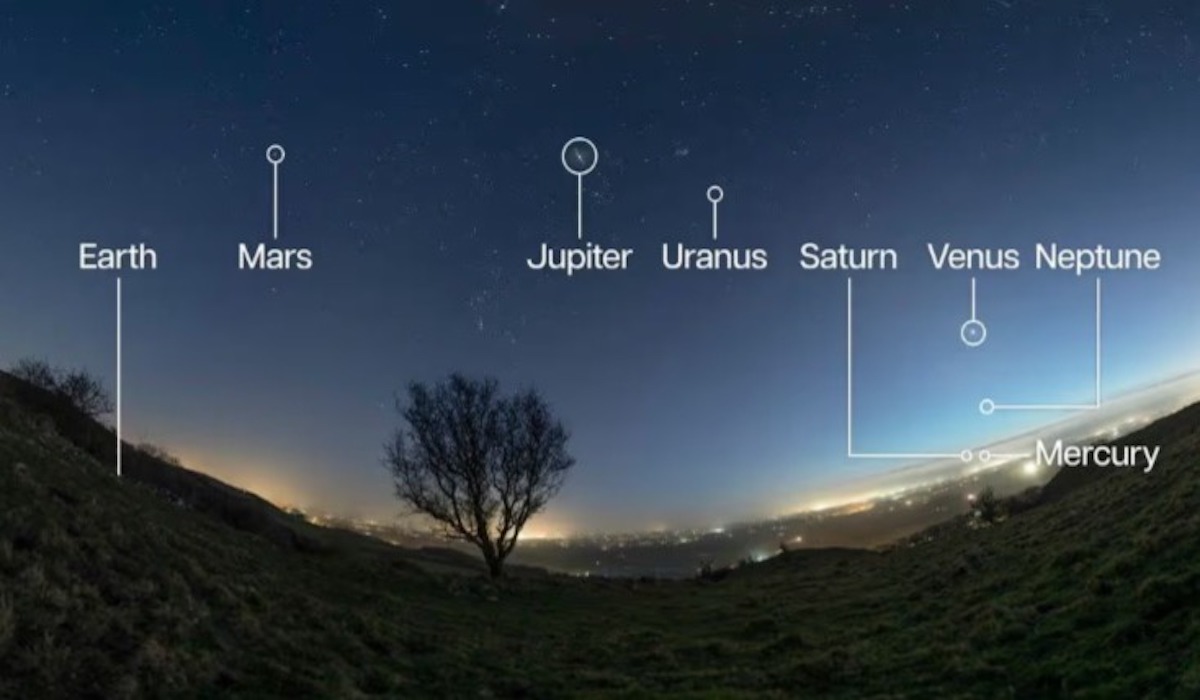
A rare astronomical event, known as a six-planet parade, will grace the Earth’s sky in late February 2026. During this alignment, Mercury, Venus, Jupiter, Saturn, Uranus, and Neptune will appear on the same side of the Sun and develop into visible above the horizon at the same time.
NASA notes that alignments of four or five planets visible to the naked eye occur every few years. Though, the inclusion of Venus and Mercury makes this planetary parade particularly noteworthy.
On February 28, 2026, these six planets are predicted to be visible shortly after sunset, with Mars being the only planet not participating in the alignment. This event is especially significant as it follows a seven-planet alignment that occurred the previous year. A similar configuration is not expected to repeat until 2040.
Best Time to View the Planetary Parade
The optimal viewing time for this phenomenon is approximately 30 minutes after sunset, specifically on February 28th. At that time, several planets will appear low in the western sky. This celestial display offers a unique opportunity for both amateur and seasoned astronomers to observe the solar system’s alignment.
While the planetary parade will be observable starting in mid-February, Venus and Mercury are expected to be most easily visible towards the end of the month. If cloudy conditions obscure the view on February 28th, observations may still be possible in the following weeks.
Planetary Positions and Viewing Difficulty
According to Royal Museums Greenwich (RMG), the experience of observing this planetary parade will vary depending on the position of each planet.
Mercury, Venus, Saturn, and Neptune will appear remarkably low on the western horizon shortly after sunset. This position makes observation more challenging due to the interference of twilight and obstacles on the horizon. Neptune will also require a telescope for visibility.
Uranus and Jupiter offer better viewing opportunities due to their higher positions. Uranus will be located in the constellation Taurus and will set around midnight, making it relatively easier to locate with a telescope. Meanwhile, Jupiter in the constellation Gemini will be the most prominent, high in the sky and visible for most of the night.
Tips for Viewing the Planetary Parade
Four planets – Mercury, Venus, Jupiter, and Saturn – can be seen with the naked eye. However, Uranus and Neptune will require binoculars or a telescope. Mercury may also be difficult to observe due to its low position near the horizon.
NASA explains that for planets to be clearly visible without assistance, their position should be at least 10 degrees above the horizon. This is because the Earth’s atmosphere near the surface dims celestial objects during sunrise or sunset. Trees, tall buildings, and light pollution can often obstruct the view.
to view Mercury, Venus, Saturn, and Neptune, observers are advised to uncover a location with an open western horizon, away from bright lights and without obstructions such as trees or tall buildings. (Manchester Evening News/Z-10)
