
An international team of scientists has developed a novel technique using chemical analysis and machine learning to detect traces of ancient microbial life, pushing back the timeline for the earliest evidence of photosynthesis on Earth. The findings, published today in PNAS, detail the discovery of biosignatures in 3.3 and 2.5 billion-year-old South African rocks, and offer a promising new approach in the ongoing search for life beyond our planet – a pursuit bolstered by a recent NASA grant to further refine the method for potential use on mars samples.
A new method combining chemical analysis and machine learning has identified traces of early organic life in rocks found in South Africa, a discovery that could inform the search for life on other planets.
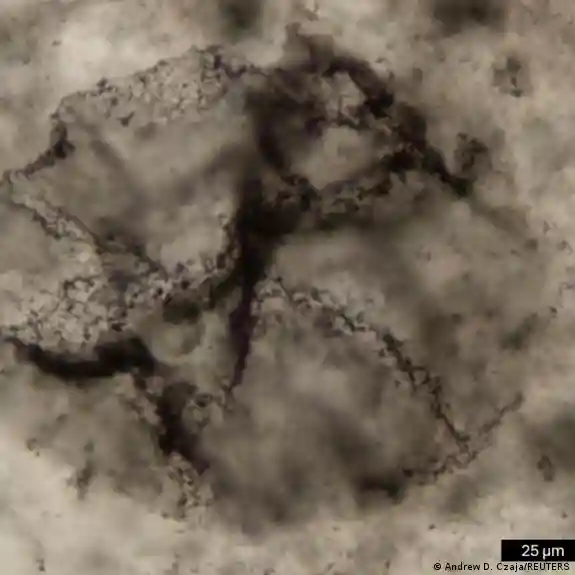
Courtesy | Researchers found evidence of microbial life in rocks discovered in South Africa
Scientists have detected some of the earliest signs of life on Earth using a novel technique that recognizes the chemical fingerprints of living organisms in ancient rocks.
The study, published Tuesday in the journal PNAS, also offers a promising outlook for the ongoing quest to find life beyond Earth.
Ancient Microbial Life Traces Found in South Africa
Table of Contents
Researchers discovered evidence of microbial life in rocks located in South Africa, estimated to be 3.3 billion years old – a time when Earth was only about a quarter of its current age.
The team also identified molecular traces of microbes that performed oxygen-producing photosynthesis in 2.5 billion-year-old rocks in the same region. This finding adds to the growing body of evidence surrounding the early evolution of life on our planet.
Machine Learning to Track Biosignatures
Leveraging a machine learning and artificial intelligence-based method, the team was able to differentiate between organic molecules of biological origin – from plants, microbes, and animals – and those of non-biological origin with over 90% accuracy.
“The most remarkable finding is that we can unravel vestiges of ancient life from highly degraded molecules. This represents a paradigm shift in how we search for ancient life,” says co-author Robert Hazen, a mineralogist and astrobiologist at the Carnegie Institution for Science in Washington.
“The human eye sees only hundreds or thousands of small ‘peaks’ of different molecules, but the machine learning method discovers subtle patterns that distinguish molecules that were once alive from those that were not,” he adds.
New Approaches to Finding Early Life on Earth
Earth formed approximately 4.5 billion years ago. Scientists searching for evidence of the earliest life on our planet have primarily relied on fossils.
These microbial deposits can be obtained from fossil formations found in Australia and South Africa, called stromatolites, which are rare and date back around 3.5 billion years.
Another approach to finding evidence of early life involves searching for traces of biomolecules – chemicals related to living organisms – in ancient rocks, the method used in the recent study.
Key Findings from the Recent Work
The authors demonstrated that oxygen-producing photosynthesis was already operating more than 800 million years earlier than previously documented with molecular evidence.
“It was known from other evidence that Earth became oxygenated around 2.5 billion years ago, perhaps a little earlier. So, we have provided the first compelling fossil organic molecular evidence, with the possibility of going even further back in the record,” Hazen states.
Identifying Signs of Life Using Organic Molecules
The earliest organisms may have been microbes that emerged hundreds of millions of years later in hydrothermal vents or terrestrial hot springs.
Co-author Anirudh Prabhu, a mineralogist and astrobiologist at the Carnegie Institution for Science, explains that this work has “roughly doubled the age at which we can identify signs of life using organic molecules, from 1.6 billion to 3.3 billion years.”
This biosignature technique can distinguish between different types of life, such as photosynthetic organisms, and also demonstrates that machine learning “can identify the fingerprints of life in ancient rocks, even when all the original biomolecules are degraded,” he adds.
Implications for the Search for Life on Other Planets
NASA rovers have collected rock samples on Mars to determine whether the neighboring planet once harbored life. Other destinations in our solar system also hold potential in the search for life, including Saturn’s moons, Enceladus and Titan, and Jupiter’s moon Europa.
The researchers have received a grant from NASA to further develop their method for identifying evidence of life. “A key area of application for our project is astrobiology,” Prabhu notes.
Hazen concludes, “We are very excited about the possibility of using this method on samples from Mars, ideally those returned to Earth, but also on a future rover mission.”
Ten la información al instante en tu celular. Únete al https://whatsapp.com/channel/0029VagwIcc4o7qP30kE1D0J canal de Diario Primicia en WhatsApp a través del siguiente link:
También estamos en Telegram como @DiarioPrimicia, únete aquí:https://t.me/diarioprimicia
