
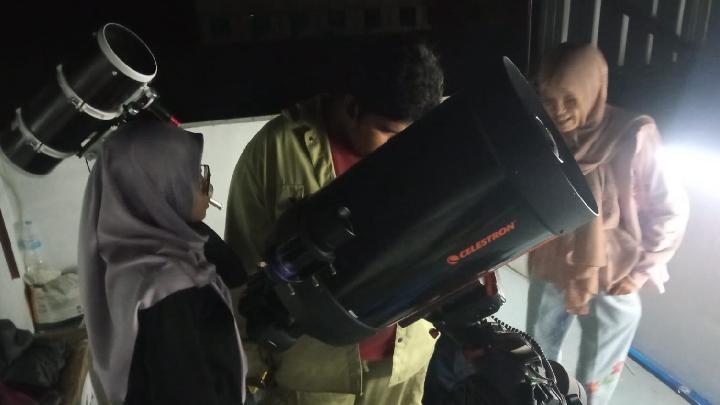
On the evening of April 26, 2026, a rare celestial event captivated astronomers and stargazers across Indonesia as asteroid (1201) Strenua passed directly in front of a distant star, briefly blocking its light in a phenomenon known as an occultation. The coordinated observation campaign, led by Indonesia’s Bosscha Observatory, marked one of the largest public astronomy efforts in the country’s history, yielding critical data about the asteroid’s size, shape, and trajectory.
A Fleeting Glimpse with Lasting Scientific Value
Occultations occur when one celestial body—such as an asteroid—passes between Earth and a more distant object, like a star, temporarily obscuring the star’s light. While the event itself lasts only seconds, the precise timing and location of these “stellar eclipses” allow scientists to refine measurements of the occulting object with remarkable accuracy. For asteroid Strenua, which measures roughly tens of kilometers in diameter, the April 26 occultation provided a unique opportunity to study its physical properties without the need for expensive space missions.
“The more observation points we have, the more precise our data becomes for determining the asteroid’s position, size, and shape,” Bosscha Observatory officials stated in a public announcement. The campaign’s success hinged on widespread participation, with 44 observation sites spanning 34 institutions, astronomy clubs, and individual observers across Indonesia. This collaborative approach not only democratized scientific research but also highlighted the growing role of citizen science in modern astronomy.
From Lembang to Kupang: A Nationwide Effort
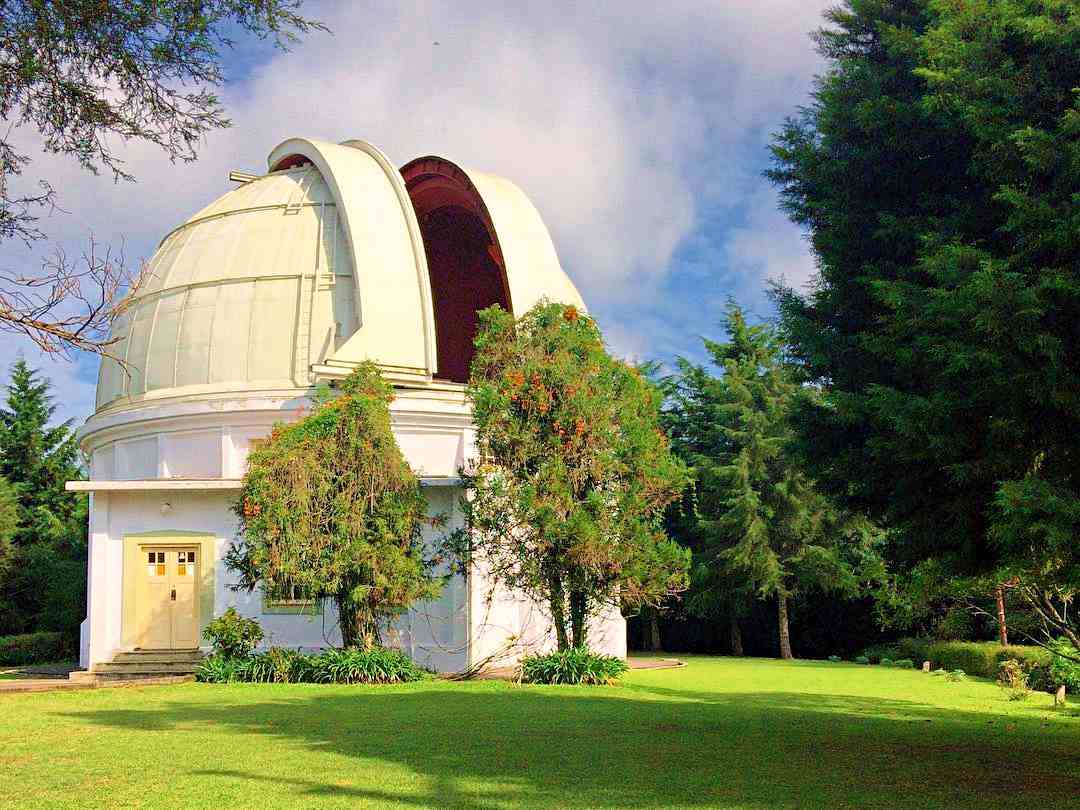
Teams were strategically deployed to maximize the chances of clear skies and optimal viewing conditions. Key locations included Bosscha Observatory in Lembang, West Java; Jayagiri, a high-altitude site near Bandung; Ciater in Subang; and Kupang in East Nusa Tenggara. Kupang, in particular, emerged as a standout location due to its favorable weather, offering observers a nearly unobstructed view of the event.
At precisely 7:41 p.m. Western Indonesia Time (WIB), the asteroid’s shadow swept across the country. Observers in Kupang, positioned near the center of the occultation’s path, recorded the longest duration of the star’s disappearance—approximately 1.52 seconds. Agus Triono Puri Jatmiko, an astronomer at Bosscha Observatory, described the moment: “The team in Kupang clearly saw the star vanish visually because their location was almost directly in the middle of the asteroid’s path.”
Other successful observations came from teams at the Observatorium Astronomi Institut Teknologi Sumatra in Lampung, Universitas Islam Negeri Walisongo in Semarang, the Penjelajah Langit astronomy club in Yogyakarta, and Imah Noong in Bandung. Yet, not all efforts were fruitful; cloud cover in Pasuruan, East Java, prevented local observer Muhammad Hammam Nasiruddin from capturing the event.
Why This Matters Beyond the Stars
While occultations may seem like niche astronomical events, their implications extend far beyond the night sky. The data collected during such observations can reveal hidden features of asteroids, such as undiscovered moons, rings, or even binary companions. These findings contribute to our understanding of the solar system’s formation and evolution, offering insights that could one day inform planetary defense strategies or future space exploration missions.
the April 26 campaign underscored the power of public engagement in science. By involving amateur astronomers and educational institutions, Bosscha Observatory not only expanded its observational reach but also fostered a culture of scientific curiosity among Indonesians. Such initiatives demonstrate how accessible technology—like commercial telescopes and digital cameras—can turn everyday citizens into contributors to cutting-edge research.
The Science Behind the Shadow
Occultations operate on a simple principle: when an asteroid passes in front of a star, the star’s light dims or disappears entirely for a brief period. The duration of this “blink” varies depending on the asteroid’s size, speed, and the observer’s location relative to the shadow’s path. By comparing timings from multiple sites, astronomers can construct a detailed silhouette of the asteroid, much like a cosmic CAT scan.
In the case of Strenua, the occulted star—cataloged as HIP 35933 (or HD 58050)—served as a distant backlight, its sudden disappearance providing a precise moment to measure the asteroid’s dimensions. The event’s path stretched across the globe, beginning in the South Atlantic Ocean, crossing central Africa, and continuing over the Indian Ocean before reaching Indonesia and concluding near eastern Australia. This global trajectory made Indonesia a critical hub for data collection.
Looking Ahead: The Future of Occultation Research
The success of the Strenua occultation campaign sets a precedent for future astronomical collaborations in Indonesia. Bosscha Observatory and its partners have demonstrated that large-scale, citizen-driven science is not only feasible but also highly effective in generating high-resolution data. As technology advances and public interest in astronomy grows, events like these could become regular fixtures in the scientific calendar, offering both educational opportunities and valuable contributions to our understanding of the cosmos.
For now, the data collected on April 26 will be analyzed to refine models of Strenua’s orbit and physical characteristics. While the asteroid itself may not pose any immediate threat to Earth, the techniques honed during this campaign will prove invaluable for studying other near-Earth objects—some of which may require closer monitoring in the future.
As the stars return to their usual brilliance, the brief disappearance of HIP 35933 serves as a reminder of how much People can learn from the fleeting shadows of the universe.
