

White House Holds Emergency Talks as Iran Sets Conditions for Nuclear Negotiations
The White House convened an emergency meeting on Monday to address escalating tensions with Iran, as Tehran laid out strict conditions for resuming nuclear negotiations—demanding the reopening of the Strait of Hormuz and the lifting of its blockade before any talks could proceed.
The crisis has left at least 2,400 mariners stranded in the critical waterway, a chokepoint for roughly one-fifth of the world’s oil supply, according to shipping industry estimates. The standoff has sent global oil prices hovering near $100 per barrel, raising concerns about energy market stability as the summer driving season approaches.
Iran’s Demands: Hormuz First, Then Nuclear Talks
In a statement released late Sunday, Iranian officials declared that negotiations over its nuclear program would only resume after the United States and its allies agreed to end the blockade of the Strait of Hormuz and restore free passage for commercial vessels. The demand marks a significant hardening of Tehran’s position, which had previously signaled willingness to discuss nuclear issues separately.
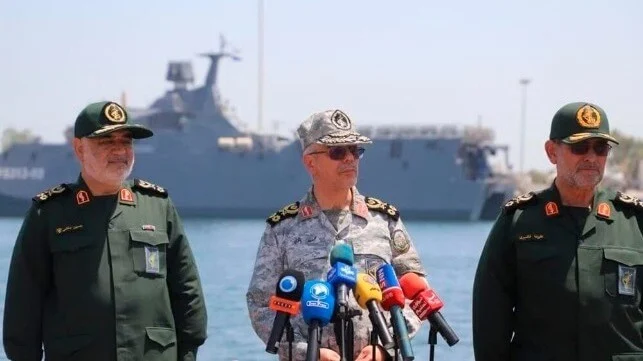
“The sequence is clear,” an Iranian foreign ministry spokesperson said in remarks carried by state media. “The Strait must be reopened, and the unjust restrictions lifted, before we can even consider returning to the negotiating table.”
The White House has not publicly responded to Iran’s conditions, but multiple U.S. Officials confirmed that emergency discussions were underway to assess the feasibility of Tehran’s demands. The talks approach as the Pentagon reportedly briefed Congress last week that clearing the strait of suspected sea mines could take up to six months—a timeline that has alarmed energy analysts and shipping executives.
Trump’s Shifting Strategy Draws Criticism
President Donald Trump has faced mounting criticism for what analysts describe as an inconsistent approach to the crisis. On Monday, he announced via Truth Social that the U.S. Had “taken decisive action” to secure the strait, though he provided no details on diplomatic efforts or military preparations. Iran did not immediately acknowledge any direct negotiations with Washington.

The United States has taken decisive action to secure the Strait of Hormuz. We will not tolerate threats to global energy security. — President Donald J. Trump
Trump’s remarks followed a weekend in which U.S. Special forces boarded a stateless oil tanker in the Indian Ocean, which the Pentagon claimed was carrying Iranian crude. The operation occurred hours after Iran’s Revolutionary Guard seized two container ships in the Strait of Hormuz, escalating the tit-for-tat blockades that have paralyzed maritime traffic in the region.
German Chancellor Friedrich Merz weighed in on the crisis during a press conference in Berlin, questioning the coherence of Washington’s strategy. “The United States lacks a convincing plan for these negotiations,” Merz said. “Diplomacy requires clarity, not mixed signals.”
Nuclear “Dust” and the Road Ahead
Amid the standoff, Trump has publicly stated his intention to eliminate what he termed Iran’s “nuclear dust”—a reference to low-enriched uranium stockpiles that could theoretically be further processed for weapons utilize. U.S. Officials have not clarified how such a removal would be executed, but experts suggest it could involve either physical extraction or verified dilution under international supervision.
Axios reported on Sunday that Iran had presented a fresh proposal to U.S. Intermediaries, offering to discuss the reopening of the Strait of Hormuz in exchange for sanctions relief. The details of the offer remain unclear, and neither side has confirmed whether the proposal was formally accepted or rejected.
The impasse has left global markets on edge. Analysts warn that prolonged disruptions in the Strait of Hormuz could trigger supply shortages, particularly in Asia and Europe, where refiners rely heavily on Middle Eastern crude. The International Maritime Organization (IMO) has called for urgent de-escalation, citing the humanitarian toll on stranded crews and the risk of environmental catastrophe from potential oil spills.
Why This Matters
The Strait of Hormuz has long been a flashpoint in U.S.-Iran relations, but the current blockade represents an unprecedented escalation. With both sides digging in, the crisis risks spiraling into a broader conflict—one that could destabilize energy markets, disrupt global trade, and draw in regional powers like Saudi Arabia and Israel.
For now, the world watches as diplomats scramble to prevent a full-blown economic and military crisis. The outcome could reshape the geopolitical landscape for years to come.
