

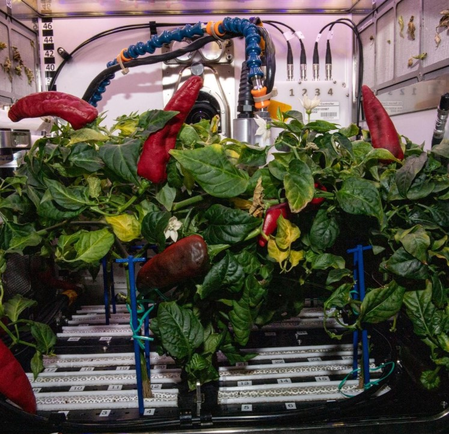
Astronauts aboard the International Space Station (ISS) have successfully cultivated green peppers in microgravity, marking a milestone in NASA’s efforts to develop sustainable food sources for long-duration space missions. The breakthrough, announced this week, comes as the agency prepares for future expeditions to the Moon and Mars—where self-sufficient food production could mean the difference between mission success and failure. The peppers, grown in NASA’s Advanced Plant Habitat (APH-04), were photographed by Expedition 66 astronaut Thomas Marshburn, who shared images on NASA’s official Instagram account with the caption: “Gardening isn’t just for Earth.”
Why Peppers? The Science Behind NASA’s Space Garden
Green peppers aren’t just a tasty snack—they’re a scientific triumph. Unlike previous space-grown crops like lettuce or radishes, peppers are more complex to cultivate, requiring precise light spectra, water management in microgravity, and careful monitoring of microbial risks. According to NASA’s official statement, the peppers were subjected to microbial analysis to study their safety and nutritional value, with astronauts reportedly enjoying them in tacos—a far cry from the freeze-dried meals of past missions.

“This investigation helps address the need for a continuous fresh-food production system in space, which is critical for long-duration missions.”
NASA’s Advanced Plant Habitat (APH) is a self-contained, carry-on-bag-sized system designed to support plant growth in space. The habitat’s red-pink LED lighting—visible in the shared photos—mimics Earth’s sunlight, while its closed-loop water delivery system prevents the bubbles that would otherwise form in microgravity. The peppers’ success builds on earlier experiments like Veggie, NASA’s first plant-growing system on the ISS, which produced lettuce in 2015.
The Stakes: Why This Matters for Deep-Space Missions
The implications of this achievement extend far beyond the ISS. For missions to Mars—where resupply from Earth would take six to nine months—astronauts will need to grow their own food. Peppers, rich in vitamins A and C, offer a critical nutritional boost compared to staple crops like potatoes or soybeans. “This isn’t just about fresh food for morale,” said a NASA spokesperson. “It’s about survival.”
- Nutritional Security: Peppers provide antioxidants and vitamins that synthetic diets can’t replicate.
- Psychological Boost: Fresh produce has been shown to improve crew morale on long missions.
- Technological Readiness: The APH system can be scaled for lunar bases or Mars habitats.
- Risk Mitigation: Microbial safety protocols ensure food won’t introduce pathogens to closed ecosystems.
While the peppers are a step forward, challenges remain. The APH system requires significant power and maintenance—resources that may be limited on a Martian colony. NASA is also testing other crops, including tomatoes and herbs, to diversify the menu. “We’re not just growing food; we’re testing the limits of biology in space,” said the agency.
Astronauts’ First Taste: From Lab to Table
The moment the peppers were harvested, astronauts didn’t just analyze them—they ate them. Photos shared by NASA show Marshburn and his crewmates preparing a meal, with one image captioned: “First space-grown peppers → first space tacos.” While the agency hasn’t released a full nutritional breakdown, preliminary microbial tests confirmed the peppers were safe for consumption. This marks the first time astronauts have eaten a crop grown entirely in space, a milestone that blends science with a touch of culinary triumph.
“The flavor and texture were surprisingly good—almost like the ones you’d find on Earth.”
This isn’t just about taste, though. The peppers’ success validates NASA’s “closed-loop” approach to space agriculture, where waste (like plant trimmings) is recycled into nutrients. Such systems could one day support entire ecosystems on the Moon or Mars, reducing the need for Earth-dependent resupply.
What’s Next: From ISS to the Moon and Beyond
NASA’s next steps involve scaling up. The agency is already planning to expand the APH system for the Lunar Gateway, a planned space station orbiting the Moon. Meanwhile, private companies like SpaceX and Blue Origin are developing their own closed-loop life-support technologies, with Elon Musk recently hinting at plans to establish a permanent Mars colony by 2030. “This pepper experiment is a proof of concept,” said a NASA official. “But the real test will be growing entire gardens on the Moon.”

- 2027: Expanded APH tests on the Lunar Gateway.
- 2028-2030: Potential Mars mission trials with hybrid Earth-space crop systems.
- 2030+: First lunar greenhouses, possibly operated by astronauts or robots.
The peppers’ journey from seed to plate also highlights a broader shift in space exploration: from short-term expeditions to long-term habitation. As NASA’s Artemis program aims to return humans to the Moon by 2026 and Mars by the late 2030s, self-sufficiency in food, water, and oxygen will be non-negotiable. The ISS’s space garden isn’t just a scientific curiosity—it’s a training ground for the future.
The Bigger Picture: Why Space Agriculture Could Redefine Humanity’s Future
Beyond NASA, this achievement has ripple effects. Companies like SpaceX and startups in vertical farming (like AeroFarms) are watching closely, as space-grown crops could inspire new Earth-based agricultural techniques. Meanwhile, universities are already studying how microgravity affects plant genetics, with some researchers suggesting space-grown crops might even be more resilient to climate change on Earth.
“If we can grow peppers in space, we can grow them anywhere—even in the most extreme environments on Earth.”
The pepper experiment also raises ethical questions. Should we genetically modify crops for space, even if it means altering their Earth-based counterparts? And how will we balance the need for nutrition with the desire for variety in long-term missions? For now, the focus remains on pragmatism: proving that humans can survive—and thrive—beyond Earth.
One thing is clear: the days of freeze-dried ice cream are numbered. The future of space exploration isn’t just about rockets and rovers—it’s about soil, seeds, and the quiet revolution of growing food where no one thought it could take root.
Sources: NASA’s official statements (May 22, 2026), Expedition 66 mission updates, Advanced Plant Habitat documentation.
