
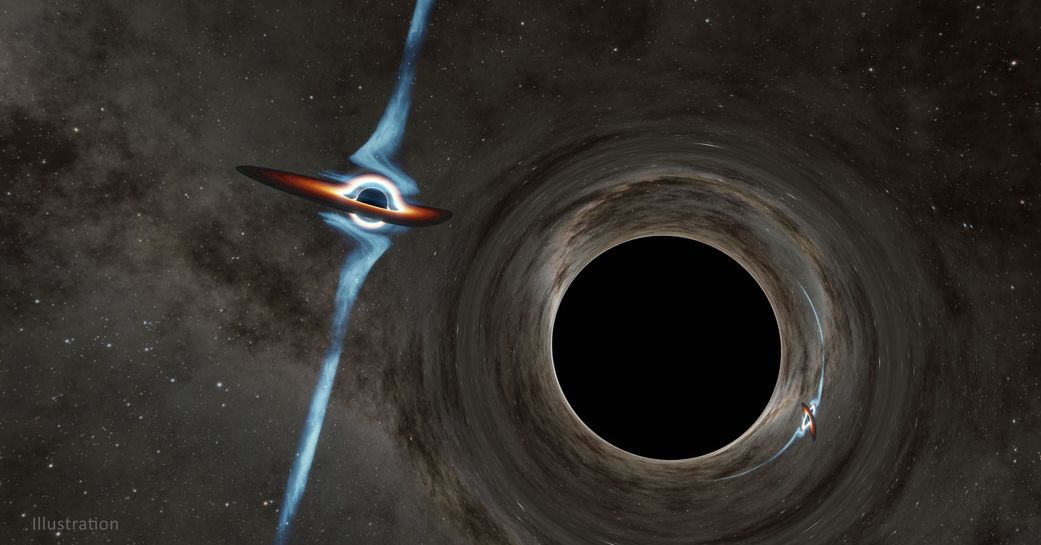
For decades, astrophysicists assumed black holes were the inevitable endgame for massive stars: a single, explosive death followed by gravitational collapse. But new research from the global LIGO-Virgo-KAGRA (LVK) Collaboration—and backed by Monash University’s analysis of 400 black hole collision events—reveals a far stranger truth: black holes are cosmic recyclers, merging repeatedly in dense stellar clusters and forming through multiple, unpredictable pathways. The discovery, published this week, doesn’t just rewrite textbooks; it forces scientists to confront a universe far more dynamic—and far more violent—than previously imagined.
Three Cosmic Assembly Lines, One Black Hole Factory
Black holes aren’t monolithic. They’re not even monolithic in their origins.
- Stellar collapse: The classic pathway, where a single massive star exhausts its fuel, collapses, and implodes into a black hole. These tend to be lighter, with masses up to ~40 times that of the Sun.
- Dense cluster collisions: In regions packed with stars, black holes don’t just form—they bump into each other. Like cosmic pinballs, they merge repeatedly, creating heavier, rapidly spinning black holes that defy traditional stellar physics.
- Hierarchical mergers: “Second-generation” black holes, born not from stars but from the wreckage of earlier black hole collisions. These objects—some exceeding 45 solar masses—carry the chaotic spin patterns of their violent past.
What’s striking isn’t just the diversity of pathways, but the scale. The LVK catalog now includes nearly 400 black hole merger events—each one a heavyweight black hole born from the collision of two smaller ones. “We’re no longer looking at individual anomalies,” says Monash University Professor Eric Thrane. “We’re seeing a true kaleidoscope of cosmic collisions.”
“We are no longer just looking at individual anomalies, instead, we are seeing a true kaleidoscope of cosmic collisions.”
The “Impossible” Black Holes That Defy Stellar Physics
The discovery of “second-generation” black holes—those born from previous mergers—solves a decades-old puzzle: the existence of black holes between 40 and 100 solar masses. These objects are too massive to form from a single star’s collapse, yet they’ve been detected repeatedly in gravitational-wave data. WIRED reports that the new analysis identifies a clear statistical signature in these heavier black holes: their spins are misaligned and chaotic, a hallmark of objects that have already participated in at least one merger.
“This is the exact signature you would expect if black holes repeatedly merged into dense stellar clusters.”
—Isobel M.
These findings challenge the prevailing model of black hole formation. If black holes can merge repeatedly in dense stellar environments, it suggests that some of the heaviest black holes we’ve observed aren’t first-generation objects at all. Instead, they’re the product of a cosmic recycling process, where black holes “eat” each other in a feedback loop of increasing mass and spin.
Why This Matters: The Universe Is More Violent Than We Thought
The implications stretch far beyond black hole origins. If black holes are merging in dense stellar clusters, it means these clusters—regions packed with stars and gas—are far more chaotic than previously believed. Gravitational waves from these collisions carry information not just about black holes, but about the environments where they form.
- Spin patterns: Black holes born from stellar collapse tend to spin in predictable, aligned directions. But second-generation black holes? Their spins are random, a direct result of chaotic mergers in dense clusters.
- Mass distribution: Heavier black holes (over 45 solar masses) are more likely to merge with smaller companions—a clue that they’re not isolated but embedded in dynamic stellar systems.
- Gravitational-wave “fingerprints”: Each merger event leaves a unique signature in spacetime. By mapping these, scientists can now reconstruct the environments where black holes form.
This isn’t just academic curiosity. Gravitational-wave astronomy is a new window into the universe—one that’s already upended our understanding of neutron stars, supernovae, and now black holes. The LVK Collaboration’s latest catalog, which includes 153 reliable black hole merger detections (with 34 belonging to the “impossible” heavyweight category), is a statistical revolution. It’s the first time scientists have enough data to distinguish between different formation pathways.
What’s Next: The Search for “Third-Generation” Black Holes
The real question now isn’t if black holes recycle, but how often. If second-generation black holes are common, could there be third-generation objects—black holes born from the merger of two second-generation black holes? And if so, what would their gravitational-wave signatures look like?
Monash University’s Thrane hints at the next frontier: “We’re moving from studying individual events to understanding the ecosystem of black hole formation.” Future detectors, including next-gen gravitational-wave observatories, may reveal even more exotic pathways—perhaps black holes forming from the collapse of primordial dark matter, or in the extreme environments near supermassive black holes.
For now, the universe has spoken: black holes aren’t just the end of a star’s life. They’re active participants in a cosmic cycle of birth, death, and rebirth—one that’s far more dynamic than we ever imagined.
One thing is certain: the LVK Collaboration’s work is just the beginning. With each new detection, we’re peeling back another layer of the universe’s most extreme physics—and the story is only getting stranger.
