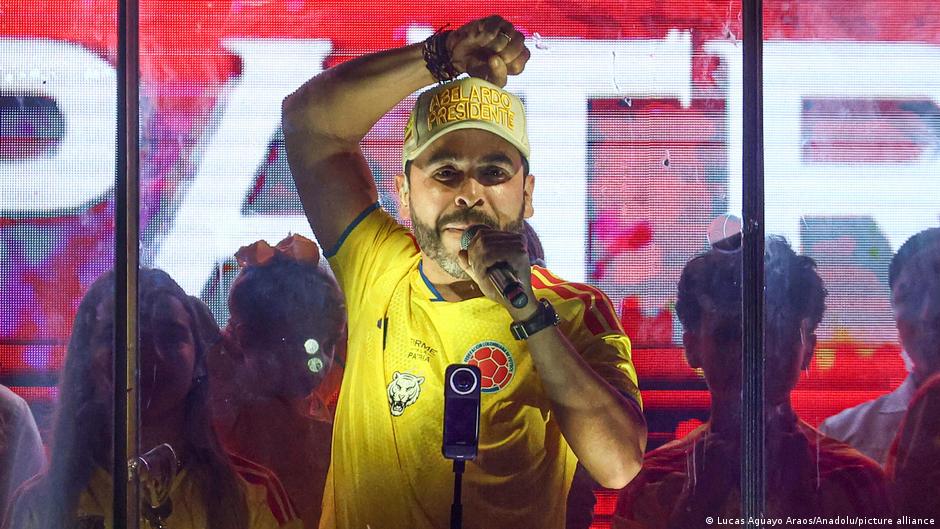
Abelardo de la Espriella emerged as the frontrunner in Colombia’s presidential election on May 31, 2026, capturing 43.74% of the vote. The lawyer and political newcomer will face second-place candidate Iván Cepeda in a June 21 runoff, setting the stage for a high-stakes ideological clash between his right-wing platform and the current government’s agenda.
A Political Outsider’s Surge to the Top
The political landscape in Colombia underwent a dramatic recalibration this past weekend. Abelardo de la Espriella, a prominent lawyer and entrepreneur with no prior political experience, secured 10.4 million votes, effectively outperforming the established political machinery. According to reporting by DW.com, his movement, Defensores de la Patria, capitalized on widespread frustration with the status quo, positioning him as an outsider capable of dismantling the traditional political elite.
While supporters view his rise as a necessary corrective, critics offer a more skeptical assessment of his background. Rodrigo Uprimny, a professor at the National University of Colombia, notably characterizes the candidate not as an external force, but as an insider who has long navigated the country’s power structures.
“Un abogado que defiende a narcos y políticos.”Rodrigo Uprimny, professor at the National University of Colombia, via DW.com
De la Espriella’s campaign strategy has relied heavily on a narrative of “iron-fisted” security, drawing explicit inspiration from international figures such as Nayib Bukele in El Salvador and Javier Milei in Argentina. His rhetoric focuses on systemic challenges including corruption, drug trafficking, and illegal activity, which he identifies as the primary impediments to Colombian stability. As noted by the BBC, his team describes this approach as one of “extrema coherencia,” or extreme coherence, rejecting the traditional governance styles that preceded the 2022 administration of Gustavo Petro.
The Polarizing Path to the Runoff
cluster (priority): DW.com
The path to the June 21 runoff is marked by deep-seated hostility. Iván Cepeda, the candidate for the Pacto Histórico, finished the first round with 40.90% of the vote, or approximately 9.7 million ballots. Despite entering the race as the favorite, Cepeda now faces an uphill battle to consolidate support against a surging right-wing coalition.
Tensions boiled over immediately following the election results. President Gustavo Petro and his candidate, Cepeda, initially questioned the data provided by the National Registry, though Cepeda later acknowledged that his campaign had found no evidence of irregularities sufficient to challenge the outcome. El Comercio reported that the public discourse has devolved into bitter name-calling, with Cepeda labeling his opponent a representative of “fascismo mafioso” and a “estafador de estafadores”—an “extortionist of extortionists.”
The vitriol is mutual. In response to a challenge for a public debate, De la Espriella demanded that his rival and the sitting president recognize the legitimacy of the first-round results before agreeing to appear on the same stage. He dismissed Cepeda as a “coward” during his post-election address.
Sociological Drivers of the Right-Wing Shift
Pro-Trump candidate leads first round of voting in Colombia presidential election
Analysts suggest the success of the De la Espriella campaign is symptomatic of a broader regional rejection of left-leaning policies. Lía Durán, a researcher at the University of Siegen, points to the “desgaste del partido del Gobierno”—the erosion of the governing party—as a primary catalyst. This exhaustion stems from a series of internal scandals, including allegations of sexual harassment and corruption within the executive branch, which have alienated key sectors of the Petro administration’s original coalition, including anti-racist and feminist movements.
The ideological framework of the current opposition is described by legal scholar Liliana Estupiñán as a return to traditional, conservative structures.
“Se ha impuesto con la misma narrativa con la que han llegado a la presidencia varios candidatos de ultraderecha en el mundo y en América Latina: seguridad, orden público, fuerza pública sin enfoque de derechos humanos, familia tradicional, heteronormatividad, mercado, negación del cambio climático, normatividad blanca, racista, clasista, capitalista, neoliberal, machista y profundamente patriarcal.”Liliana Estupiñán, constitutional law professor, via DW.com
Furthermore, the failure of the “Paz Total” policy, intended to pacify armed groups, has left a vacuum in security policy that De la Espriella has successfully exploited. By promising a return to aggressive, US-aligned security measures, he has tapped into a regional demand for order, even as his campaign remains under heavy security protocols, including protection by at least 35 bodyguards per event due to frequent death threats.
What to Expect in the Final Three Weeks
cluster (priority): news.google.com
With only three weeks until the final vote, the political atmosphere in Colombia is increasingly volatile. The collapse of the political center—highlighted by the poor performance of Paloma Valencia, who garnered only 6.92% of the vote—has left voters with a binary choice between two starkly different visions for the country’s future.
The immediate future will likely be defined by the following factors:
The Debate Stalemate: While both candidates have expressed interest in a debate, the condition that the government must first validate the first-round results remains a significant hurdle.
Security Concerns: The high level of threats against candidates highlights the physical danger surrounding the current electoral cycle.
Regional Fractures: The ability of the Petro administration to recover from internal scandals and address the perception of failed security policies will be the deciding factor for Cepeda’s campaign.
For now, the country remains in a state of high tension. The “Tigre,” as De la Espriella is known, enters the final stretch with momentum, but the ability of the left to reorganize and mobilize the electorate against what they characterize as an extremist threat remains the great unknown of the 2026 election cycle.
ail: emily.johnson@headlinez.news
Bio:
Emily Johnson serves as News Editor at Headlinez.News, overseeing the publication’s coverage of national and breaking stories. She has worked in journalism for more than 12 years, building a reputation for precision, credibility, and rapid-response reporting. Emily’s editorial philosophy focuses on clear, fact-based writing that helps readers understand the full context behind the day’s most important events. Her expertise bridges traditional reporting and modern digital news strategies.
Expertise: Breaking news, political reporting, fact-checking, newsroom coordination, public affairs.
Location: Washington, D.C., USA