
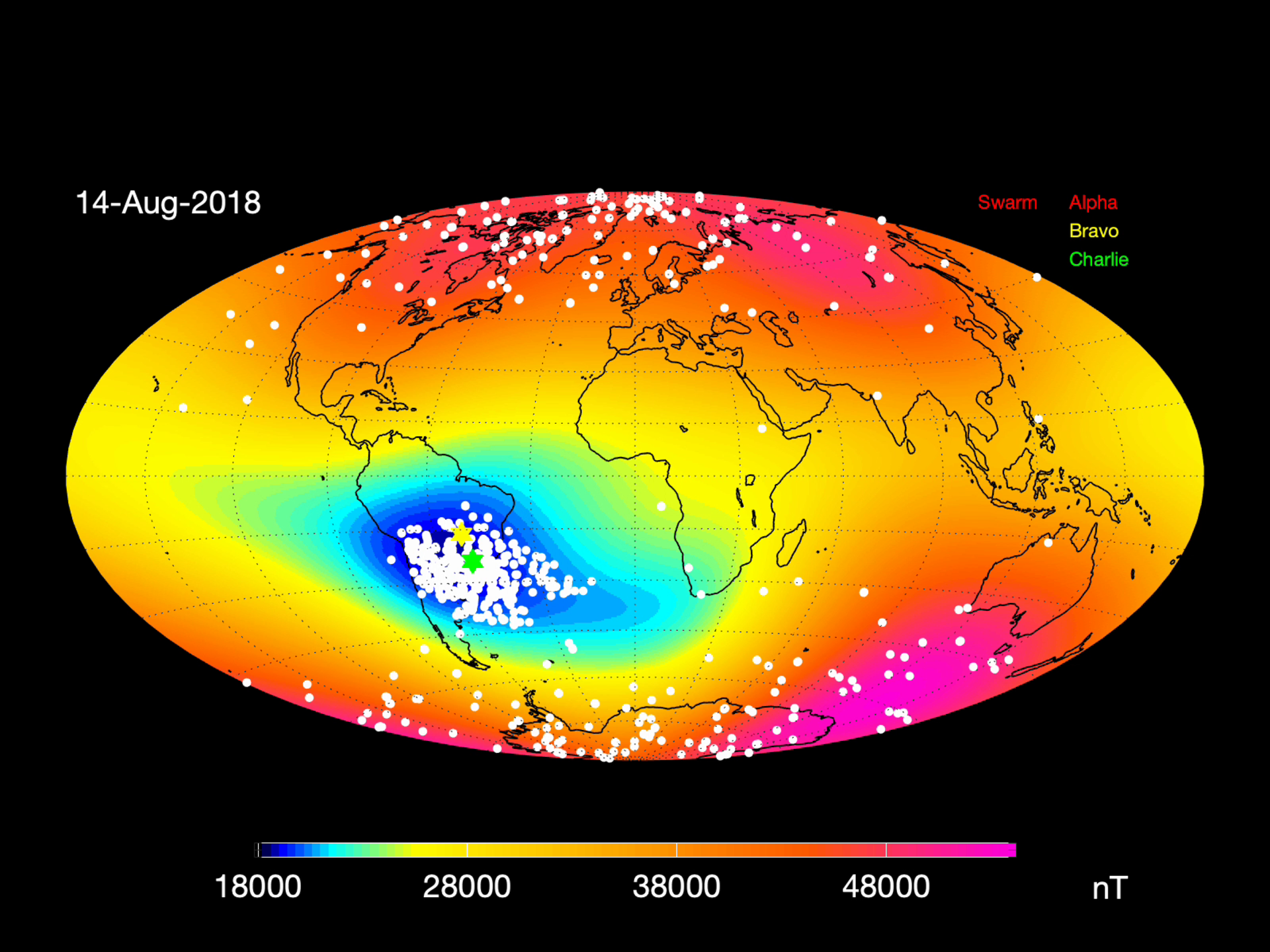
The Earth’s magnetic field has shifted more than 2,000 kilometers, according to a June 10, 2026, report by the European Space Agency (ESA). The agency’s satellite data shows the geomagnetic pole moved 2,150 kilometers since 2020, with the greatest displacement recorded in 2025. Scientists warn the rapid shift could disrupt navigation systems and satellite communications. "This is the fastest recorded movement in over a century," said Dr. Lena Hofmann, a geophysicist at the German Research Centre for Geosciences (GFZ). "We are closely monitoring the implications for global infrastructure."
ESA Data Confirms Unprecedented Magnetic Field Movement
The ESA’s Swarm satellite constellation, launched in 2013, tracks changes in the Earth’s magnetic field. A June 2026 analysis of the mission’s data revealed the geomagnetic north pole has migrated from its 2020 position near 85°N, 130°W to 82°N, 155°W. This represents a 2,150-kilometer shift, surpassing the previous record of 1,800 kilometers between 2015 and 2020. The movement accelerated sharply after 2023, with the pole traveling 700 kilometers in 2024 alone.
"The rate of change is concerning," said Dr. Hofmann, who contributed to the ESA report. "The field’s instability could affect systems reliant on magnetic navigation, including aviation and maritime operations." The agency noted that the shift is not uniform, with some regions experiencing stronger fluctuations than others.
Implications for Global Navigation and Technology
The Earth’s magnetic field is generated by fluid motions in the planet’s outer core, a process that remains only partially understood. While the field has always fluctuated, the current pace of change has raised alarms among researchers. The U.S. National Oceanic and Atmospheric Administration (NOAA) confirmed the ESA findings in a June 11, 2026, statement, adding that the shift could necessitate updates to global navigation systems.
"Airplanes and ships use magnetic bearings for orientation," said NOAA spokesperson Mark Reynolds. "If the field continues to shift at this rate, we may need to recalibrate instruments more frequently." The agency also highlighted risks to satellite operations, as magnetic disturbances can interfere with onboard electronics.
Scientific Debate Over Causes and Long-Term Effects
The rapid movement has sparked debate about its causes. Some researchers link it to changes in the Earth’s core, while others suggest external factors, such as solar activity, could play a role. A May 2026 study published in Nature Geoscience proposed that the shift may be part of a longer-term pattern, though the exact mechanisms remain unclear.
Dr. Hofmann emphasized that while the current movement is unusual, it does not necessarily indicate an imminent reversal of the magnetic poles. "Pole reversals occur over thousands of years," she said. "This is a short-term fluctuation, but we must monitor it closely."
Future Monitoring and Industry Adaptation
The ESA and NOAA have pledged to continue tracking the magnetic field’s evolution. The International Geomagnetic Reference Field (IGRF), a global standard for magnetic data, will likely be updated in 2027 to reflect the latest measurements. Meanwhile, industries reliant on magnetic systems are assessing potential adaptations.
"The key question is whether this shift is a temporary anomaly or the start of a new phase in the Earth’s magnetic behavior," said Dr. Hofmann. "We need more data to answer that, but for now, our focus is on understanding the implications."
The article’s findings underscore the dynamic nature of Earth’s geophysical systems and the challenges of predicting long-term changes. As scientists refine their models, the public and industries will need to stay informed about developments in this critical area of research.
Find more reporting in our Tech section.
