
OpenAI Executives Backtrack on Calls for Potential Government Funding
OpenAI, the creator of ChatGPT, swiftly walked back comments made yesterday suggesting the company might seek a government “backstop” to finance its planned $1.4 trillion investment in AI infrastructure, a move that sparked immediate criticism.
Chief Financial Officer Sarah Friar initially proposed that the U.S. government should guarantee financing for the company’s chip and data center purchases during a Wall Street Journal event. She described a potential government guarantee as a way to “drop the cost of financing” and “increase the loan-to-value.” Friar later clarified on LinkedIn that the government should contribute to America’s AI growth alongside the private sector, but that OpenAI was “not seeking a government backstop for our infrastructure commitments.” This initial suggestion raised concerns about taxpayer liability for a highly valued, private company.
The comments drew sharp rebuke from market analysts, including Mike O’Rourke of Jones Trading, who questioned the appropriateness of a government bailout for a $500 billion company. “It is absurd that OpenAI insiders think the U.S. government should furnish them with preferential borrowing rates while they get to grow the value of their privately held shares on the backs of American taxpayers,” O’Rourke wrote. The debate highlights growing scrutiny of how OpenAI intends to fund its ambitious expansion, which is significantly impacting the semiconductor industry and companies like Nvidia.
CEO Sam Altman intervened today, stating on X that OpenAI expects $20 billion in revenue this year and anticipates reaching “hundreds of billions” annually by 2030 through enterprise AI and consumer devices. Altman emphasized the company “does not have or want government guarantees” and asserted, “If we screw up and can’t fix it, we should fail.” He suggested government investment should focus on building domestic chip fabrication plants, aligning with the White House’s national security priorities. President Trump’s AI Czar, David Sacks, echoed this sentiment, stating “there will be no federal bailout for AI.”
Officials indicated that the focus will remain on fostering a competitive AI landscape, with the understanding that market forces should ultimately determine success or failure within the industry.
New York
—
OpenAI, the world’s leader and ChatGPT parent company, went into panic mode on Thursday over what it said was a very public misstatement.
Two top executives furiously backtracked from an earlier comment that suggested OpenAI might need government support to cover the $1.4 trillion in chips and data center infrastructure it’s committed to buying.
Here’s how the situation unfolded and why the since-retracted comment was so controversial.
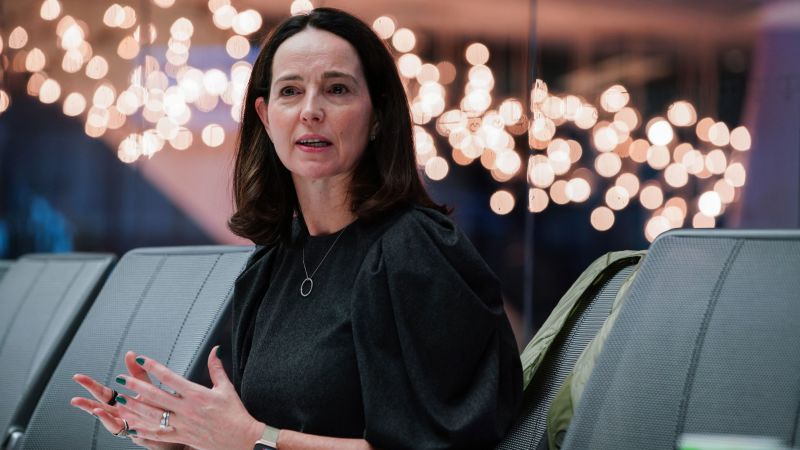
OpenAI’s Chief Financial Officer Sarah Friar raised eyebrows on Wednesday when she suggested that the US government should “backstop” the company’s aggressive investments in artificial intelligence infrastructure.
“The backstop, the guarantee, that allows the financing to happen, that can really drop the cost of the financing but also increase the loan-to-value, so the amount of debt that you can take on top of an equity portion,” she said at a Wall Street Journal event.
In other words: a federal government “backstop” for the debt AI companies take on to make chip investments.
Friar quickly walked back the comments, clarifying in a LinkedIn post that the government needed to “play their part” in combination with the private sector to contribute to America’s AI growth. But OpenAI was “not seeking a government backstop for our infrastructure commitments.”
But that may have confused matters even further and added to a chorus of questions that have been growing in recent weeks about how the not-yet-profitable startup plans to pay for its AI data center and chip commitments.
Friar’s initial comment took heat because it seemed to imply that the US government — and thus, taxpayers — should be on the hook if OpenAI can’t figure out how to pay for all the chips it has said it will buy. Like, how your parents who co-signed on your lease would be responsible if you didn’t pay your rent.
And that didn’t sit well with many people, given that OpenAI is a private company valued at $500 billion, from which taxpayers wouldn’t be seeing any direct benefit if it succeeds.
“Will there be a political movement to forgive AI chip loans like student loans? Can OpenAI wind up in conservatorship like Fannie Mae and Freddie Mac?” Jones Trading chief market strategist Mike O’Rourke wrote in emailed commentary Wednesday. “It is absurd that OpenAI insiders think the U.S. government should furnish them with preferential borrowing rates while they get to grow the value of their privately held shares on the backs of American taxpayers.”
What’s more, the comments seemed to suggest — as many investors and Silicon Valley watchers have worried in recent months — that OpenAI isn’t quite sure how it will pay for its $1.4 trillion in infrastructure commitments without some creative maneuvering. That would be an issue for everyone, since it has been on a dealmaking spree with Nvidia, AMD, Amazon and others, helping to prop up the stock market.
By Thursday, OpenAI CEO Sam Altman stepped in to try to further clarify the company’s position on a government backstop. He revealed that the company expects to earn $20 billion in revenue this year and plans to grow to “hundreds of billions” in annual revenue by 2030 with investments in things like enterprise AI and consumer devices.
Altman reiterated that the company “does not have or want government guarantees for OpenAI datacenters.”
“We believe that governments should not pick winners or losers, and that taxpayers should not bail out companies that make bad business decisions or otherwise lose in the market,” Altman said in an X post.
The government could consider, however, investing in its own data centers and guarantee loans for building new US chip fabrication plants, he said. The White House has pushed tech giants to do just that to protect national security.
“If we screw up and can’t fix it, we should fail, and other companies will continue on doing good work and servicing customers,” Altman said. “That’s how capitalism works and the ecosystem and economy would be fine.”
President Donald Trump has said that building new AI infrastructure and ensuring that America wins the global AI race are national priorities. His administration has committed to pulling back on AI regulations and streamlining permitting for new data centers and energy infrastructure.
Trump’s AI Czar David Sacks said on X Thursday that “there will be no federal bailout for AI,” adding that if one AI company fails, “others will take its place.”
