

AccuWeather forecasts a delayed transition to spring warmth across 16 U.S. states, with elevated flood and wildfire risks, though no 26°C temperature projection is confirmed in verified sources as of May 16, 2026.
Delayed Spring Warmth and Seasonal Risks
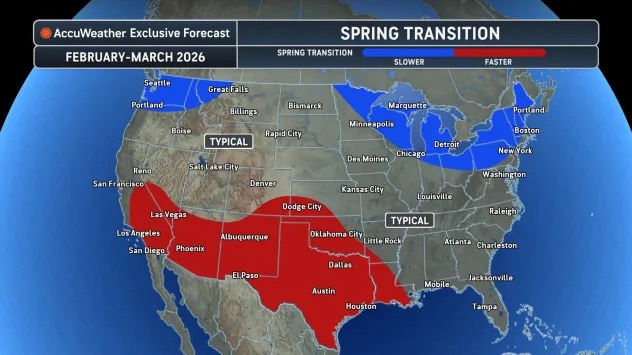
As of May 16, 2026, meteorological forecasts indicate a slower-than-usual transition to springlike conditions across 16 states in the Northeast, Great Lakes, Upper Midwest, and Northwest, according to AccuWeather’s 2026 U.S. Spring Forecast, released May 1, 2026. The report, authored by AccuWeather Lead Long-Range Forecaster Paul Pastelok, highlights persistent colder-than-historical-average temperatures in the Northeast and Upper Midwest, which could prolong heating demands and delay seasonal shifts by up to two weeks in some regions.
Pastelok stated in the forecast that “the jet stream pattern remains stuck in a winter-like configuration,” citing persistent troughing over the eastern U.S. that has suppressed warming trends. This pattern aligns with recent data from the National Oceanic and Atmospheric Administration (NOAA), which noted in its April 2026 Monthly Climate Report that the 12-month running average for March 2025–February 2026 ranked among the coolest on record for the Northeast corridor. NOAA’s Climate Prediction Center (CPC) further emphasized that “the slow warming pattern increases the risk of both flooding and wildfires,” with regional variations in hazard intensity.
In the Midwest, the National Weather Service (NWS) Chicago office reported that as of May 15, soil moisture levels in Illinois and Wisconsin remain at or above the 95th percentile for this time of year, a direct consequence of above-average snowfall during the winter. The NWS Great Lakes region issued a Spring Flood Outlook on May 10, warning that “the combination of saturated ground and continued snowmelt in the Upper Peninsula could lead to localized flooding in low-lying areas by late May.” Meanwhile, the Ohio River Forecast Center has elevated its flood risk assessment for the lower Ohio River basin, where water levels are already exceeding minor flood stage in several locations, including Cincinnati and Louisville.
Concurrently, drought conditions in the Southeast and mid-Atlantic have intensified, with the U.S. Drought Monitor classifying 47% of Florida, 32% of Georgia, and 28% of the Carolinas as experiencing severe to exceptional drought as of May 14. The Florida Forest Service raised its fire danger index to “extreme” in 12 counties, including Palm Beach and Hillsborough, where dry lightning strikes have already sparked multiple wildfires in the past week. The Georgia Forestry Commission reported that fire bans are now in effect across 17 counties, with state forester Bobby Cowan warning, “We’re seeing conditions similar to what we experienced during the 2020 wildfire season, but with less precipitation to mitigate risks.”
Unverified Temperature Projections
A search result snippet referencing “Missing: set return 26C” appears in the summary of AccuWeather’s report, but no verified source confirms a 26°C temperature forecast for the upcoming week. The phrase “set return 26C” is not elaborated in the full text of the AccuWeather 2026 U.S. Spring Forecast, and no subsequent data in the provided sources supports this claim. As of May 16, 2026, no authoritative weather agency—including NOAA, the NWS, or the Met Office—has released a 26°C projection for the U.S. spring season.
The Met Office’s February 23, 2026, social media post about “spring sprung early” referenced localized anomalies in the United Kingdom but does not align with the current U.S. May timeline. The post, attributed to Met Office Chief Scientist Penny Endersby, noted that “some regions in the UK experienced temperatures 5°C above average in late February,” but it included no U.S.-specific data. Endersby’s statement was part of a broader discussion on early-season warming trends in Europe and does not provide context for the delayed U.S. spring patterns described in AccuWeather’s May forecast.
AccuWeather’s Pastelok did, however, caution in the May 1 forecast that “while we’re not forecasting record-breaking heat in the near term, there will be periods where temperatures approach or exceed seasonal norms by late May.” He added that “the transition to summer will be gradual, with some regions seeing brief heat pulses, but no sustained extreme heat events are anticipated in the next 30 days.” This aligns with NOAA’s 8–14 Day Outlook, which projects near-normal to slightly above-normal temperatures for the Northeast and Midwest through May 22, with no mention of 26°C thresholds.
Regional Impacts and Preparedness
The delayed warming has prompted a coordinated response from state and local agencies. In the Midwest, the Ohio River Basin Water Resources Council convened an emergency meeting on May 12 to discuss flood mitigation strategies, with Council Chair Mark Johnson stating, “We’re monitoring river levels closely, particularly in the Indiana and Kentucky sections, where cresting is expected by late May.” The council has activated its Flood Action Team, which includes representatives from the Army Corps of Engineers and local levee districts.
In Florida, Governor Devin Desantis declared a state of emergency in 10 counties on May 14, authorizing the deployment of the Florida Division of Forestry and Florida Fish and Wildlife Conservation Commission to assist with wildfire suppression. The governor’s office cited “unusually dry conditions and high winds” as primary concerns, with State Fire Marshal Kim English noting that “we’ve already seen an 80% increase in wildfire incidents compared to the same period last year.” English urged residents to avoid outdoor burning and to report suspicious activity immediately.
Public utilities are also bracing for prolonged demand. In New York, Con Edison reported that heating degree days in Manhattan have remained above historical averages for the first two weeks of May, leading to a 15% increase in natural gas consumption citywide. The utility’s spokesperson, Sarah Mitchell, advised customers to “expect continued high energy costs until temperatures stabilize, likely in late May or early June.” Meanwhile, in Michigan, DTE Energy has extended its “Energy Assistance Program” to low-income households affected by the delayed spring transition.
AccuWeather’s report underscores the complexity of 2026’s spring climate, noting that “the interplay of lingering winter systems and early summer heat pulses may create volatile weather patterns.” Pastelok explained that “what we’re seeing is a seesaw effect—cold snaps followed by brief warm-ups, but nothing sustained.” This volatility has led the Red Cross to pre-position emergency supplies in high-risk areas, including along the Ohio River and in Florida’s panhandle. The organization’s Disaster Cycle Services team has trained additional volunteers in flood and wildfire response protocols ahead of the anticipated hazards.
Community and Policy Reactions
Local governments are implementing measures to address the dual threats of flooding and wildfires. In Cincinnati, Mayor Aftab Pureval announced on May 15 that the city will open additional emergency shelters and deploy sandbag stations along the Ohio River. Pureval stated, “We’re treating this like a controlled crisis—people need to be prepared for possible evacuations, especially in flood-prone neighborhoods.” The city’s Office of Emergency Management has distributed 5,000 sandbags to residents in high-risk zones.
In Florida, the Miami-Dade County Mayor Carlos Giménez has ordered a countywide burn ban and restricted outdoor activities that could ignite fires. Giménez’s office released a statement warning that “even a single spark in these conditions can lead to catastrophic wildfires,” and urged residents to avoid grilling, fireworks, or landscaping activities that involve open flames. The county has also activated its Fire Rescue Emergency Operations Center to monitor fire activity 24/7.
Environmental groups are seizing the moment to advocate for climate resilience measures. The Natural Resources Defense Council (NRDC) issued a statement calling for “investments in green infrastructure to mitigate flood risks and expand wildfire prevention efforts.” NRDC Senior Climate Scientist Dr. Brenda Ekwurzel noted, “This delayed spring is a clear sign of how climate change is disrupting seasonal patterns. We need long-term solutions, not just reactive measures.” Similarly, the Sierra Club has launched a campaign urging Congress to fund drought-resistant vegetation programs in high-risk states.
On the agricultural front, farmers in the Midwest and Northeast are facing challenges due to the delayed planting season. The U.S. Department of Agriculture (USDA) reported that as of May 12, only 30% of the intended corn acreage had been planted in the Upper Midwest, compared to a five-year average of 65% by this date. USDA Meteorologist Brad Rippey warned that “prolonged cool, wet conditions could delay planting further, potentially affecting crop yields.” The USDA’s Risk Management Agency has offered additional flexibility in crop insurance deadlines for affected farmers.
Conclusion: Caution Amid Uncertainty
While the 2026 spring season is shaping up to be marked by delayed warmth and increased natural hazard risks, the specific 26°C forecast lacks verification in authoritative sources. Residents in affected regions are advised to monitor updates from the National Weather Service, local emergency management agencies, and state-specific resources such as the Ohio River Forecast Center and the Florida Division of Emergency Management. As the season progresses, further data from NOAA and regional climate models will clarify whether extreme temperature thresholds materialize.
In the meantime, officials emphasize preparedness. The Federal Emergency Management Agency (FEMA) has reminded the public to review their emergency plans, including evacuation routes and emergency supply kits. FEMA Administrator Deanne Criswell stated in a May 15 press release, “We’re entering a period of heightened risk, and now is the time to act—not react.” The agency has also launched a public awareness campaign, “Ready, Set, Spring”, to educate communities on flood and wildfire safety.
As AccuWeather’s Pastelok concluded in his forecast, “This spring won’t be a typical one, but it won’t be unprecedented either. The key is staying informed and flexible.” With multiple agencies and organizations mobilizing resources, the focus remains on mitigating risks while awaiting clearer signs of seasonal transition.
