
The innovative puzzle game Cassette Boy, developed by Kiyoshi Honda and published by Pocketpair Publishing, is generating buzz ahead of its showcase at the 2026 Taipei Game Show. A recent interview with 4Gamers details the game’s unique mechanics-which involve manipulating outlook to alter the game world-and the design philosophy behind it. The conversation explores the inspiration drawn from quantum physics and the challenges of balancing gameplay with spatial reasoning, offering insight into the creative process of this intriguing indie title.
The puzzle indie game *Cassette Boy*, published by Pocketpair Publishing, is making an appearance at the 2026 Taipei Game Show. Developer Kiyoshi Honda will be present to interact with players and shared insights into the game’s development and core concepts with 4Gamers.
*Cassette Boy* is an action-puzzle RPG where manipulating perspective is key to gameplay. The central mechanic revolves around “rotating the viewpoint.” Players rotate the camera to transform a pixelated 2D world into a 3D structure, utilizing these shifts in perspective to reveal pathways or make enemies and obstacles disappear. This innovative approach to spatial reasoning highlights a growing trend in game design that challenges traditional perceptions of game worlds.
Related Reading:Steam puzzle RPG *Cassette Boy* launches, changing the existence of things through rotating observation
4Gamers had the opportunity to interview the game’s creator, discussing the inspiration drawn from “Schrödinger’s cat” and how that concept was integrated into the game’s logic, as well as the design philosophy that underpinned the game’s retro pixel aesthetic.
Inspired by the Cosmos: How “Schrödinger’s Cat” Became a Game Mechanic
Q: The game’s core mechanic is “changing the state of objects by rotating the viewpoint,” which brings *Fez* to mind. What was the initial inspiration that led you to make this the central gameplay element?
Honda: It actually started with my fascination with the “universe.” As an art designer, I initially focused on how to visually represent 3D objects as 2D planes that could be freely rotated. But a purely visual effect wasn’t engaging enough, and I struggled with that for a long time.
Later, because I enjoy quantum mechanics, I remembered Einstein’s “moon argument” – the idea that the moon only exists when you observe it. That’s when it hit me: what if I applied this to a game, where objects that are turned out of view lose their function or disappear? That’s how the “Schrödinger system” came to be.
Q: In this 3D space design where “everything is connected,” what were the biggest technical or logical challenges you faced?
Honda: The biggest hurdle was “trade-offs.” When you rotate the viewpoint, things disappear, but I had to carefully consider the extent of that disappearance. Some things couldn’t vanish completely; I needed to leave a hint of a line or shadow. Finding that balance was difficult, ensuring it felt visually logical to the player.
Also, as my background is in art, programming was a huge mountain to climb. I completed the level logic entirely on my own, which took a lot of effort.
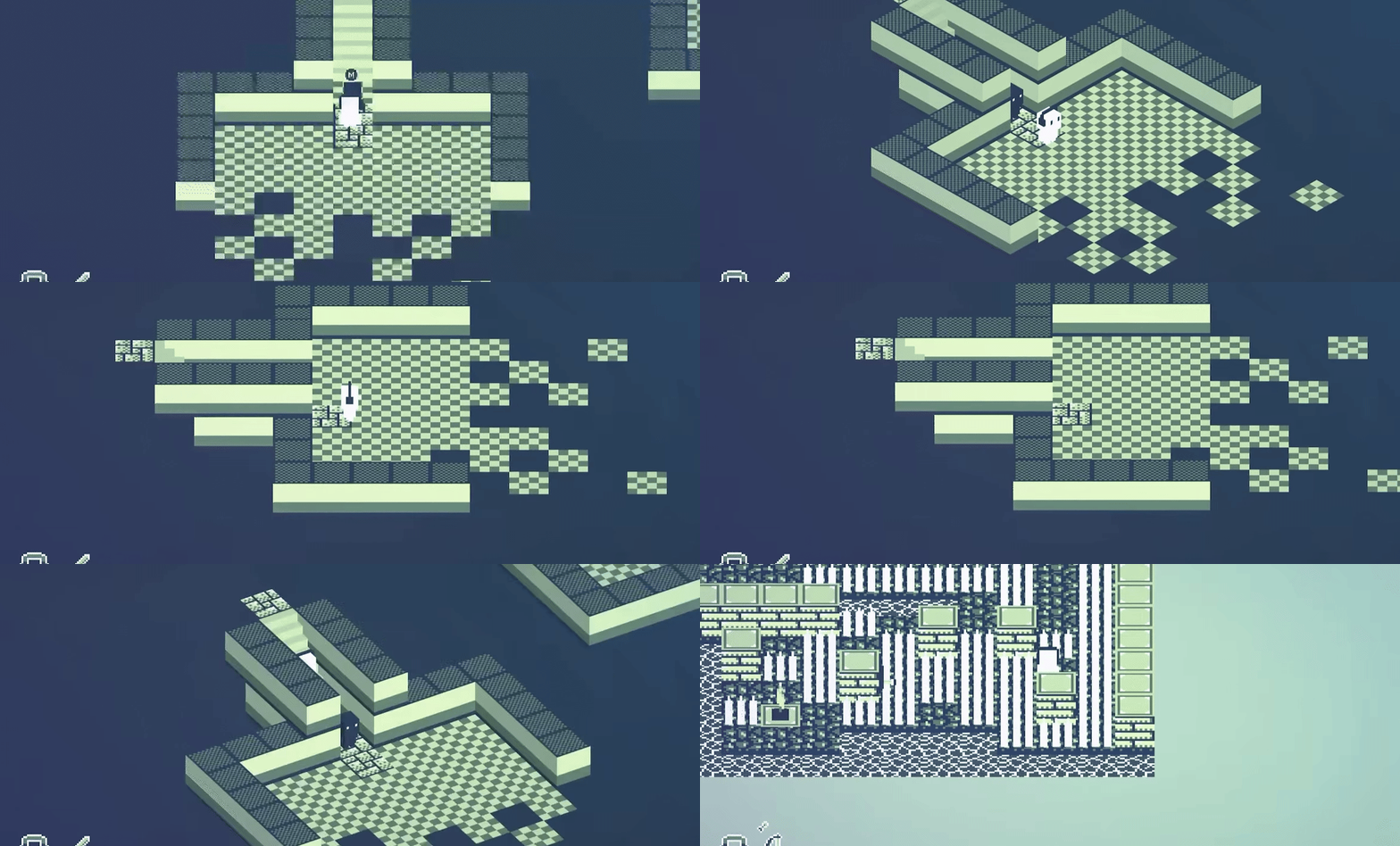
Iterating in the Real World: Frequent Showings to Find the Right Answers
Q: How did you balance “puzzle difficulty” with “players’ spatial perception”?
Honda: That’s a very difficult question, because everyone’s spatial sense is different. I realized I couldn’t find the answer on my own.
So, I took a very direct approach: over the three years of development, whenever I had a demo, I would frantically attend various game shows. I observed where players got stuck, listened to their feedback, and adjusted the game based on real-world data.
Q: Among the many levels, is there a design you’re particularly proud of?
Honda: Rather than a specific level, it’s a “mechanism.” There are buttons in the game that activate when you stand on them and deactivate when you leave. I designed a system where, if you rotate the viewpoint while standing on the button to hide the switch, the switch remains activated even after you step away. I think this design, which “freezes” the state using the viewpoint, is quite innovative, and I really like it.
Q: The game also features boss battles. How does the design logic of those differ from the puzzles?
Honda: I actually treat boss battles as “puzzles.” While you can brute-force them with action elements, utilizing the viewpoint rotation mechanic – for example, rotating the view to hide the boss’s defenses and weaken them – is much more effective.
The biggest challenge is that once players grasp the trick of “things disappearing when hidden,” the difficulty drops significantly. So, I had to put a lot of thought into what new elements to add after A disappears to maintain the challenge and gameplay.
The Aesthetics of Negative Space: A Character Without a Shadow
Q: Some players have noted the lack of shadows on the character, making it harder to judge position during 3D jumps. Was this a deliberate design choice?
Honda: Yes, that was essentially intentional. To maintain the “flatness” of the visuals, I deliberately omitted shadows. This does increase the difficulty of judging position, but I wanted to create “negative space” in the gaming experience.
I didn’t want to present all the information to the player; I wanted them to gain a sense of discovery through exploration. Of course, we’ll continue to monitor feedback, and we may consider adjustments if necessary.
Q: The current keyboard controls don’t feel as intuitive as a gamepad (such as the Esc key function or lack of custom key bindings). Are there plans to adjust this?
Honda: The game was originally designed with “gamepad operation” as the core concept. For the parts where keyboard support is weak, we’ll maintain the current state for now and improve it based on feedback. As for custom key bindings, it’s very complex in terms of programming logic, and I’ll try my best, but it might be difficult at the moment.
Q: The title emphasizes “Cassette,” and the art and color scheme have a strong GBA aesthetic. What works inspired this?
Honda: I grew up playing games, and I was deeply influenced by the Game Boy. Recently, there’s been a resurgence of interest in old handheld consoles, so I bought some old consoles and cartridges to revisit them. I wanted this game to evoke the pure experience of that era. The works that inspired me include some early pixel games and the *Legend of Zelda* series.
:format(avif):quality(60):no_upscale()/https%3A%2F%2Fimg.4gamers.com.tw%2Fpuku-clone-version%2Ffb366379abed69943e2cd356e91f457a58439849.JPG)
Q: Finally, how would you describe the experience *Cassette Boy* will offer players, and what message do you have for the Taiwanese players looking forward to the game?
Honda: I poured all my heart and soul into making this game, and I hope everyone will give it a try. It has a unique gameplay mechanic, and you can have a completely new experience. Or maybe you’re drawn in by the art – either way, I hope you enjoy it.
Pocketpair Publishing exhibited at the 2026 Taipei Game Show from January 29 to February 1, showcasing *Cassette Boy* and other indie titles at booth S87 and publisher booth A13 on the fourth floor of Hall One at the Nangang Exhibition Center.
  </div><script>
    !function (f, b, e, v, n, t, s) {
      if (f.fbq) return;
      n = f.fbq = function () {
        n.callMethod ?
          n.callMethod.apply(n, arguments) : n.queue.push(arguments)
      };
      if (!f._fbq) f._fbq = n;
      n.push = n;
      n.loaded = !0;
      n.version = '2.0';
      n.queue = [];
      t = b.createElement(e);
      t.async = !0;
      t.src = v;
      s = b.getElementsByTagName(e)[0];
      s.parentNode.insertBefore(t, s)
    }(window, document, 'script',
      'https://connect.facebook.net/en_US/fbevents.js');
    fbq('init', 523702398135869);
    fbq('track', 'PageView', {title: "Turning Perspective on its Head: A Developer Interview with *Cassette Boy* | 4Gamers"});
  </script>