

Nestled 700 meters beneath a mountain in Guangdong, China, the world’s largest neutrino observatory, JUNO, has begun yielding promising results just weeks after becoming fully operational at the end of August 2025. The massive detector is registering signals from neutrinos – often called “ghost particles” for thier elusive nature – with unprecedented precision. Early data reveals subtle discrepancies in neutrino behavior that could point to new physics beyond our current understanding of the universe, marking a critically important step forward in the decades-long quest to unravel the mysteries of these basic particles.
A massive detector, located hundreds of meters beneath a mountain in southern China, has registered signals from elusive “ghost particles” known as neutrinos – and the initial findings are causing excitement within the global physics community. The detector is the Jiangmen Underground Neutrino Observatory (JUNO), the world’s largest neutrino observatory, which became fully operational at the end of August 2025.
Situated 700 meters underground near Guangdong, JUNO contains 20,000 tons of ultra-pure liquid scintillator within a sphere the size of an office building. When neutrinos, nearly massless particles that pass through trillions of human bodies every second, interact with protons in the liquid, they create tiny flashes of light recorded by more than 43,000 photomultiplier tubes (PMTs).
The scale of the project is immense – the detector is 20 times larger than Japan’s KamLAND and boasts unprecedented sensitivity.
SCROLL TO CONTINUE WITH CONTENT
Early Data Reveals Unexpected Neutrino Behavior
Despite collecting effective data for just 59 days (August 26 – November 2, 2025), JUNO has already yielded surprising results. Initial measurements indicate that neutrinos originating from the Sun behave slightly differently than those produced by nearby nuclear reactors.
This subtle discrepancy had been previously suspected, but JUNO’s data now confirms it with 1.6 times greater precision than all previous experiments combined.
“This level of precision achieved in just two months of operation demonstrates that JUNO is performing as designed,” said Wang Yifang, project manager and spokesperson for JUNO at the Institute of High Energy Physics (IHEP), Chinese Academy of Sciences.
|
Jiangmen Underground Neutrino Observatory (JUNO) di Jiangmen, China Foto: Xinhua/Jin Liwang
|
Hints of New Physics Beyond the Standard Model?
The Standard Model of particle physics – the prevailing theory describing how fundamental particles interact – makes precise predictions about neutrino behavior. The discrepancies detected by JUNO, though currently at a statistical level of 1.5 sigma (not yet statistically significant), could indicate new physics beyond the Standard Model, or at least gaps in our current understanding.
The Standard Model initially posited that neutrinos were massless. Experiments in Japan and the United States later proved that neutrinos can oscillate between three “flavors” (electron, muon, and tau) as they travel through space.
This oscillation implies that neutrinos do have mass, but we still don’t know the exact amount or the order of their masses – whether it’s a normal or inverted hierarchy.
Primary Goal: Determining the Neutrino Mass Ordering
|
On the left, you can see the photosensors that form JUNO’s internal active shield. On the right, the acrylic sphere is being filled with liquid scintillator. Foto: Xinhua/Jin Liwang |
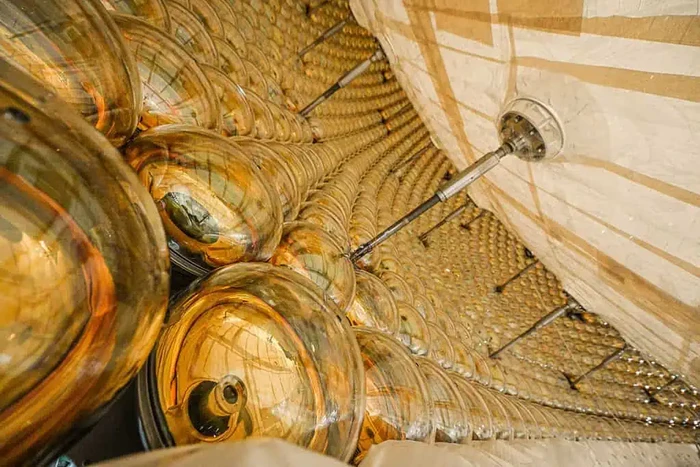
JUNO’s overarching goal is to resolve a decades-old puzzle in physics: the neutrino mass ordering. Understanding this ordering is crucial because it relates directly to a fundamental cosmic question:
“Why did matter survive after the Big Bang, instead of being annihilated by antimatter?”
“The mass ordering is a gateway to the ultimate question: why are we here,” said Sam Zeller, deputy director of the massive DUNE neutrino project in the United States, to Physics Today.
JUNO observes the subtle oscillation patterns of antineutrinos from reactors at two nearby nuclear power plants – Yangjiang and Taishan – located 53 km away. After six years of data collection, the team hopes to determine the mass ordering with a confidence level of 3 sigma.
This experiment involves a large international collaboration: more than 700 scientists from 74 institutions in 17 countries. “JUNO’s success reflects the commitment and creativity of our international community,” said Marcos Dracos from the University of Strasbourg and CNRS/IN2P3, France.
Because the energy of reactor antineutrinos is low, JUNO requires extremely precise calibration. The detector must achieve an energy resolution of 3% at 1 MeV with an uncertainty of less than 1%. Initial results suggest JUNO is already exceeding its design specifications.
A friendly competition is underway. DUNE in the US is targeting a definitive 5 sigma measurement, while Hyper-Kamiokande in Japan will combine atmospheric and accelerator neutrinos.
Looking ahead, after determining the mass ordering, JUNO will open new doors in physics, astrophysics, and Earth geophysics. The detector is sensitive enough to capture the first neutrino signals from a nearby supernova, providing an early warning for astronomers before the star explodes.
JUNO will also study geoneutrinos from radioactive decay in the Earth’s crust and mantle, to reveal how much heat our planet generates from within.
“JUNO will continue to produce important results and train a new generation of physicists for decades to come,” said Cao Jun, director of IHEP.
Each of these goals pushes the same boundaries: what can neutrinos tell us about the origin of matter, energy, and everything we see in the universe? With these initial findings, JUNO has proven itself to be one of the most powerful scientific instruments of the 21st century.
Page 2 of 2
Watch Video “When Cherly Juno Cherrybelle Showed Off at the David Foster Jakarta Concert“
[Gambas:Video 20detik]
(afr/afr)
