
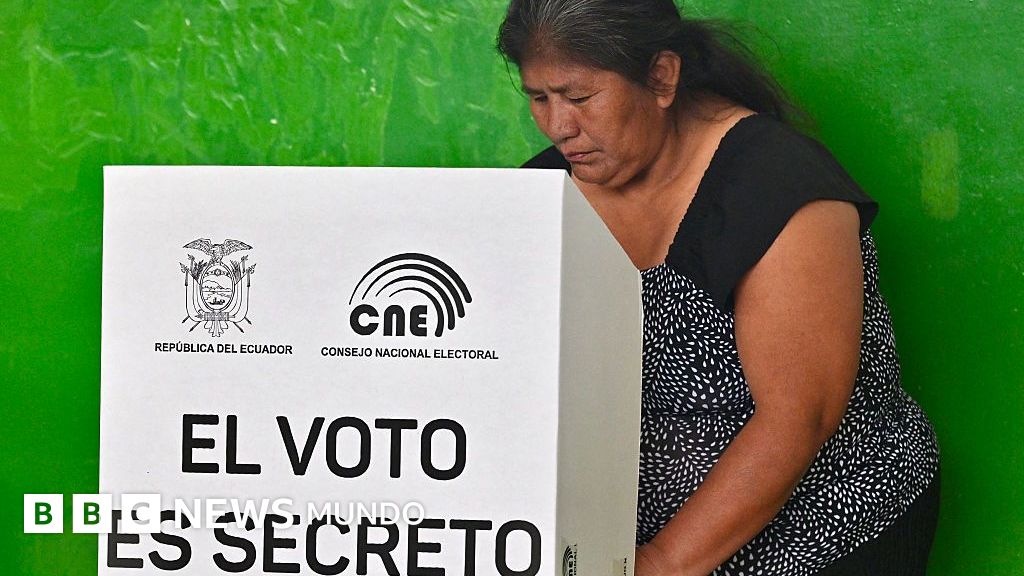
Ecuadorian voters have overwhelmingly rejected President Daniel Noboa‘s proposed constitutional reforms in a nationwide referendum held Sunday, dealing a critically important blow to his governance’s agenda. The four questions on the ballot – concerning foreign military bases, a new constitutional assembly, the number of assembly members, and political party funding – all failed to secure voter approval despite Noboa’s efforts to address both security concerns and governmental streamlining. With over 80% of votes tallied, the results signal a strong message from the electorate and raise questions about the path forward for Noboa’s presidency.
Fuente de la imagen, Marcos Pin / Getty images
-
- Autor, Redacción*
- Título del autor, BBC News Mundo
-
Ecuadorians overwhelmingly rejected constitutional reforms proposed by President Daniel Noboa in a nationwide referendum held Sunday.
With over 80% of votes tallied, the “no” vote prevailed clearly on all four questions put before the electorate. The outcome represents a significant setback for Noboa’s administration and its agenda.
President Noboa had hoped voters would approve lifting a constitutional ban on the establishment of foreign military bases within Ecuador’s borders. This proposal was central to his strategy to address escalating security concerns in the country.
He also sought approval to convene a constitutional assembly to draft a new national charter, reduce the number of assembly members, and eliminate state funding for political parties. The proposals were presented as a means to streamline government and combat corruption.
According to data released by the National Electoral Council (CNE), all of Noboa’s proposals were met with a firm rejection from voters.
A full 60.55% of voters opposed removing the prohibition on foreign military bases from the constitution.
Noboa argued that a foreign military presence and increased international cooperation would strengthen the fight against crime, a key priority for his government. U.S. Secretary of the Interior Kristi Noem recently visited the country amid a broader campaign by the U.S. government to combat “narcoterrorists” in Latin America.
However, Ecuadorian voters were unconvinced by the president’s arguments.
No to a Constitutional Assembly
Ecuadorians also rejected the call for a new constitutional assembly and, consequently, a new constitution, with the “no” vote securing 61.61% of ballots.
The proposal to eliminate public funding for political parties was opposed by 58.06% of voters, while the plan to reduce the number of assembly members was rejected by 53.45%, according to the CNE.
According to the latest official data, only in one of the country’s 24 provinces (Tungurahua) did the “yes” vote prevail on all four questions.
In three other regions (Pichincha, Chimborazo, and Zamora Chinchipe), voters supported the proposal to reduce the number of assembly members. In four additional provinces (Loja, Napo, Pastaza, and Galapagos), voters also favored reducing the number of lawmakers and eliminating funding for political parties, while both the constitutional assembly and the return of foreign military personnel were rejected.
The electoral body also reported that voter turnout for the process exceeded 80% of registered voters.

Fuente de la imagen, GERARDO MENOSCAL/AFP via Getty Images
Noboa Respects the Results
Following the rejection of his proposals, Noboa posted on his X account: “These are the results. We consulted with the Ecuadorians and they have spoken. We kept our promise: to ask them directly. We respect the will of the Ecuadorian people.”
His rival, Luisa González of the Correista movement, celebrated the results, telling reporters gathered at her party’s headquarters in Quito that the outcome was the result of “sowing hatred,” according to Ecuavisa.
Noboa had worked to convince voters of the benefits of his proposals, particularly regarding the fight against organized crime, which has become one of Ecuador’s main problems in recent years.
The Ecuadorian president accompanied U.S. Secretary of the Interior Kristi Noem on her visit days before the referendum to the former Manta base, where U.S. forces were stationed until 2009, when then-President Rafael Correa’s government decided to end the bilateral agreement with the U.S. for its joint use.

Fuente de la imagen, Gerardo Menoscal / Getty
Noboa has sought to position Ecuador as one of the countries committed to fighting drug trafficking in the region, a priority the U.S. government under Donald Trump has identified as key to national security.
In 2024, he ratified two agreements for joint military operations with Washington, which have led to seizures of drugs and weapons at sea.
Between January and September, Ecuador seized 146 tons of drugs, a decrease compared to the 208 tons confiscated during the same period in 2024, according to the Ministry of the Interior.
According to Cristian Carpio of the political risk analysis firm Profitas, the referendum result shows “wear and tear” in Noboa’s administration, which came to power two years ago with the fight against crime as its banner.
“The result could also demonstrate a weariness among the population with the electoral processes that have been so continuous in recent years,” Carpio added.
*with information from Guillermo D. Olmo and Juan Francisco Alonso

Subscribe here to our new newsletter to receive a selection of our best content each Friday.
And remember you can receive notifications in our app. Download the latest version and activate them.
