
After a year of La Niña conditions, forecasters are closely monitoring a potential shift back to El Niño, a climate pattern with far-reaching global consequences. The World Meteorological Organization recently issued an alert indicating a high probability of El Niño developing in the coming months – a reversal occurring at an unusually rapid pace. This article examines the potential impacts of this developing pattern, with a particular focus on how it might influence weather conditions in Portugal and across the globe, based on analysis of historical El Niño events and current modeling.
The El Niño climate pattern, which has garnered significant attention from the scientific community, may return soon, after dissipating just over a year ago and being replaced by its opposite, La Niña.
These phenomena, which as previously explained, reflect variations in ocean temperature in the eastern equatorial Pacific, have wide-ranging impacts on global climate. Globally, a temperature increase of between 0.3 and 0.6ºC is anticipated, while the typical signal in the Atlantic is for fewer hurricanes than usual.
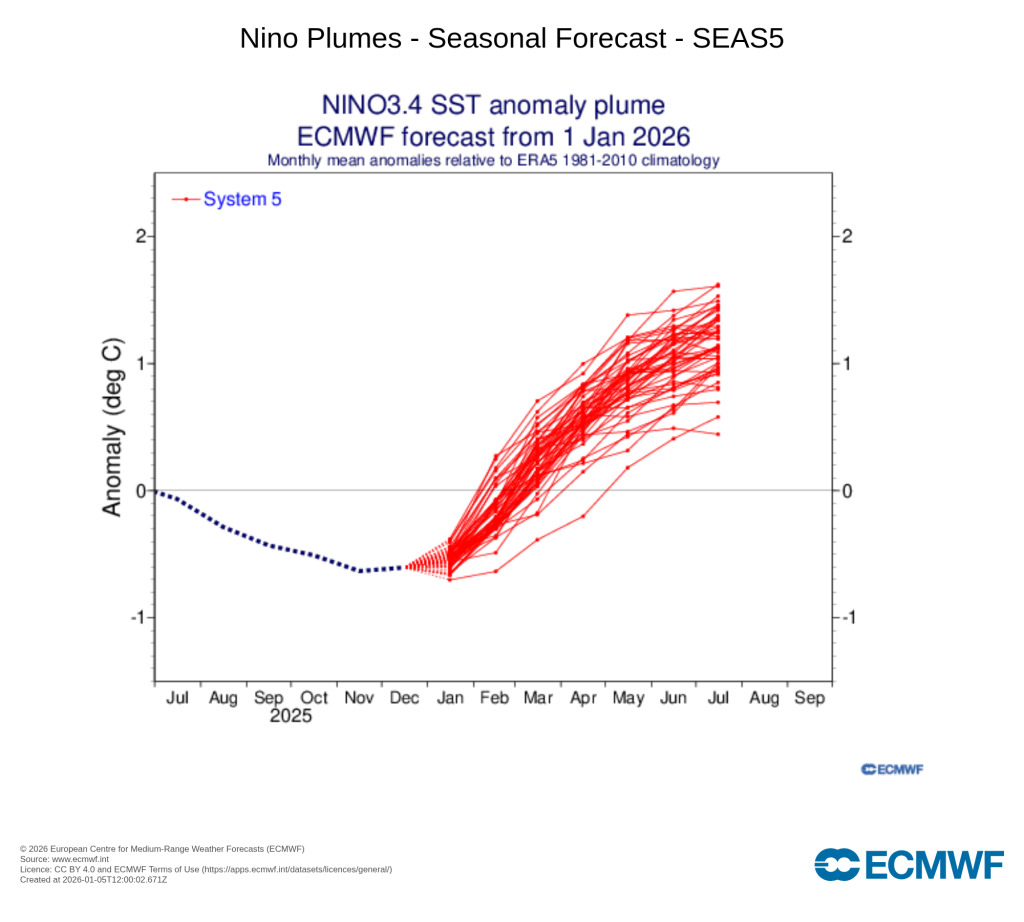
What is particularly sparking interest regarding the likely 2026 El Niño is the speed of its potential formation, rapidly reversing the current trend, and its possible intensity – between +1 and +2ºC – which could signify a strong El Niño event. This rapid development is unusual!
Looking back at previous years with strong El Niño events allows for analysis of climate trends in Portugal and worldwide – continue reading for more information!
STRONG EL NIÑO – WHAT COULD IT MEAN FOR PORTUGAL?
Globally, as previously noted, the most significant effects are expected to be substantial warming – potentially pushing temperatures to levels not yet reached, nearing a 2ºC increase in warming. However, predicting regional impacts, specifically for Portugal, is far more difficult, and there is typically no strong correlation between this phenomenon and the country’s climate.
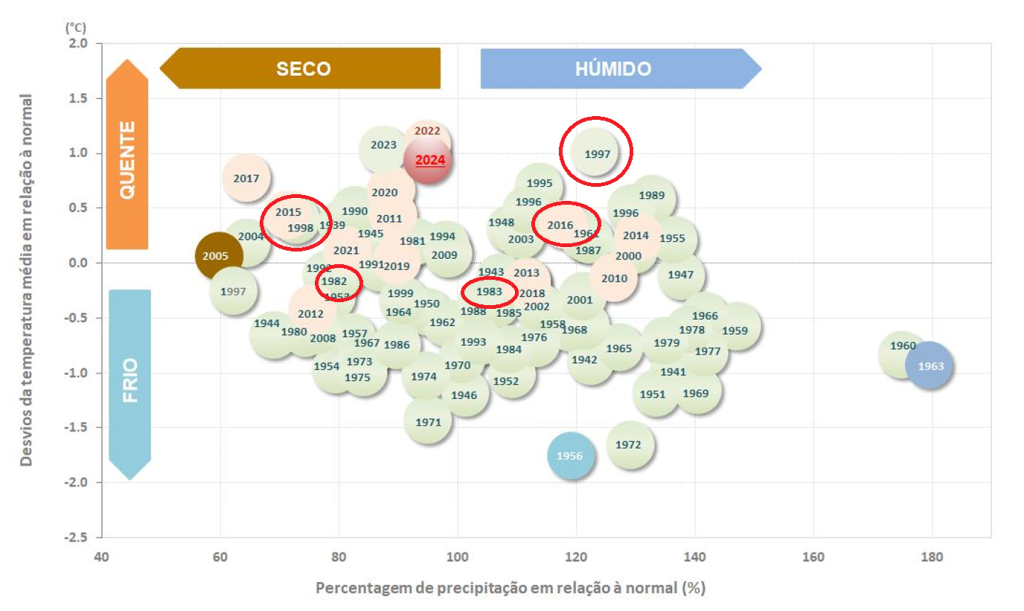
Examining past instances of intense ENSO+ anomalies reveals a weak statistical signal. Looking at events such as 1982-83, 1997-1998, and 2015-2016 – all strong El Niño events – reveals little in common. While 2015 and 2016 were warm years, precipitation patterns were quite different – 2015 was very dry, while 2016 was very wet.
1997 is of interest, as it demonstrates a trend: El Niño can lead to warmer temperatures in Portugal. Indeed, 1997 is one of the warmest years on record in Portugal (the third warmest, after 2022 and 2023), and was also relatively wet.
In 1982 and 1983, the trend was different, with temperatures remaining near normal and precipitation also close to average – despite this being one of the strongest El Niño events ever recorded, it had little impact on Portugal’s climate.
In conclusion, it is difficult to predict what will happen in Portugal. While some climate signals and statistical data suggest increased rainfall (particularly in autumn and spring) and higher temperatures (potentially extreme in summer), there are also years where this phenomenon has not significantly altered Portugal’s climate. However, in the context of current global warming, there is concern that extreme heat, unfortunately, may occur, and we believe this is the greatest risk!
GLOBAL CLIMATE IMPACTS
As previously mentioned, El Niño is a natural and normal climate phenomenon (it is important to note this!) that occurs when the surface waters of the eastern equatorial Pacific Ocean become abnormally warm, altering global atmospheric circulation. This change affects the distribution of winds in the atmosphere, and modifies normal patterns of atmospheric pressure, and consequently, temperatures and precipitation
The main consequence of El Niño is the alteration of tropical convection, with more instability and rain in the Central and Eastern Pacific, typically. Some regions that are normally drier may become wetter, while others experience intense and sometimes prolonged droughts
Changes registered in the tropical latitudes also propagate to other mid-latitudes through various atmospheric teleconnections, altering the jet stream – and consequently, potentially, the trajectory and intensity of storms, including in the Atlantic Ocean – which in turn influences the positioning of subtropical highs.
Globally, El Niño years tend to be warmer, as the ocean releases more heat into the atmosphere. This contributes to record temperatures on a global scale, especially when combined with accelerating global warming – for this reason, we believe that if 2026 is confirmed as the year of El Niño’s return, the next 2-3 years could bring new temperature records to Earth – and could even lead us to reach 2ºC of warming relative to the pre-industrial era.
El Niño also tends to reduce hurricane activity in the Atlantic, and increase it in the Pacific, due to changes in atmospheric circulation. In the Atlantic, there is generally a strengthening of wind shear, which makes it difficult to organize and intensify tropical systems, while in the Pacific it creates conditions more favorable to the formation of more frequent (and intense!) cyclones. Obviously this is a superficial analysis, and exceptions occur, but it would be good if another calm tropical year in the Atlantic were confirmed – after 2025 also being relatively calm!

IN SUMMARY – WHAT TO EXPECT?
- The ECMWF model is very confident in the formation of the El Niño phenomenon in the coming months, rapidly reversing the current negative oscillation
- For this reason the probability of it occurring is very high – over 60/70% – with a moderate probability of being an intense phenomenon
- Globally it will certainly have impacts, and the next few years could be extremely warm – even breaking records
- There may be fewer tropical cyclones than usual in the Atlantic, and more in the Pacific – and more intense. This is not a guarantee, but the statistically observed trend
- In Portugal the signal is not very significant, but still tends to be a little more precipitation and higher temperatures with this phenomenon. We reinforce, however, that there are other more important factors, so further analysis will be needed
If you found this article in your Google News/Discover feed, please click follow/like (on the ❤️ symbol) to see more of our forecasts and information and stay up to date! Also follow the Luso Meteo – Meteorology and Climate page on our social networks and on Google News HERE for more updates and information!
If you would like to help with donations to the project, to support website/maintenance costs and subscription services to bring you the best content, you can do so, we would be very grateful!, by MBWay to 918260961, or IBAN to PT50 0007 0000 0029 3216 7422 3
Thank you very much for your trust and preference ❤️
Special thanks to WebDig, our website hosting service – highly recommended, with incredible reliability and support!
