
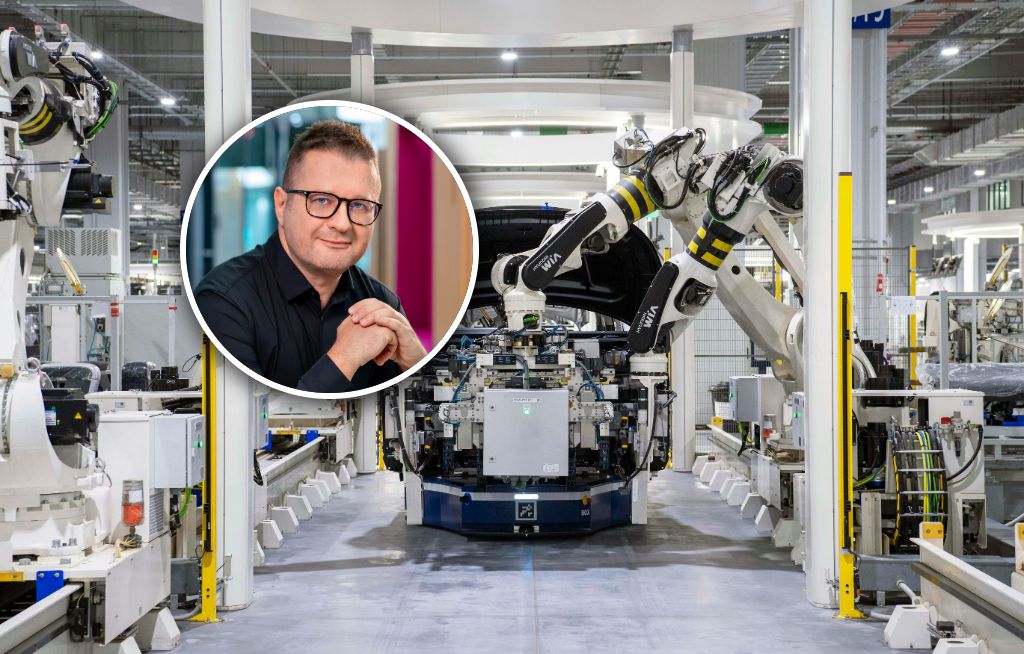
Europe’s industrial sector is facing notable headwinds, with new data revealing a loss of 500 jobs per day and increasing concerns over competitiveness against China. This article delves into the challenges-including high energy costs and regulatory burdens-facing European manufacturers, but also presents a counter-narrative from industry leaders who argue the continent retains key technological strengths and innovative capacity. based on an interview with Siemens Poland president Maciej Zieliński, the report examines how Polish and wider European companies are adapting and investing in future technologies like automation and digitalization too navigate this evolving landscape.
Europe’s industrial sector is facing a significant downturn, losing an average of 500 jobs per day, primarily in manufacturing, according to recent data. The crisis is particularly impacting the automotive industry, as reported by the European Trade Union Confederation (ETUC). The continent is experiencing factory closures, mass layoffs, and a capital flight to other regions, while Chinese manufacturers strengthen their position in the EU market.
Experts are characterizing the situation as a “structural break” rather than a temporary fluctuation. The primary drivers of the crisis in Europe are high energy prices – double those in the U.S. and 90% higher than in China – and rising labor costs.
Businesses, industry leaders, and agricultural representatives point to a conflict between the EU’s ambitious climate goals and a lack of effective mechanisms to protect industry and entrepreneurship amidst excessive regulation. Calls are mounting for the urgent implementation of a competitiveness strategy encompassing cheaper energy, streamlined regulations, and investment support, with warnings of lasting deindustrialization and irreversible job losses.
Where Does Winter Lettuce in Poland Come From? Business Reveals
These figures and warning signs represent one side of the story. The other perspective comes from a source close to European and Polish business.
Robert Kędzierski, money.pl: Does European industry still have a chance of surviving in the face of competition from China?

Maciej Zieliński, President of Siemens Poland: I would turn that question around and argue that there is no global industry without European industry. Europe is a powerful industrial force. The production of chips worldwide relies on European companies that manufacture the systems and production lines. Global automation wouldn’t exist without companies like Siemens. The production of rail vehicles and the generation and transmission of energy are also led by European companies.
Certain energy-intensive and highly polluting industries have migrated primarily to China, but the technologies that truly make a difference originate in Europe. I absolutely do not see negative trends in that regard.
What about the automotive industry, which appears to be the biggest victim of Chinese competition?
The automotive sector is being used as a scapegoat. Germany was the number one in the automotive industry, and everyone assumed it would only continue to grow. Now, due to the shift to battery-powered vehicles, we’re facing competition from China and Korea. We simply need to address this and adapt, not lament that it’s impossible.
Imagine ten years ago, futurists predicted that by 2025, the taxi driver profession would disappear because all taxis would be autonomous. But today? The taxi driver profession exists in Warsaw, and the scale effect has led to more services than ever before. The same will happen in the automotive industry – companies that transform correctly will emerge stronger.
Does Poland have any particular advantages in this situation?
Our companies have secured numerous international contracts in automation and energy over the past 30 years, and very intensively for the last two decades, often due to slightly lower engineering costs, but primarily due to a high standard of work. Today, Polish engineering has a completely different position and a certain reputation.
We win on quality for the price. Even if the price is at a European level, we’ve built a strong potential in engineering in electrical engineering and automation over the last 30 years. Poland is no longer stereotypically perceived as a post-communist country – at least in technical industries.
Which Polish companies are succeeding?
There are many examples. Among the ten largest companies in the world producing liquid cooling systems for data centers, two are Polish. These companies supply their solutions to the United States, China, and Europe. The data center market is growing exponentially, and liquid cooling is a key technology for artificial intelligence servers.
A company from Świebodzin produces furnaces for various industries, including aerospace, and sells 60% of its production in the United States. In Poznań, a company has a 40% share of the US market for license plate manufacturing machines. One of our partner companies has automated most of the municipal incinerators in Scotland and England.

What about more recognizable brands?
Fakro holds 30% of the global market for roof windows – one in three roof windows worldwide comes from Małopolska. Maspex, which started as a small juice bottling plant, operates globally and has just acquired the largest wine producer in Moldova. Mlekovita has 26 dairies and exports to China and Arab countries.
We don’t have globally recognizable brands, but that’s due to history – we haven’t accumulated wealth for the last hundred years. We only started getting rich in the last 30 years. However, we have many medium-sized companies in various industries that are essential for global corporations.
Are European companies lagging behind China in terms of robotics?
That’s a stereotype. We, as Europeans, have been building factories and installing production lines in China for decades. There has been a transfer of technology. Technologically, we are not behind in automation or robotics – we are pioneers.
Our factory producing Simatic controllers is one large, roboticized mechanism. People are responsible for design and quality control, not the production itself. In automotive factories, all parts move on automated carts, and everything is assembled by robots. Humans supervise several workstations. We are not much different from China in terms of technology.
![Polska gospodarka jest "kuloodporna". Radzimy sobie lepiej mimo kryzysów [ANALIZA]](https://v.wpimg.pl/MzM1OTlmYhssUzlnQxZvDm8LbT0FT2FYOBN1dkNcf0J9SWAyBQEoCChBIHoLHzgKLEY_ehwBYhs9WGAiXUIpEz5BIzUVQigXL1Qrew9ZeRt5BCxmQQl_SXgcezdfD2AbeQQpeV4JL0l-BHZtClp4Hm9M)
Where does the perception of China’s technological dominance come from?
It’s a matter of approach to work and life, values, and democracy. In China, there is a work culture – work is the top priority. You have to work on weekends, you have to work overtime. We value our private time, rest, and time with family. That’s a completely different level of commitment.
It’s a question of choice – do we want to change our lifestyle to be more like China? In my opinion, no. Certain differences will remain, and we must win through competence and specialization. Some industries, like photovoltaics, have migrated to China, and that cannot be reversed. But there are technologies and businesses that are developing in Europe.
![Oto pozycja gospodarki Polski w globalnych rankingach. "Możemy być dumni" [OPINIA]](https://v.wpimg.pl/Zjc3OWM2dQsCUTlkYkl4HkEJbT4kEHZIFhF1dWIDaFJTS2AxJF4_GAZDIHkqQC8aAkQ_eT1edQsTWmAhfB0-AxBDIzY0HT8HAVYreCsLOA4HBC5nYAs5XVQeezQsBndTAAQqentTOAxUBHY0e1diD0FO)
What’s the recipe for competitiveness for Polish companies?
Investment. Our entrepreneurs need investment to develop their businesses, scale them up, and go global. Companies currently have more funds in their bank accounts than in loans – that’s quite strange. In most countries, credit drives investment and development. Our entrepreneurs don’t like loans; they’re afraid of them.
Regarding robotics, South Korea already has nearly 1,000 robots per 10,000 employees. In Poland, it’s less than 100, while the European average is several hundred. Investment in robotics, automation, and software supporting production is the best recipe for development.
What specifically should an average Polish manufacturing company do?
The key is digitalization, but not just by buying a piece of software. It’s about a holistic approach – designing solutions in the virtual world to shorten product time to market and save on prototypes.
The Covid-19 vaccine was created thanks to a digital twin – a mathematical representation on a computer. In the automotive industry, we used to have to produce five models to see if they would work. Today, we simulate all phenomena in the virtual world – atmospheric, mechanical, accidents. Only when the digital twin of a car works is it put into production.
The same can be applied to the bicycle industry. Instead of 15 years of empirical trials, thanks to simulation, we now produce bicycles costing several thousand euros that we sell worldwide. Companies investing in digitalization and automation will not only survive – they will grow and conquer markets.
![Polacy w UE wciąż są pariasami? Powód niskich płac jest zaskakujący [ANALIZA]](https://v.wpimg.pl/NTMwNzkyYTUsFThJRAJsIG9NbBMCW2J2OFV0WERIfGx9D2EcAhUrJigHIVQMCzskLAA-VBsVYTU9HmEMWlYqPT4HIhsSVis5LxIqVV0cKGZ0FCtIRkt7bXxaeklZSGM2KBQrVwlJfWF-R3lDWUstbG8K)
What is the state of the European and Polish economies?
The global, European, and Polish economies are interconnected – supply chains are highly integrated. Europe is somewhat stagnant, but it’s not a recession. We are seeing slight economic growth. Poland is projecting between 3 and 3.5% growth, which is significant given the size of our economy. Western countries are seeing growth between 0-1%.
Many countries in our region have specific development programs – in Poland, it’s energy and railway infrastructure, while in Germany, initiatives aim to restore infrastructure to its former glory. We also have increased defense spending requiring new production capacity, data centers, and sustainable development issues. All of this could drive growth.
Regarding green technologies and sustainable development, over 30% of patents in the industry belong to European companies. We have significant capital, although also some structural problems. I don’t see things in a dark light.
Interviewed by Robert Kędzierski, a reporter for money.pl
![Polska za chwilę będzie bogatsza niż Japonia? Zdumiewające prognozy [ANALIZA]](https://v.wpimg.pl/ZGJiODA4dSYrCzl3bk94M2hTbS0oFnZlP0t1Zm4FaH96EWAiKFg_NS8ZIGomRi83Kx4_ajFYdSY6AGAycBs-LjkZIyU4Gz8qKAwra3AFPiR9DykibFFvJS9EeyVyBHd_K156aXJWaCMoC3d0eVE7JmgU)
