
Nacionais
【2025 Year-End Outlook: A Review of Global Developments】
By Zhang Jian (Vice President, China Institute of Modern International Relations)
For Europe, 2025 proved to be a year of setbacks, diminished influence, and, in many respects, missteps. The protracted conflict in Ukraine, shifting dynamics in transatlantic relations, and persistent economic struggles have deepened the challenges facing the continent. As the world undergoes profound changes and existing policies prove unsustainable, Europe needs a strategic and intellectual recalibration. Whether it commits to pursuing the long-discussed goal of strategic autonomy or remains stuck in a nostalgic status quo will determine its future.
Europe’s Predicament: Pressured From All Sides
Europe has been grappling with significant difficulties in recent years, but 2025 presented an unprecedented level of hardship.
The ongoing war in Ukraine has made sustained support for Kyiv increasingly difficult. European leaders view the conflict as existential and consider Russia its most direct and significant threat. Throughout 2025, despite a substantial shift in U.S. policy toward Ukraine, Europe continued to strongly support Ukraine, including forming a volunteer coalition and coordinating aid efforts. It also implemented multiple rounds of sanctions against Russia. However, European nations simultaneously faced varying degrees of budgetary crises, leading to a reduction in the means and resources available for aid to Ukraine, particularly as the U.S. scaled back its assistance. During the Biden administration, Washington and European aid to Ukraine were roughly equivalent. Now, with the Trump administration significantly cutting aid to Ukraine, even maintaining current European levels is proving difficult, and increasing assistance further would place a heavier burden on European finances and trigger greater economic, social, and political problems.
Currently, the European Union is demonstrating its predicament by insisting on using frozen Russian assets to aid Ukraine, despite legal and reputational risks. The EU has also exhausted many of its sanctioning options, with recent measures largely symbolic. Rising hostility between Europe and Russia continues, with European nations accusing Russia of hybrid warfare tactics – including drone attacks, infrastructure sabotage, and disinformation campaigns – aimed at undermining public support for Ukraine. Russia, in turn, accuses Europe of obstructing peace negotiations, deliberately escalating tensions, and increasing the risk of direct conflict. While Europe intensifies its support for Ukraine, “Ukraine fatigue” is also becoming increasingly apparent. The victory of parties opposed to continued aid to Ukraine in the October 2025 Czech elections illustrates the growing divisions and contradictions within Europe, which are likely to continue.
The economy continues to struggle, and efforts to boost competitiveness have yielded limited results. The war in Ukraine has severely impacted economic growth in the EU, costing the bloc access to Russia as a source of affordable energy and a key market for its goods. In 2025, Europe also faced increased trade barriers from the United States. All EU products entering the U.S. market are now subject to a 15% general tariff, with higher tariffs on industries like steel and aluminum. In 2023, the EU economy grew by a mere 0.4%. It rebounded to 1% growth in 2024, and is projected to grow by only 1.4% in 2025. Major European economies like Germany, France, Italy, and the United Kingdom are performing even more weakly. Germany’s economy experienced two consecutive years of negative growth in 2023 and 2024, and is expected to grow by only 0.2% in 2025. This economic backdrop has placed immense pressure on European governments’ finances. In 2025, the French Borne government was forced to resign after failing to pass its budget in parliament. Governments in the UK and Germany faced criticism for struggling to balance cuts to social spending with increased defense and aid expenditures. Protests and unrest in Bulgaria led to the government’s collapse due to plans for tax increases in the 2026 budget. The EU has consistently sought to improve competitiveness, but has yet to see tangible results.
Transatlantic relations have deteriorated, with unprecedented consequences. The post-World War II transatlantic alliance has been the cornerstone of European diplomacy and security for eight decades. However, in 2025, the U.S. adopted a significantly different attitude toward Europe, viewing it as an ideological and economic rival, and a nation in need of regime change. The Trump administration’s new National Security Strategy report, released on December 5, contained limited discussion of Europe but concentrated on expressing dissatisfaction, contempt, and hostility toward the continent. According to the report, Europe’s “economic decline is secondary; the more serious reality is civilizational collapse.” The EU is seen as part of Europe’s problems. One of the U.S.’s tasks, the report suggests, is to help European nations undergo regime change, bringing right-wing forces to power. Europeans find the U.S. targeting of Europe unacceptable. The divergence in values and the mutual perception of threat have widened the rift. Economic tensions persist over issues like tech company regulation. If Europe can tolerate these shocks, the U.S. stance on security poses a major challenge. The U.S. no longer views Russia as a threat and seeks “strategic stability” with Moscow. It considers the conflict in Ukraine a European problem, viewing Ukraine and Europe as obstacles to peace. The U.S. is no longer a steadfast ally alongside Europe, but rather acts as an intermediary in negotiations between NATO and Russia. These developments are all impacting Europe. Despite European efforts to appease the U.S., the Trump administration continues to disregard a “declining Europe,” as evidenced by the draft “28-point” peace plan for Ukraine.
On May 16, attendees of the Sixth European Political Community Leaders’ Meeting pose for a group photo in Tirana, Albania. Xinhua News Agency
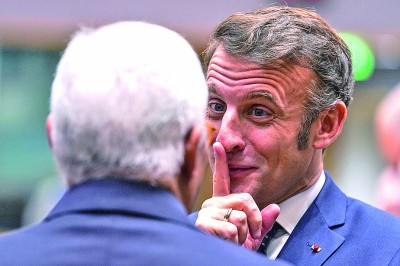
On December 18, French President Macron (right) talks with European Council President Costa before an EU summit in Brussels, Belgium. Xinhua News Agency
The Question of European Autonomy: Strategic Independence
The United States has long been Europe’s primary security guarantor and a close partner and ally on global order and international affairs. But as all of that becomes unreliable and illusory, the issue of strategic autonomy, long discussed in Europe, has resurfaced.
In 2025, Europe did increase its efforts toward strategic autonomy. French President Macron, German Chancellor Metz, and European Commission President von der Leyen all declared a need to reduce dependence on the U.S. in security and defense matters. In March, von der Leyen announced at an emergency summit in Brussels that Europe must “rearm” and submitted a special financing plan for “rearming Europe,” aiming to mobilize up to €800 billion in funding over the next decade. Accompanying this plan, the “European Defense White Paper – 2030 Readiness Plan” urged member states to improve the quality and coordination of procurement, with the goal of building a “safe and resilient Europe” by 2030. The plan was approved by EU member states in May, with the first €150 billion in loans earmarked for critical areas such as ammunition, missiles, and drones.
Given Europe’s dependence on U.S. security, economic realities, and internal divisions and contradictions, this latest effort toward strategic autonomy faces even greater obstacles than in the past, and its success is uncertain.
First, there is over-reliance on the United States. While Europeans have a deep understanding that Europe “can no longer rely on the United States as it has for the past 80 years, and must realize that the United States today is very different from the past, subject not only to the will of Trump but also to the institutionalization of a new worldview.” But psychologically and realistically, Europe is reluctant to truly abandon its dependence on the U.S., seemingly unable to imagine – or dare to imagine – a future without America. In 2025, despite the U.S.’s harsh and humiliating treatment of Europe, most European nations remained hesitant to openly criticize Washington. The EU’s acceptance of the U.S.’s unilateral 15% tariff and its offer to open its markets further was tantamount to surrender, unprecedented in the last 80 years. Nevertheless, the EU presented this as a successful agreement because it avoided a U.S. abandonment of European security. Europe fears a U.S. troop withdrawal, a “brain death” of NATO, and a U.S. withdrawal from the Ukraine conflict – in short, being abandoned by the U.S. Europe’s current emphasis on security and increased defense spending is partly aimed at pleasing the U.S. and keeping it engaged in Europe. While Europe is talking about strategic autonomy, it doesn’t seem fully committed, with NATO still prioritized in its security strategy.
Second, there is a severe lack of financial resources. Europe’s long-term economic stagnation has structural causes, such as aging populations, over-regulation, and excessive welfare programs. It has also fallen behind in the development of information and digital technologies, with Germany’s recent deindustrialization accelerating. Looking ahead, Europe’s economic prospects are bleak, making it difficult to sustainably finance large-scale defense spending. Currently, there is a growing contradiction between social spending and defense spending, as increased military expenditures will inevitably squeeze funding for other areas. Many European countries, particularly France, Italy, and the UK, are already heavily indebted, with high budget deficits and public debt. Even Germany’s debt is expected to rise rapidly in the coming years. European countries generally have high tax rates and struggle to find new sources of revenue, and economic growth remains sluggish. In this situation, they can only borrow more. Excessive borrowing could lead to financial and debt crises, jeopardizing Europe’s strategic autonomy efforts. Currently, Europe faces the question of “guns or butter,” which has sparked social and political divisions. Ignoring development and focusing solely on military buildup will not bring strategic autonomy, but will instead destroy Europe’s hopes of achieving it.
Third, divisions and contradictions within Europe are growing. Countries like Italy and Spain do not feel threatened by Russia and are less willing to increase military spending. Larger countries like Germany and France are more concerned with making their own companies “European champions” than with cooperating to integrate defense industries, with the slogan of defense industrial integration taking a backseat to immediate interests. Nordic and Central European countries prefer to buy U.S. weapons rather than French or German products. Furthermore, no member state is willing to cede control of defense to the EU. For the EU, a more fatal problem is the rise of right-wing forces in Europe, particularly in key countries like France and Germany. These right-wing forces are so-called “sovereignty parties,” emphasizing national sovereignty, opposing EU power, and opposing EU-led defense integration. These are the forces the U.S. wants to support. If more right-wing forces come to power in EU countries, this round of European strategic autonomy efforts is likely to fail.

This is a view of Berlin, Germany, taken on February 18. Xinhua News Agency

Demonstrators set fire to hay bales and old tires on the streets in Brussels, Belgium, on December 18. Xinhua News Agency
The Path Forward for Europe: A Need for Rebalancing
Looking ahead to 2026, Europe’s outlook remains bleak. Faced with unsustainable internal and external policies, Europe needs a strategic and intellectual rebalancing.
First, a rebalancing of transatlantic relations. To achieve true strategic autonomy – or if it wants to firmly embark on the path of strategic autonomy – Europe must redefine its relationship with the United States and normalize transatlantic ties. Europe’s dependence on the U.S. is largely due to inertia. The EU’s 27 countries possess considerable economic, technological, industrial, and military power, and the U.S. needs Europe in many respects, such as its markets, technology, and capital. In fact, Europe does not need to rely on U.S. military protection, especially if it can rebuild its relationship with Russia, which would significantly reduce its psychological dependence on the U.S. Europe can also fundamentally change its view of NATO, prioritizing a “defense alliance” over a “NATO-first” approach.
Second, a rebalancing of development and security. Currently, European politics and policies are accelerating securitization, such as prioritizing military spending over other expenditures, squeezing investment in education and research, and increasing economic protectionism and fortress building. However, excessive securitization brings new problems. The European economy will become more sluggish, its competitiveness will decline, and social security will continue to be undermined, leading to a right-wing surge, social discontent, and political instability, making Europe less secure and making its “rearmament” more difficult. Europe needs to curb the impulse toward over-securitization and consider economic development and social needs more.
Third, a rebalancing of values and reality. Europe has long promoted so-called values-based diplomacy, which hides a sense of civilizational superiority and Eurocentrism, running counter to global trends. Today’s Europe does not have time to dwell in “nostalgia” and needs to face a world that has undergone profound changes. Viewing China as a systemic rival, being wary of and guarding against China, yet being unable to do without practical cooperation with China; courting the U.S. only to be rejected and reprimanded – Europe’s contradictory policies are unsustainable. Looking ahead, Europe needs less ideological obsession and more realistic strategic thinking.
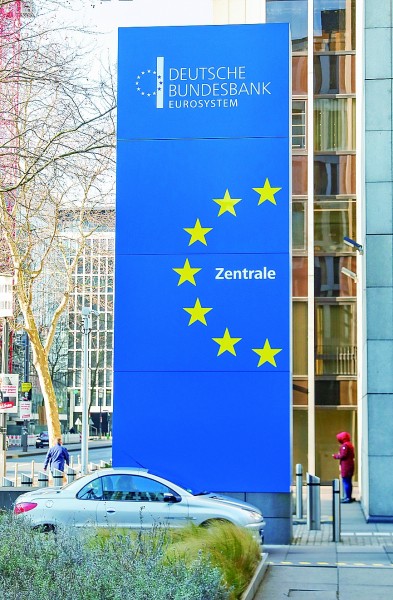
This is a view of the headquarters of the Deutsche Bundesbank in Frankfurt, Germany, taken on February 18. Xinhua News Agency
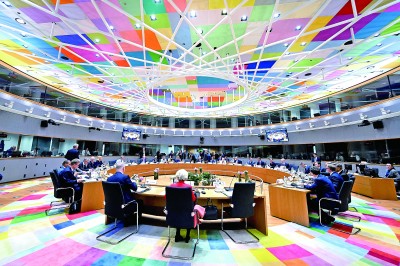
The EU held a summit in Brussels, Belgium, on June 26, emphasizing that it will continue to significantly increase European defense and security spending. Xinhua News Agency
(Source: Global Times, December 28, 2025, Page 08)
[[
Editor: Jiang Shuqi ]
