
French farmers are continuing widespread protests across southwestern France, disrupting travel and demonstrating opposition to the government’s strategy for containing a contagious cattle disease. Blockades went up Saturday along key roadways in the occitanie region, following a partial lifting of roadblocks elsewhere, as farmers express mounting frustration with policies requiring the slaughter of entire herds to control the spread of contagious nodular dermatitis (CND). the ongoing actions signal a deepening crisis for France’s agricultural sector as the new year approaches.
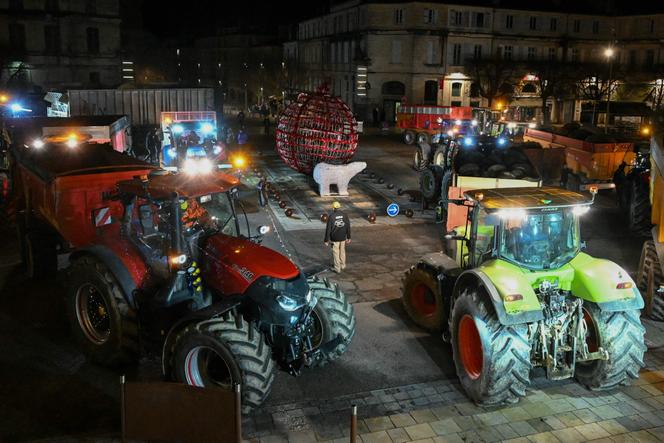
Farmers across southwestern France continued protests Saturday, December 27, blocking several roads and highways in the Occitanie region, demonstrating against the government’s handling of a cattle disease outbreak. The action follows the lifting of most roadblocks in Nouvelle-Aquitaine on Friday.
The Ministry of the Interior reported Saturday morning that blockades were in place on the A75 at Buisson (Lozère) and Sévérac-d’Aveyron, the A64 at Carbonne (Haute-Garonne), the RN88 at Baraqueville, near Rodez, and the RD1124 at Ordan-Larroque, at the entrance to Auch. One remaining blockade was also reported in Nouvelle-Aquitaine, on the RD824 at Tartas (Landes).
Overnight from Friday to Saturday, farmers again dumped straw and waste in front of the prefecture of the Gers department to protest, in particular, the mandatory slaughter of entire herds upon detection of contagious nodular dermatitis (CND), according to an Agence France-Presse (AFP) journalist on the scene. “Christmas is over, we are ready to do New Year’s,” said Vincent Arbusti, spokesperson for the Coordination Rurale (CR) union of the Gers, while manning a blockade at the entrance to Auch.
Renewed Protests Planned for January
Approximately 155 miles northeast of Auch, on the A75 highway connecting Clermont-Ferrand to Béziers, farmers successfully unified blockades at Severac d’Aveyron and Buisson on Friday evening, according to Eloi Nespoulous, co-president of the CR of Aveyron. He stated that the highway is now closed to traffic for nearly 100 kilometers north of the Millau viaduct. The ongoing protests highlight the growing frustration among French farmers over animal health policies.
“We joined forces with the CR48 at La Canourgue to block a 12-mile section that was still open,” between the two previously closed areas in Lozère and Aveyron. “We dumped materials to ensure it was closed,” he added.
In Nouvelle-Aquitaine, the CR lifted several highway blockades on Friday, but is calling for a renewed effort in January. “After twelve days of struggle, we are lifting the camp at Cestas,” south of Bordeaux, the CR Gironde declared in a statement, lamenting the “silence” and “disdain” shown by the government. The Pyrénées-Atlantiques branch confirmed to AFP the dismantling of blockades on the A64 at Briscous, near Bayonne, and at a toll plaza in Pau.
Since the beginning of the CND epidemic in Savoie this summer, the government has been attempting to contain the spread of the virus based on “three pillars”: systematic slaughter of a herd upon detection of a case, vaccination, and restriction of movement. This approach has been strongly contested by some farmers, particularly from Coordination Rurale (the second-largest agricultural union) and Confédération Paysanne (the third), who reject the strategy of slaughtering entire herds upon detection of even a single case.
Despite occasional joint action, disagreements persist between these two unions. Sylvie Colas, spokesperson for Confédération Paysanne in the Gers, told AFP on Saturday that she opposes “acts of vandalism.” “This is the fifth time the prefecture has been damaged,” she said, denouncing a “lack of responsibility” from the CR and “the cost of these damages to local authorities.”
