
Ottawa is preparing for a potentially pivotal shift in its relationship with First Nations as Prime Minister Mark Carney pledged a national summit in early 2026 to address Indigenous concerns regarding resource development.Teh announcement follows a strong rebuke from the Assembly of First Nations (AFN), which is demanding the federal government withdraw from a recently established pipeline agreement with Alberta, raising questions about the future of the project and federal-provincial relations on resource extraction. The summit promises to place First Nations leaders at the forefront of agenda-setting for major infrastructure projects and Indigenous consultation processes.
OTTAWA – Prime Minister Mark Carney announced plans for a national summit early in 2026 to address concerns raised by First Nations leaders regarding resource development and Indigenous rights, a move coming as the Assembly of First Nations (AFN) calls for the cancellation of a pipeline agreement with Alberta. The announcement, made during a speech to hundreds of First Nations chiefs gathered in Ottawa this week, signals a potential shift in the federal government’s approach to major infrastructure projects and Indigenous consultation.
“You will set the agenda,” Carney told the assembled chiefs, drawing applause. The promise of First Nations leadership determining the summit’s focus comes amid growing tensions over a recent agreement between Ottawa and Alberta to build a pipeline to Asian markets.
The Prime Minister delivers his speech to a packed room at the extraordinary chiefs assembly in Ottawa.
Photo : Radio-Canada / Shushan Bacon
The AFN passed a resolution demanding the federal government withdraw from the agreement with Alberta, which also contemplates changes to the federal ban on oil tankers in the waters off northern British Columbia. The move underscores the growing opposition to the pipeline project from Indigenous communities along the proposed route.
Chief Donald Edgars, of the Village Council of Old Massett at Haida Gwaii, who presented the resolution, stated, “A pipeline to the coast of British Columbia is just a dream.” The resolution also calls on Canada, Alberta, and British Columbia to recognize the climate emergency and uphold the United Nations Declaration on the Rights of Indigenous Peoples.
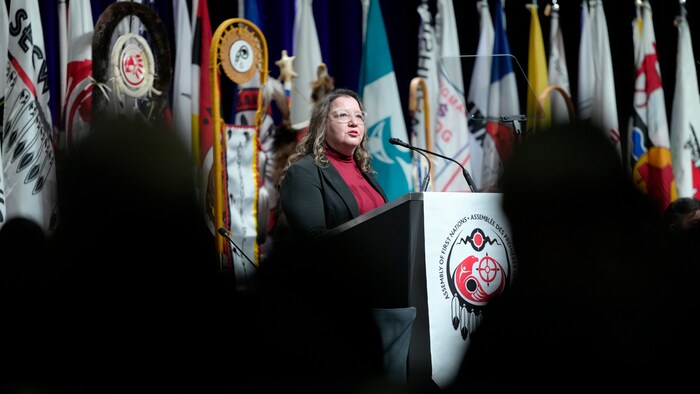
AFN National Chief Cindy Woodhouse Nepinak speaks during the Special Chiefs Assembly in Ottawa on Tuesday, December 2, 2025.
Photo: The Canadian Press / Adrian Wyld
AFN National Chief Cindy Woodhouse Nepinak opened the assembly by arguing that “it’s as if First Nations rights can be erased by a simple federal-provincial protocol.” She added, “Canada can create all the protocols, project offices, and advisory groups it wants: the chiefs are united.”
When it comes to approving major national projects on First Nations lands, there will be no way around rights holders.
The AFN represents over 630 chiefs across Canada, meeting twice a year to set their political priorities. The pipeline agreement, announced last week, has quickly become a focal point of contention.
Marilyn Slett, Chief of the Heiltsuk Nation on the British Columbia coast, said in a press release that “this pipeline project will never see the day.” The agreement commits Canada and Alberta to respect Indigenous rights and treaty rights, and to “conduct early, consistent, and meaningful consultations” with Indigenous peoples.
According to a draft agenda released by the AFN, chiefs will hear directly from the Major Projects Office and its Indigenous Advisory Committee on Wednesday. The case highlights the challenges of balancing economic development with Indigenous rights and environmental concerns.
Bill S-2 on the Agenda
Chiefs are also expected to discuss Bill S-2, legislation introduced in the Senate to amend the Indian Act, including the removal of the so-called “second-generation cut-off rule.” This rule prevents grandchildren of individuals who lost Indian status from regaining it.
With files from Brett Forester, CBC Indigenous
