
From a kitchen experiment born of personal frustration, a thriving international hair care business has emerged. Ismail Ali, a recent business graduate, launched Alié Moisture after recognizing a gap in the market for inclusive, high-quality products catering to textured hair. His story-beginning with self-funded research and development in his teens-highlights the power of entrepreneurial spirit and responding directly to consumer needs,a strategy that has already gained traction across Europe and into Nigeria.
Ismail Ali launched a successful hair care company after struggling to find products suitable for textured hair as a teenager. The entrepreneur’s journey began with kitchen experiments and a small loan, and has now expanded into international markets.
Ali, now a recent business graduate, realized at age 16 that options for textured hair care were limited. Existing products often contained unpronounceable ingredients and carried a high price tag. Determined to find a solution, he began formulating his own recipes.
“I started experimenting in the kitchen every day after school, using oils, shea butter, and even my mom’s immersion blender,” Ali said. The early attempts weren’t always successful, with batches often molding or equipment breaking down. While his mother wasn’t initially thrilled with the kitchen chaos, Ali says it ultimately paid off six years later, marking the beginning of Alié Moisture.
“I was working part-time at a children’s amusement park, earning around $60 an hour,” Ali explained. “I saved up 3,500 Swedish krona all on my own, and then I went home and searched on YouTube: ‘How to make a conditioner.’”
After many attempts, without any success, Ismail noticed what was missing.
After numerous failed attempts, Ali discovered a crucial missing ingredient: preservatives. Through independent research, he learned what was required to create stable, long-lasting hair products. Years of saving, combined with a grant from the Wallenberg Foundation, allowed him to outsource production and refine his formulas with the help of Italian chemists.
One of the biggest hurdles for Alié Moisture was securing its first retail partnership. A turning point came when the beauty chain Taj Mahal decided to take a chance on Ali’s vision, which then spurred the brand’s international expansion. The company’s growth has been fueled by social media buzz, starting with influencer Filip Dikmen, one of the first in Sweden to promote the products. This early support, Ali said, felt like validation that the business was on the right track.
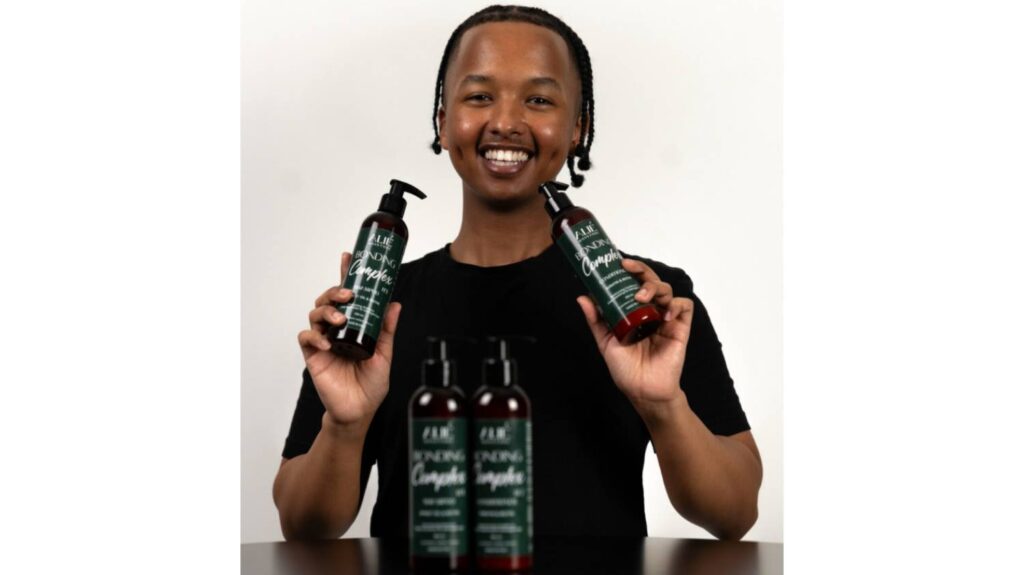
Attention from Chioma Ikokwu and Mariam Timmer of Real Housewives of Lagos proved pivotal in opening doors to the Nigerian market. Ali balanced his entrepreneurial pursuits with his education, successfully completing a degree in business administration this summer.
On the days I was a student and in the evenings I transitioned into CEO
“I built Alié Moisture from the ground up while I was in high school and then university. On the days I was a student and in the evenings I transitioned into CEO.”
The company has seen remarkably few returns since its launch, a testament to Ali’s commitment to developing products in direct response to customer feedback gathered through social media. “Our community is so involved in the work that we can post an event on our Instagram account and ask them how they want us to design labels or poll them on product scents,” Ali said.
Looking ahead, Alié Moisture has several new projects in the pipeline, including the launch of the Alié Foundation, which will support young entrepreneurs in underserved communities. Ali has learned that a “no” doesn’t always mean final, and that active listening is key to understanding what’s being communicated.
Ahead, Alié Moisture has several new projects planned
Ali says his driving force is creating value through inclusivity and sustainability. He believes that access to hair care for textured hair promotes representation and acceptance, highlighting how far the conversation around hair has come since he was a 16-year-old forced to create his own solutions.
Esra Aydogan

