
One of the most fascinating and elusive questions in modern biology has been answered: how a single cell, the zygote, can develop into the most complex structure in the known universe – the human brain. Researchers have discovered that this incredible complexity doesn’t rely on long-distance chemical signals, but rather on the individual “family history” of each neuron. This breakthrough offers new insights into brain development and could have implications for understanding and treating neurological disorders.
For years, scientists believed cells oriented themselves using “chemical beacons.” However, the sheer size, density, and complexity of the brain made it difficult to explain how these signals could reach every corner of the organ. Now, a team of neuroscientists at the Cold Spring Harbor Laboratory (CSHL), in collaboration with researchers from Harvard University and ETH Zurich, has proposed a surprising alternative.
The solution, they found, is elegantly simple: the brain builds itself by following its own genealogical tree. It doesn’t require an external architect; it simply remembers its family.
Goodbye to the ‘Chemical GPS’
For a long time, the prevailing idea in developmental biology has centered on what are known as chemical gradients or ‘morphogens,’ substances theoretically described by Alan Turing in the 1950s. The classic idea was that cells exchanged positional information primarily through chemical signals that, like a lighthouse beam, become weaker with distance. Cells closer to the signal would become one type of tissue, even as those farther away would become another.
However, researchers found a fundamental problem with this theory. “The only thing a cell ‘sees’ is itself and its neighbors,” explained Stan Kerstjens, the lead author of the study. Which means the chemical system only works when dealing with a few dozen cells in an early embryo. The brain, however, is much more complex, containing billions of neurons, each needing to land in the correct location. At that scale, chemical signals become diluted, like trying to hear a whisper in a crowded stadium – the signal is lost in the noise before it reaches its destination. “A cell in the wrong place,” Kerstjens explained, “becomes the wrong thing, and the brain doesn’t develop properly. Each cell must answer two questions: Where am I? And what do I need to become?”
In a growing brain, chemical signals become diluted. It’s like trying to listen to a whisper in a football stadium full of people.
The research team’s new approach shifts the focus to what could be called the ‘family history’ of the cells themselves. “Consider how human populations spread across a country over generations,” Kerstjens explained. “Descendants settle near their parents, so people who share ancestry end up in neighboring regions, creating large-scale geographic structures without the need for long-distance communication.”
Following the ‘Family’
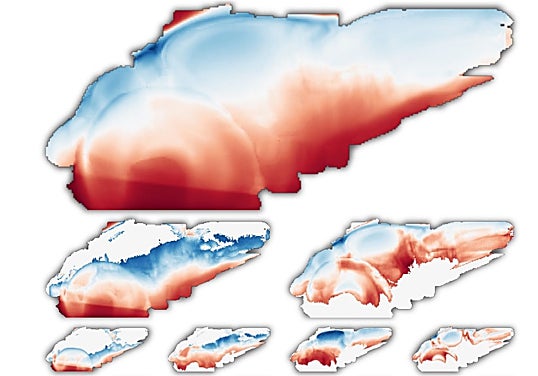
This is essentially a model of position information based on lineage. Researchers argue that, similarly, cells don’t need to receive a chemical instruction from the other side of the brain. They simply need to know who their parents are and who their siblings are. In Kerstjens’ words, “cells that descend from the same progenitor tend to stay close to each other.”
This creates a kind of intrinsic coordinate map. It’s as if each neuron carries a ‘surname’ that automatically indicates its ‘zip code.’ If your surname is ‘Visual Cortex,’ you stay with your family in the back of the brain; you don’t migrate to the frontal lobe. The cell doesn’t need an external GPS to tell it where it is, but carries its ‘coordinates’ inscribed in its family lineage.
A Universal Mechanism
To demonstrate their theory, Kerstjens and his team designed what they called a “scalable lineage-based positional information model.” They didn’t stop at theoretical mathematics, but validated their calculations by analyzing individual gene expression in developing mouse brains. By tracking clones (groups of cells descended from the same ancestor), they saw that the theory held true: ancestry predicted location. They then confirmed that the same mathematical pattern likewise worked in zebrafish, to further solidify their findings.
According to the study, this demonstrates a universal mechanism, one that works equally well in the small brain of a fish and the complex brain of a mammal. Kerstjens clarified that this doesn’t mean chemical signals don’t exist; rather, lineage and chemistry work together. Lineage provides the overall map (the ‘scaffolding’ structure), and chemistry refines the local details.
From Cancer to AI
The implications of the study extend far beyond basic neuroscience. The research offers a new way to look at cancer, for example. Tumors are, after all, tissues that grow and organize (or disorganize) following biological rules. Understanding how lineage determines position could shed light on how cancer cells ‘forget’ their place and decide to migrate (metastasize) or colonize neighboring tissues.
in a world increasingly obsessed with Artificial Intelligence, this discovery could also become a genuine ‘roadmap’ for computer engineering. Until now, our artificial neural networks have been designed in a very rigid way. But if we want to create AIs that ‘self-replicate’ or increase their complexity, we may need to imitate nature.
“The brain, in a way, makes us intelligent,” Kerstjens reflected. “But how did it manage to develop this capacity, not only during its growth time, but over evolutionary time? This is a fundamental piece of that great puzzle.”
It could even be that future AI models won’t be trained with hundreds of thousands of examples and data, but will simply be ‘cultivated,’ passing information from one generation of code to the next, just like our own neurons. Once again, nature demonstrates that the simplest solution—in this case, following the family—is often the one that allows us to build the most astonishing wonders.
