
The Iberian Peninsula, long considered a relatively stable landmass, is now confirmed too be slowly rotating clockwise, a discovery with potential implications for seismic hazard assessment in the region. A new study, led by researchers at the University of the Basque Country, details the millimeter-per-year movement driven by the complex interaction between the African and Eurasian tectonic plates. This research, published in *ScienceDirect* in early 2026, provides unprecedented detail on the geodynamics of southwestern europe and builds upon decades of research into the region’s tectonic history [[1]], [[2]].
A new study reveals the Iberian Peninsula is slowly rotating clockwise due to tectonic pressures from the African plate. This geological phenomenon, occurring at a millimeter-per-year pace, could have significant implications for seismic activity in the region and a deeper understanding of earthquake generation in southwestern Europe.
It’s easy to assume the ground beneath our feet is static, but even the Earth’s most solid parts are in constant flux. For example, the Iberian Peninsula is undergoing a surprising movement: a slow but steady clockwise rotation driven by the tectonic pressure exerted by Africa.
New Findings on the Iberian Peninsula’s Rotation
Table of Contents
Researchers at the University of the Basque Country led a recent study that confirms this phenomenon with unprecedented detail, as reported by La Brújula Verde. By analyzing seismic and satellite data, the team observed how the boundary between the African and European tectonic plates generates a force causing the Iberian Peninsula to rotate. This discovery underscores the complex dynamics at play beneath the Earth’s surface and the potential for new insights into plate tectonics.
While seemingly minimal, this rotation has important implications for understanding the movements of tectonic plates and the geodynamics of the European continent.
The Significance of Tectonic Plate Interaction
The interaction between the Eurasian and African plates in the western Mediterranean is incredibly complex. While this boundary is well-defined in some areas, the interaction zone in southern Iberia is much more diffuse and chaotic. Here, the Alborán microplate plays a crucial role, driving the peninsula’s rotation.
The researchers found that the collision between the Eurasian and African plates isn’t uniform. In areas like the Gibraltar arc, the collision is absorbed by the Earth’s crust, but in others, such as southwestern Iberia, tectonic forces are transmitted more easily, causing rotation in the region.
Implications of this Tectonic Shift for Seismic Activity
This rotation of the Iberian Peninsula isn’t merely a geological curiosity; it has practical implications. Studies of this movement can help scientists identify and better understand active faults that generate earthquakes in the region. Areas undergoing significant deformation require deeper analysis to identify the responsible tectonic structures and assess their seismic potential.
The Data Behind the Discovery
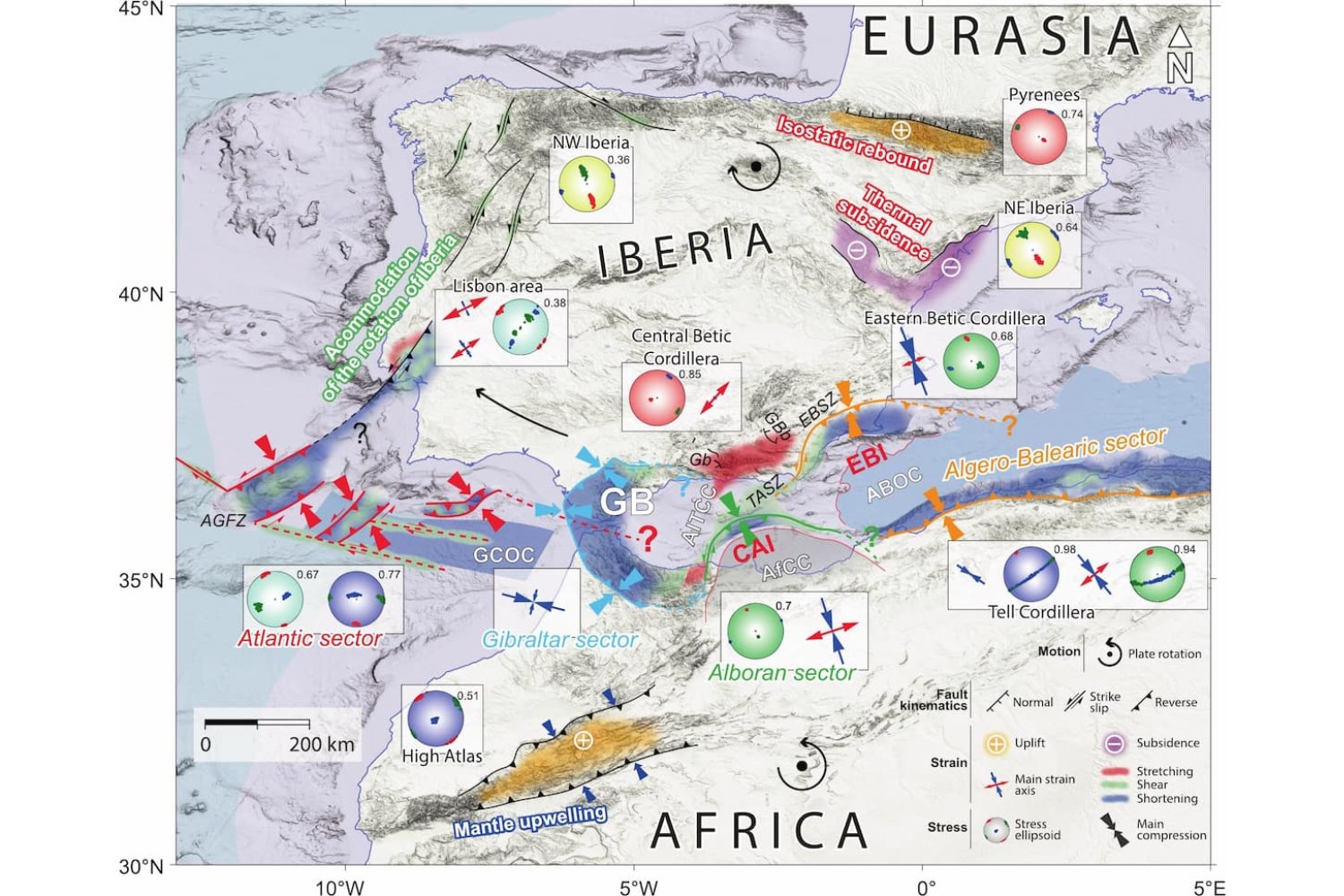
The study is based on a combined analysis of seismic data, indicating the deep forces acting on the Earth’s crust, and satellite observation data, showing how the Earth’s surface responds to these forces. Integrating both data sources allowed scientists to accurately measure the rotation of the Iberian Peninsula, a phenomenon previously only theorized.
Although this rotation is extremely slow (on the order of millimeters per year), its geological impact is significant and reinforces the need for more comprehensive studies on the region’s geodynamics. Identifying active faults will not only improve understanding of past earthquakes but also help predict future risks.
The Importance of this Finding for Future Geological Research
The study also highlights the importance of continuing research on the geodynamics of southwestern Iberia. In areas like the western Pyrenees and the Gibraltar arc, precise information about the nature of active faults and their seismic potential is still lacking. With the discovery of this tectonic shift, scientists have opened new avenues of research that could improve earthquake prediction capabilities in these zones.
What appears to be an insignificant movement on a human scale is actually a key piece to understanding tectonic processes at a large scale and how they affect the region. The Iberian Peninsula, far from being a static block, is in constant motion, and this discovery is just the beginning of a deeper understanding of the Earth’s mysteries.
