
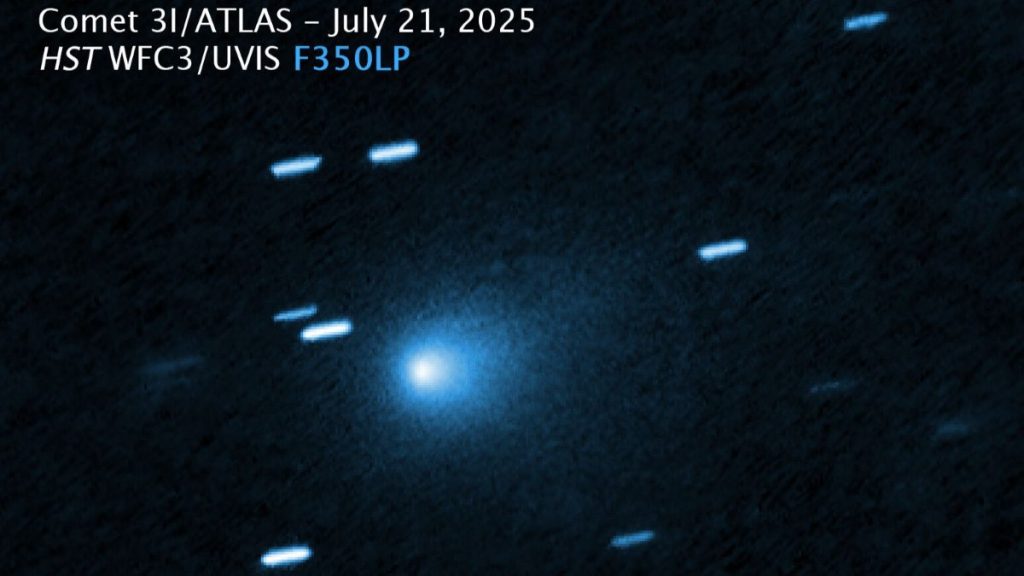
Interstellar comet 3I/ATLAS is releasing water at a staggering rate, ejecting a volume equivalent to approximately 70 Olympic-sized swimming pools every single day. This discovery provides critical insights into the composition of objects originating from outside our solar system and the distribution of water in the cosmos.
A Rare Interstellar Visitor
Discovered on July 1, 2025, by the Asteroid Terrestrial-impact Last Alert System (ATLAS), the object—also designated as C/2025 N1 (ATLAS) and previously known as A11pl3Z—is the third confirmed interstellar object to pass through our solar system, following 1I/ʻOumuamua and 2I/Borisov.
The comet travels on a hyperbolic, unbound trajectory. According to orbital data, it reached perihelion on October 29, 2025, coming within 1.35645 AU of the Sun. While it passed Earth at a distance of 1.8 AU, astronomers have confirmed it posed no threat to our planet.
Physical Characteristics and Composition
Scientific analysis reveals a nucleus with a mean diameter ranging from 0.520 to 0.748 km based on non-gravitational data, though Hubble observations suggest a wider range between 0.32 and 5.6 km. The comet possesses a CO2 coma spanning approximately 700,000 km and a total mass of 4.4×10¹⁰ kg.
The object’s movement is characterized by high velocity, reaching a maximum orbital speed of 68.3 km/s at perihelion, with a hyperbolic excess velocity (v∞) of 58 km/s. Its rotation period is estimated between 15.48 and 16.16 hours depending on the observation method used.
Scientific Implications
The massive release of water from 3I/ATLAS is of significant interest to the scientific community. Understanding how water is transported and preserved in interstellar objects helps researchers better comprehend the chemical building blocks available in other star systems, which is fundamental to the study of planetary habitability.
While most astronomers view the object as a natural comet, some researchers studying alien life have suggested the possibility that 3I/ATLAS could be an artificial vehicle. Though, many in the scientific community have dismissed these claims as unfounded.
