

The James Webb Space Telescope has delivered another cosmic curveball and this time, it’s rewriting the origin story of the universe’s most massive black holes. Astronomers have long believed these gravitational giants grew slowly over billions of years, but new observations suggest they may have formed in a cosmic blink—shattering decades of astrophysical theory.
The Mystery of the “Little Red Dots”
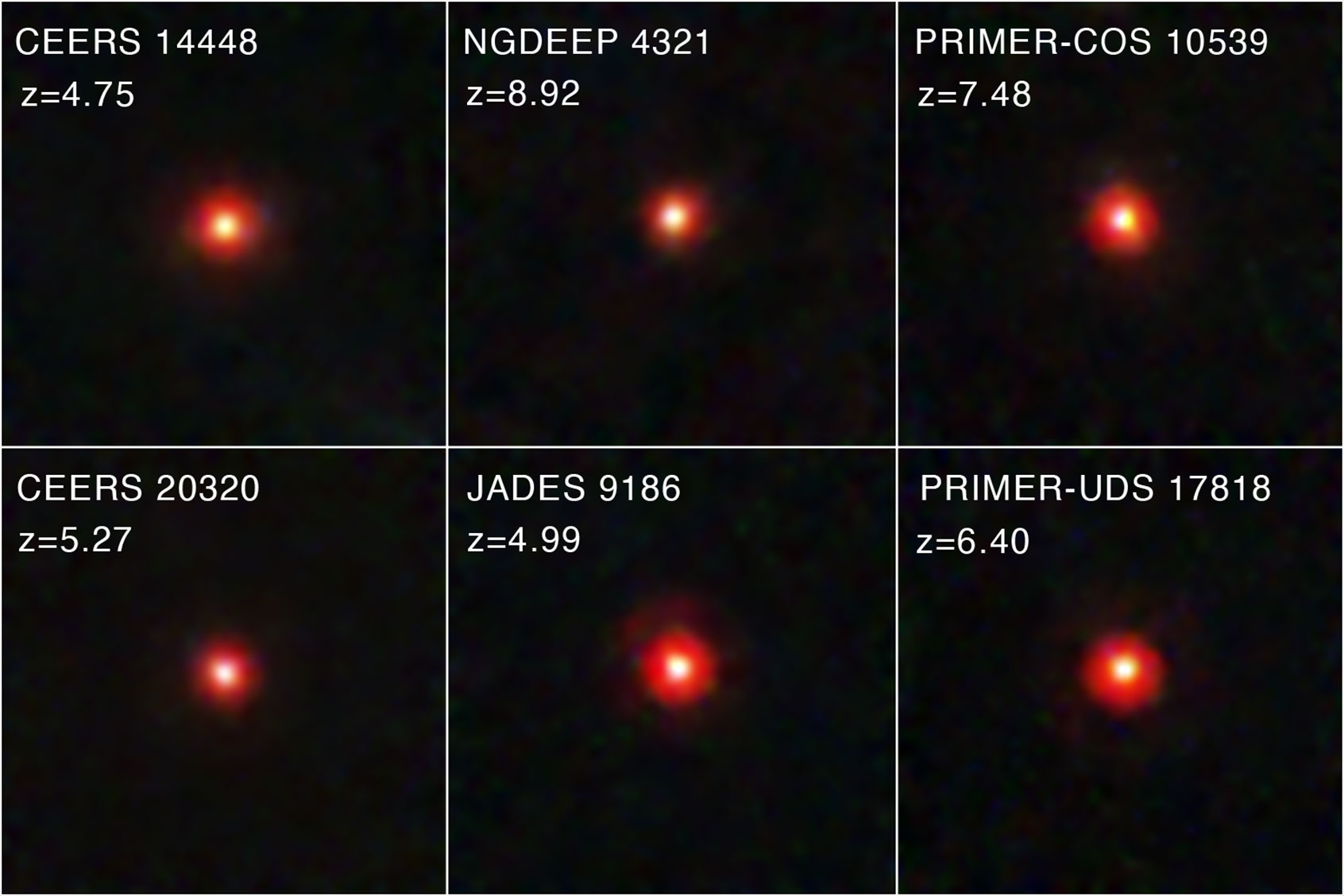
When the James Webb Space Telescope began scanning the early universe in December 2022, researchers expected to find familiar cosmic structures. Instead, they stumbled upon a baffling phenomenon: tiny, intensely bright red objects now dubbed “little red dots” (LRDs). These compact anomalies, detected in the universe’s infancy, defy conventional explanations for how supermassive black holes—weighing millions or even billions of times the mass of our Sun—could have emerged so quickly after the Huge Bang.
“These objects shouldn’t exist—at least not according to the timeline we’ve relied on for decades,” said one astrophysicist involved in the research. The discovery, published in multiple peer-reviewed studies, has sent shockwaves through the scientific community, forcing a rethink of cosmic evolution.
A Timeline That Doesn’t Add Up
The traditional model of black hole formation is straightforward: massive stars burn through their nuclear fuel, collapse into black holes of modest size (tens to hundreds of solar masses), and then gradually merge over billions of years to form supermassive behemoths. It’s a slow, methodical process—one that should have taken far longer than the few hundred million years these new observations suggest.
Yet the James Webb’s data tells a different story. Some of these supermassive black holes were already thriving just 500 million years after the Big Bang, a time when the universe was still in its cosmic toddlerhood. “The math doesn’t work,” admitted a researcher. “There simply isn’t enough time for them to grow this large under the aged rules.”
A Radical New Theory: Direct Collapse
With the standard model in crisis, scientists are exploring an alternative: direct collapse. Instead of starting compact and growing over eons, these black holes may have formed almost instantly from the gravitational collapse of massive gas clouds in the early universe. This process would bypass the require for stellar remnants, allowing supermassive black holes to emerge fully formed—or at least, far faster than previously thought possible.
Computer simulations are beginning to support this idea, though gaps remain. “We’re seeing pieces of the puzzle fall into place, but the full picture is still unclear,” said a lead author of one study. The direct collapse hypothesis could explain the LRDs’ unusual brightness and compact size, but it also raises new questions about the conditions of the early universe that made such rapid formation possible.
A Cosmic Detective Story
The James Webb’s observations aren’t just challenging theories—they’re uncovering entirely new cosmic phenomena. In one striking case, astronomers spotted a supermassive black hole nestled not within a galaxy, but in the chaotic aftermath of a galactic collision. Dubbed the “Galaxy of Infinity” for its distinctive figure-eight shape, this system revealed a black hole growing in isolation, surrounded by a vast cloud of gas and dust.
“It’s like finding a skyscraper in the middle of a construction site with no foundation,” said an astronomer. The discovery adds another layer to the mystery, suggesting that supermassive black holes might form in unexpected environments—far from the galactic centers where they’re typically found today.
Why This Matters for Innovation and Beyond
While the study of supermassive black holes might seem esoteric, it has real-world implications for technology and our understanding of the universe. The James Webb Space Telescope, a marvel of modern engineering, is pushing the boundaries of what we can observe—and in doing so, it’s forcing scientists to rethink the fundamental laws governing cosmic evolution. These breakthroughs could one day inform advancements in quantum computing, gravitational wave detection, and even space exploration.
For now, the “little red dots” remain an unsolved riddle, but they’ve already accomplished something extraordinary: proving that even our most established scientific theories are subject to revision. As researchers dig deeper, one thing is clear—the universe is far stranger, and far more efficient, than we ever imagined.
“The universe doesn’t follow our rulebook. That’s what makes it so exciting.”
