
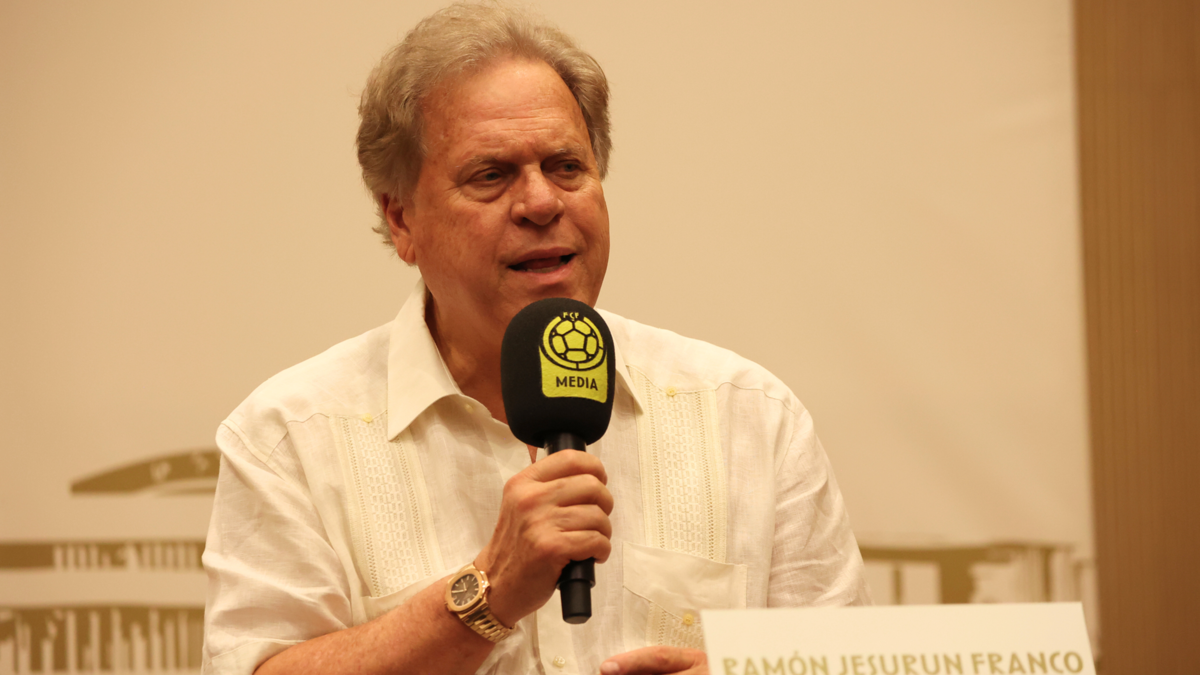
The future of Ramón Jesurún as president of the Colombian Football Federation hinges on a legal challenge to his potential fourth term in office. The Ministry of Sport has clarified that it currently lacks the authority to issue a binding statement on the matter.
According to regulations, a federation leader can serve up to three consecutive four-year terms, a maximum of 12 years. The legal debate surrounding Jesurún’s possible reelection centers on whether his current tenure constitutes two or three periods, as he initially took the position in 2015, replacing Luis Bedoya, who stepped down amid the ‘Fifagate’ scandal and surrendered to U.S. Authorities.
The discussion is rooted in Decree 1228 of 1995, which sets limits on reelection for members of sports organizations’ administrative bodies. The decree explicitly states:
“The administrative body shall not have fewer than three members, including the president, who will be the legal representative. Their term will be four years, and they may be re-elected for up to two successive periods. No one may hold office by election in more than one organization.”
Ramón Jesurún Foto:Federación Colombiana de Fútbol
Mindeporte Issues Statement
On Monday, March 2nd, the Ministry of Sport released a statement addressing the situation, clarifying that “the Directorate of Inspection, Oversight and Control of the Ministry of Sport does not have the competence to issue statements authorizing or binding on situations that have not yet materialized and that depend on private autonomy.”
“The Directorate of Inspection, Oversight and Control of the Ministry of Sport issues opinions of a general and abstract nature on matters within its competence, which are not intended to resolve particular situations or to provide advice aimed at resolving disputes or determining legal consequences arising from acts or decisions of the bodies of a sports entity. Its responses to inquiries are not binding or compromising to the Entity,” the Ministry stated.
Document from Mindeporte sent to EL TIEMPO. Foto:EL TIEMPO
In response to a specific inquiry from EL TIEMPO, Mindeporte indicated that “The exercise of public function is subject to a strict legal framework that delimits not only what authorities can do in the exercise of their functions, but likewise the time and factual conditions under which they can issue opinions and/or administrative actions.”
Ramón Jesurún Foto:EFE
The Ministry further explained: “In this sense, one of the fundamental pillars of administrative and constitutional law is the impossibility of public entities issuing binding or decisive opinions on future and uncertain events planned by the administrators, in this case, the sports organizations that make up the National Sports System.”
Finally, Mindeporte expressed in its document: “This restriction is not merely a procedural formality, but constitutes a safeguard of legal certainty and the constitutional principle of legitimate trust in the fulfillment of the functions of the state apparatus, additionally protecting the autonomy of private will and the principle of impartiality that must govern the state’s action. Likewise, by avoiding pronouncements on hypothetical scenarios, the legal system prevents the risk of prejudgment and undue administrative congestion, where the State would end up assuming the role of strategic advisor or guarantor of risks of sports organizations.”
DEPORTES
