
Here’s a short introductory paragraph to prepend to the article, aiming for a smooth and informative tone:
“`
The seemingly endless repetition of `
` tags might appear nonsensical at first glance, but this pattern frequently enough points to a specific issue in web progress: a problematic or unintended nesting of divs. This can stem from various sources, including errors in code generation, templating engines, or even malicious attempts to exploit vulnerabilities. Understanding the cause and addressing this repetitive structure is crucial for maintaining website performance and security. Let’s delve into the reasons why this happens and how to fix it.
“`
Tragic incidents at sporting events, where fans have lost their lives, are sadly well-documented throughout history. Stadiums like Hillsborough and Heysel are forever linked to moments of devastation instead of athletic joy.
Less known is a similar tragedy that unfolded in Czechoslovakia on December 2, 1965, in Jihlava. What was intended to be a major ice hockey celebration at the site of today’s Horácká aréna instead became a dark day for the nation’s hockey history.
The events at the stadium that day resulted in two deaths and dozens of injuries among spectators. Understanding the circumstances surrounding these events is crucial for improving safety measures at large public gatherings.
By the 1965-1966 season, Dukla Jihlava had firmly established itself as a dominant force in Czechoslovakian hockey. The team, based in the Vysočina region, had been relocated from Olomouc eight years prior and was quickly developing a strong identity under coach Jaroslav Pitner.
Pitner skillfully utilized the opportunity to recruit the best young hockey players from across Czechoslovakia, who were typically required to complete a two-year mandatory military service. Beyond these recruits, he also identified future stars from the Jihlava area, including Jaroslav Holík, Jiří Holík, and Jan Suchý. This blend of regional talent and drafted players created a winning combination for the years to come, as Jihlava began to consistently win championships.
The team succeeded the Red Star Brno, which had a similar advantage previously, but had since transitioned into a civilian team. The 1965-1966 season marked a clash between these two eras.
Dukla Jihlava | Sport SZ
- Founded in 1956 as ASD Dukla Olomouc, the club initially represented the ground forces of the Czechoslovak People’s Army.
- Relocated to Jihlava in 1957.
- Won the Czechoslovak Championship 12 times (1967-72, 1974, 1982-85, and 1991).
- Won the Spengler Cup 5 times.
- Notable players include Jiří and Jaroslav Holík, Jan Suchý, Jan Klapáč, Josef Augusta, Jan Hrbatý, Milan Chalupa, Jaroslav Pitner, Stanislav Neveselý, Oldřich Válek, Petr Vlk, and Bedřich Ščerban.
- Today, the club has the most modern arena in the Czech Republic and plays in the second-highest league (the First League).
At the end of the 1965-1966 season, Brno and Jihlava finished with the same number of points – 56. Only a goal difference awarded the title to Brno for the eleventh time. However, Jihlava would soon dominate, beginning with the following season.
Each of the 36 games in the regular season carried significant weight, and in addition to the rivalry between the two Moravian teams, Slovan Bratislava also aimed to contend for the championship, having finished as runners-up four times in the previous five years.
When Slovan Bratislava traveled to Jihlava on December 2, 1965, only one point separated the two teams.
The stakes were high. The match drew immense attention, with a previous game against Sparta in Jihlava attracting 9,000 spectators. Demand was even greater for this particular contest, but the stadium simply couldn’t accommodate more fans.
Four Thousand Too Many and Chaos Ensued
The TJ Dynamo Jihlava, the stadium operator at the time, attempted to address the high demand in a disastrous manner, selling tickets as if the venue were a modern NHL arena.
Investigations later revealed that at least 11,000 tickets had been issued.
It was estimated that around 2,000 additional fans gained entry without tickets. The stadium’s capacity, which also lacked a roof at the time, was exceeded by approximately 4,000 people.
Adding to the danger, the stadium hadn’t yet received official approval for use.
On December 2, 1965, the stadium quickly filled to capacity. Inside, conditions became increasingly cramped. According to witnesses, a chilling incident then unfolded.
Local military personnel arrived at the game and, despite having valid tickets, were refused entry by event staff. The soldiers forced their way inside, potentially being the final trigger for disaster.
Inside, it was impossible to move, with people pressed against the railings and beginning to faint. Those who fell were trampled by the crowd, unable to get up. The surging mass overwhelmed the barriers, which then collapsed.
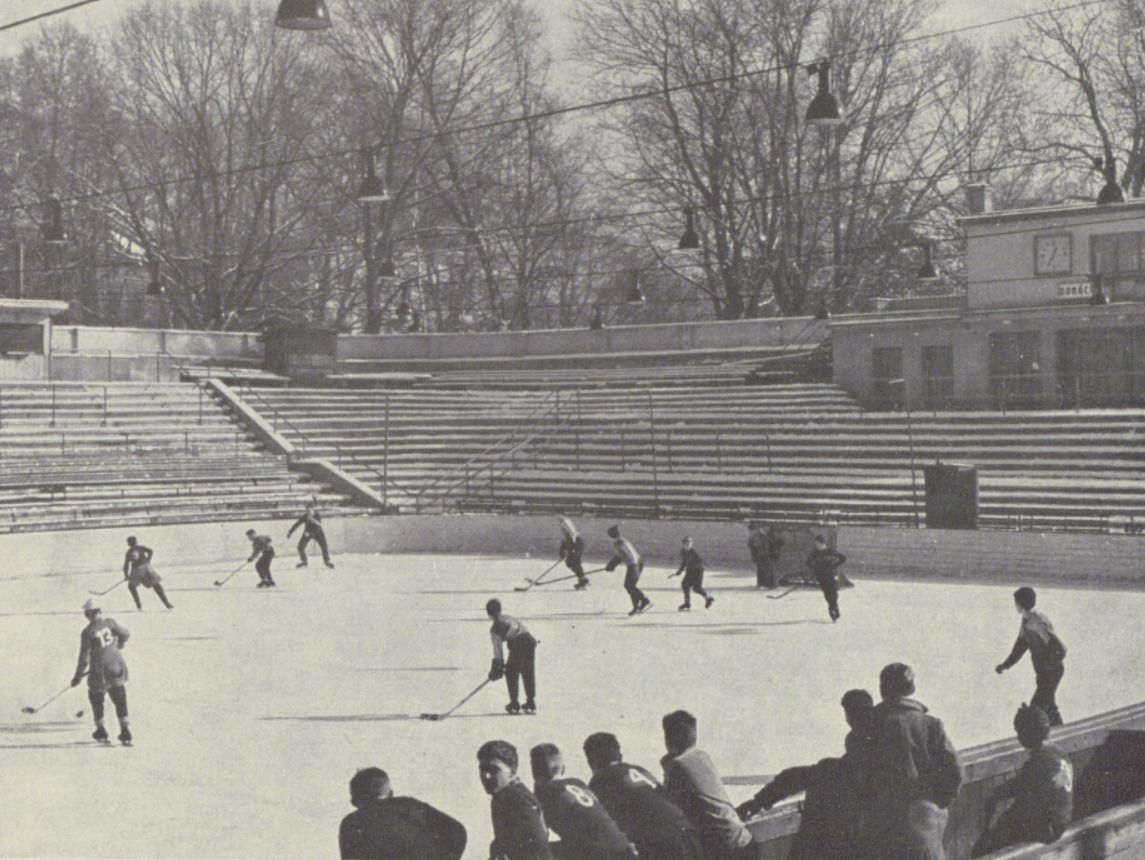
Photo: Tomáš Kučera archive
In Jihlava, games were often played in the open air, as was the case for the tragic match in 1965.
There were 77 members of the Public Security Force on site, but they were overwhelmed by the crowd, estimated at around 13,000 people. Some fans had already fled onto the ice surface before the game began, attempting to escape being trampled.
Not everyone was so fortunate. “The organizers pulled spectators over the barriers, and they lay there with torn clothes and injuries on the ice. It was terrible,” a fan later recalled.
The final toll was tragic and devastating.
Twenty-two people suffered minor injuries, such as fractures.
Four people were seriously injured.
Twenty-eight-year-old Zdeněk Dvořáček from Kamenice near Jihlava died at the stadium, and another spectator succumbed to his injuries later in the hospital.
Play On: Nothing Happened
As was common practice at the time, the regime attempted to cover up the tragic events. In Jihlava, the game proceeded despite the deaths.
Players were only informed of a few injuries and were not given the full extent of what had occurred. “We were in the locker room. Something had happened, so we went to look. But they sent us back inside,” Jihlava goalkeeper Miloš Podhorský recalled years later.
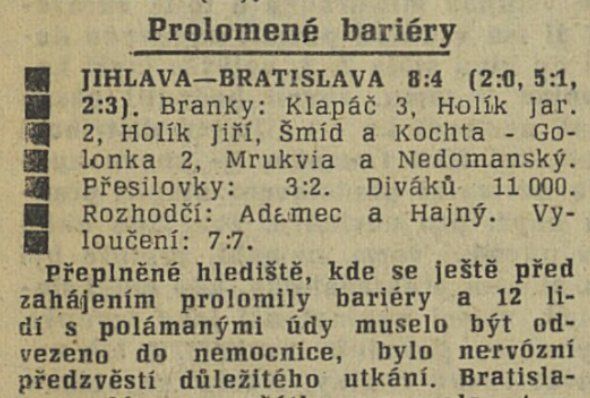
Photo: Tomáš Kučera archive
Jihlava won the game 8-4 against Slovan Bratislava, largely due to a hat trick from Jan Klapáč and an outstanding performance from Jaroslav Holík, who scored two goals and assisted on three others. The game featured other Czechoslovakian hockey stars, including Jan Suchý, Jiří Holík, Vladimír Dzurilla, Ján Starší, Jozef Golonka, and Václav Nedomanský.
They would only learn the full extent of the tragedy later.
The news was limited to brief, dry reports in the press.
A year and a half later, a summary of the court decision appeared. Two minors received compensation of 236,756 crowns from the state insurance company.
The chairman of the Regional Court in Brno, B. Smutný, stated at the time: “This is a very complex case, both in terms of securing important materials for assessing its objective aspects and, especially, its subjective aspects. Hearing 155 witnesses, studying expert opinions, and assessing subjective guilt is extremely time-consuming.”
The specific person responsible for the tragedy was never publicly identified. The public only learned the following from the press: “The court concluded that the operator, TJ Dynamo Jihlava, was responsible for the consequences. The club held a sporting event at a stadium that had not been approved for use, allowed overcrowding, and failed to provide adequate security.”
Silence followed. The public never learned the name of the second person who died.
The headline in the newspaper the following day, commenting on the sporting aspect of the game, is chilling in retrospect: “Jihlava’s Graveyard of Dreams…”
