
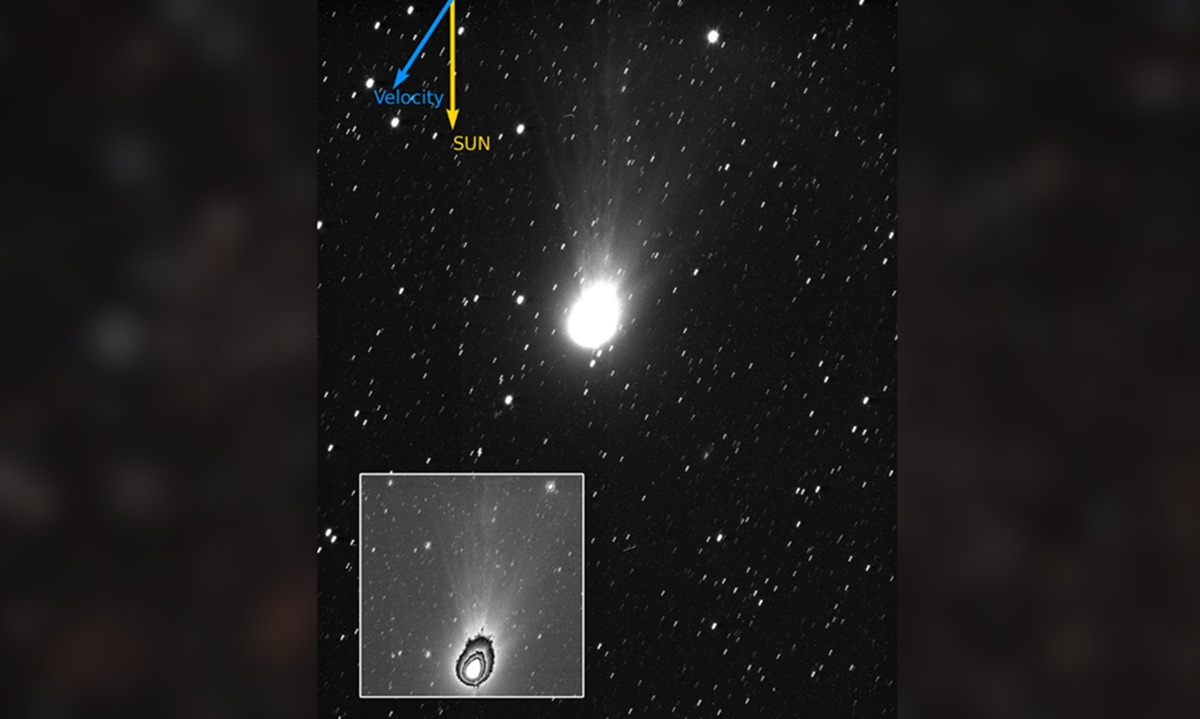
The European Space Agency’s (ESA) Jupiter Icy Moons Explorer (JUICE) spacecraft has returned stunning images of an interstellar visitor – a comet originating from beyond our solar system. The remarkable images were captured by the spacecraft’s JANUS science camera as JUICE continues its journey toward Jupiter.
The object has been identified as the interstellar comet 3I/ATLAS. The images from JUICE clearly show the comet’s glowing coma – a cloud of gas – and the expansive tail of gas and dust trailing behind it.
Third Interstellar Visitor Detected
Comet 3I/ATLAS marks the third time an object from interstellar space has been detected passing through our solar system. Unlike most comets, which originate from the Kuiper Belt or Oort Cloud at the edges of our solar system, this icy wanderer formed around another star before drifting into our cosmic neighborhood.
In the released images, a bright, egg-shaped feature at the center is the comet’s coma, a vast cloud of gas and dust released as sunlight heats the comet’s icy core. Extending from the coma is a long tail formed by solar radiation and the solar wind. This observation provides valuable data for understanding the composition of objects originating from other star systems.
Intensive Observations at 66 Million Kilometers
The JANUS camera captured the images on November 6, 2025, just seven days after 3I/ATLAS reached its closest approach to the sun. At the time the images were taken, the JUICE spacecraft was approximately 66 million kilometers (41 million miles) from the comet.
Throughout November, five sophisticated instruments aboard JUICE – JANUS, MAJIS, SWI, PEP, and UVS – conducted intensive observations. These instruments gathered image and spectrometry data to determine the composition and activity level of the cosmic wanderer.
Data Transmission Challenges
Though the observations were made late last year, scientists have only recently been able to view the results. This was due to JUICE’s position on the opposite side of the sun from Earth during the observation period.
This positioning necessitated slower data transmission speeds, hindering the process. The instrument team received the complete data set last week and is now working to analyze it. Experts are scheduled to convene at the end of March to discuss key findings from this mysterious comet. (Space/Z-2)
