

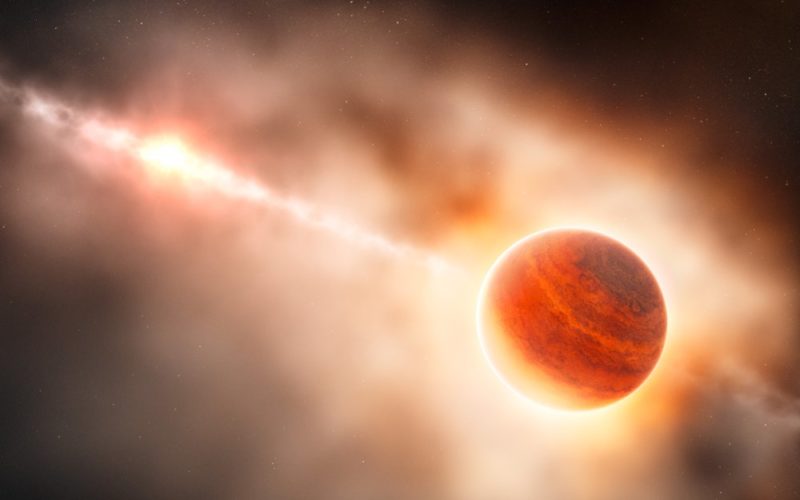
Although Jupiter reigns supreme in our solar system, astronomers have discovered even larger planets – dubbed “super-Jupiters” – orbiting distant stars. A new study published in Nature Astronomy utilizes the James Webb Space Telescope (JWST) to analyze the HR 8799 system, located approximately 130 light-years from Earth. This system is already known to host several massive planets, and the latest observations reveal four gas giants with masses between five and ten times that of Jupiter, orbiting at distances of 15 to 70 astronomical units from their star – a region where traditional planet formation theories struggle to explain their existence.
Typically, astronomers envision two primary scenarios for the birth of gas giants: a “bottom-up” process, similar to Jupiter, where a rocky core gradually accretes dust and gas, or a “top-down” process, akin to star formation, where a gas cloud collapses directly under gravity. Given the location of the HR 8799 planets at the outer edges of their star’s protoplanetary disk, many scientists previously hypothesized that these distant behemoths formed through gravitational collapse, as core accretion would be too slow to assemble such massive planets before the gas disk dissipated.
To unravel the mystery of their origins, the research team employed JWST’s Near-Infrared Spectrograph (NIRSpec) to search for sulfur in the planets’ atmospheres. Sulfur is typically locked within solid rocks or ice during the early stages of planet formation. A significant presence of sulfur in a planet’s atmosphere suggests it consumed substantial amounts of solid material during its growth, indicating a core accretion pathway. The results were surprising: the team detected hydrogen sulfide in the atmospheres of the inner three planets, confirming that these planets, despite their immense size – up to ten times Jupiter’s mass – formed through a similar bottom-up process of core accretion.
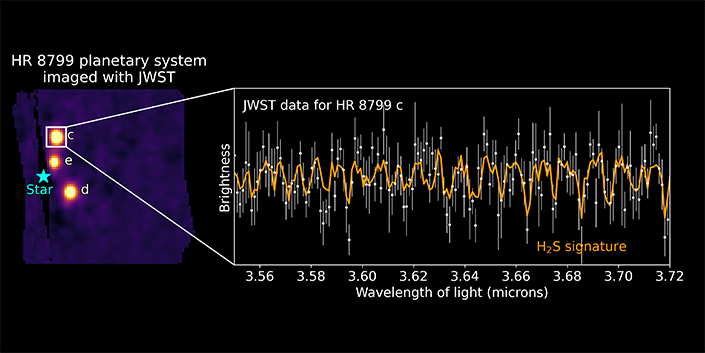
▲ This image shows the evidence JWST captured of the planets’ origins. The left panel displays three of the giant planets in the HR 8799 system; the right panel shows the “chemical fingerprint” of planet ‘c’ created by scientists. The orange curve’s fluctuations at specific points indicate the presence of hydrogen sulfide, revealing that these massive planets formed like Jupiter, by gradually accumulating rocks and ice. (Source: UCSD)
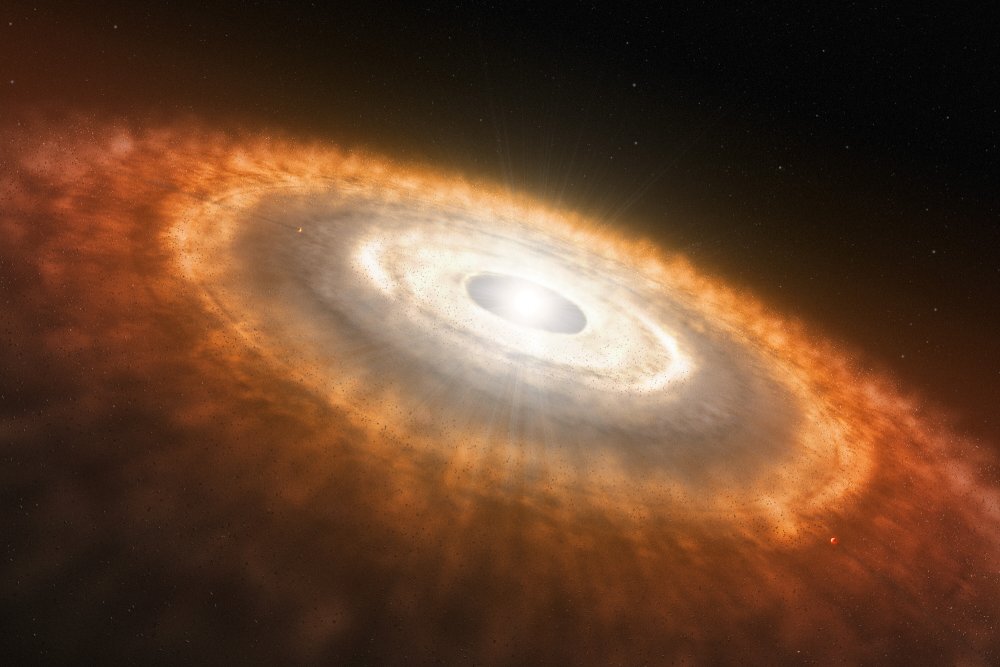
▲ An artist’s impression of a protoplanetary disk accreting nearby material. (Source: ESA/Webb)
This discovery presents a new puzzle for astronomers, as current models struggle to explain how planet-forming material could accumulate so efficiently at such a remote distance from the star. These planets are not only rich in sulfur but also uniformly abundant in carbon and oxygen, suggesting an incredibly high rate of solid material merging during their formation. The research challenges existing frameworks for planetary evolution, and scientists are currently unable to explain how the universe could assemble such super-giants with this “ultra-high efficiency” in such a sparse environment. Further exploration of similar systems is now underway to determine whether HR 8799 represents a unique case or if our understanding of how the universe creates planets is fundamentally incomplete.
(本文由 台北天文館 授權轉載;首圖為一顆氣態巨行星形成初期藝術想像示意圖,來源:ESO)
延伸閱讀:



科技新知,時時更新
