
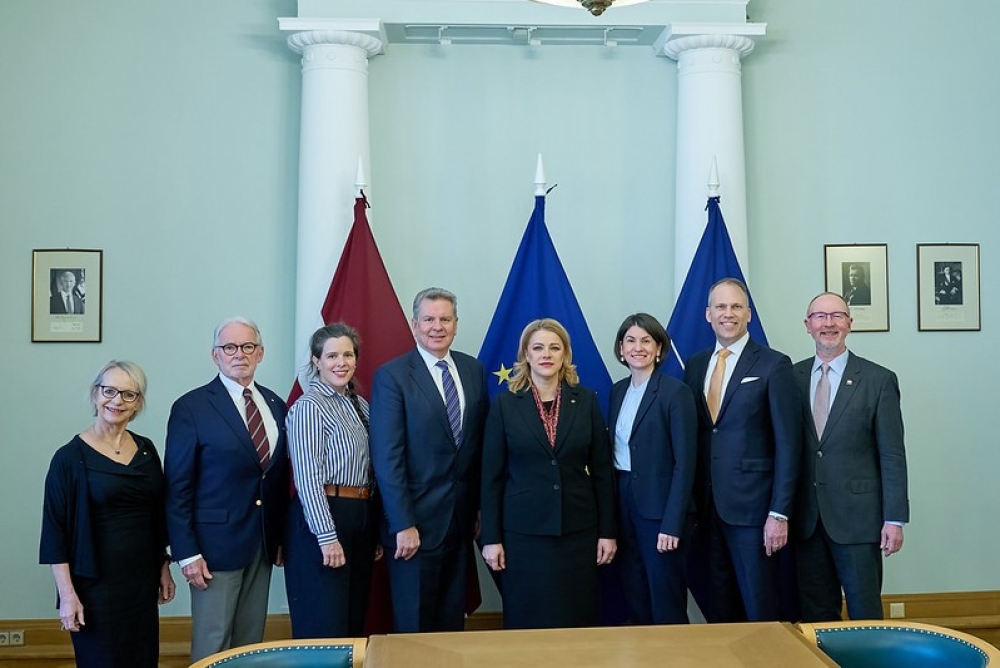
Latvian Prime Minister Evika Siliņa has called the country’s global diaspora a “cornerstone” of national security, economic growth, and state resilience, as she met with representatives of the World Federation of Free Latvians (PBLA) on Tuesday. The discussions in Riga marked a renewed push to strengthen ties with Latvian communities abroad, particularly in the U.S., Germany, Canada, Australia, and Sweden.
The meeting underscored Latvia’s strategic focus on leveraging its diaspora—one of the largest per capita in Europe—as a critical asset in an era of regional instability. With tensions simmering in neighboring Belarus and Russia’s ongoing war in Ukraine, officials say engaging expatriate communities is no longer just cultural diplomacy but a matter of geopolitical necessity.
Siliņa, who took office in September 2023, framed the diaspora’s role as multi-dimensional. “Our compatriots abroad are not just ambassadors of Latvian culture—they are active contributors to our defense, our economy, and the very fabric of our statehood,” she said during the talks. The prime minister’s office later confirmed that the discussions centered on three key areas: education, cultural preservation, and economic collaboration.
Latvia’s diaspora, estimated at over 300,000 people—nearly 15% of the country’s current population—has deep historical roots. Many fled during World War II or the Soviet occupation, settling in Western Europe, North America, and Australia. Today, these communities maintain strong cultural institutions, including schools, media outlets, and advocacy groups, which have become vital conduits for investment and political influence.
The PBLA, founded in 1955, serves as an umbrella organization for Latvian communities worldwide. Its delegates at Tuesday’s meeting represented chapters from five countries, highlighting the diaspora’s geographic reach. Although no concrete policy announcements emerged from the talks, officials indicated that future initiatives could include expanded scholarship programs for diaspora youth, joint business ventures, and coordinated advocacy efforts in international forums.
For Latvia, the timing of the outreach is significant. The Baltic nation has spent the past decade bolstering its defenses against potential Russian aggression, including hosting NATO troops and modernizing its military. Diaspora communities have played a quiet but pivotal role in these efforts, from lobbying foreign governments for support to funding domestic projects. In 2024, for example, Latvian expatriates in the U.S. And Canada raised millions for the country’s defense fund, according to government records.
The meeting too touched on cultural preservation, a long-standing priority for Latvia’s diaspora. The country’s State Archives hold extensive collections of documents, photographs, and personal records from Latvian communities abroad, chronicling everything from post-war refugee life in Germany to the establishment of cultural centers in Australia. These archives, some of which date back to the 1940s, serve as a bridge between generations, ensuring that language, traditions, and historical memory endure.
Siliņa’s engagement with the diaspora reflects a broader trend among Baltic and Eastern European nations, where governments are increasingly viewing expatriate communities as strategic partners. Estonia and Lithuania have launched similar initiatives in recent years, offering dual citizenship pathways and tax incentives to encourage economic ties. For Latvia, which lost nearly a third of its population to emigration after joining the European Union in 2004, the diaspora represents both a challenge and an opportunity.
“The strength of Latvia lies not just within our borders, but in the hearts and minds of those who carry our identity across the world,” Siliņa said. As the country navigates an uncertain geopolitical landscape, that identity—and the networks that sustain it—may prove more valuable than ever.
