
The Odéon-Théâtre de l’Europe in Paris is currently presenting a compelling juxtaposition of theatrical styles, offering audiences a study in contrasts through two distinct productions running concurrently. Marie-José Malis’s staging of Arthur Schnitzler‘s Le Voile de Pierrette and Susanne Kennedy and Markus Selg’s The Work represent divergent approaches to exploring the human psyche,one rooted in silent expression and the other in digital immersion. Critics are noting the ambitious scope of both endeavors, with early reviews focusing on how effectively each production connects-or fails to connect-with its audience, as detailed below. The productions opened December 16th and run through December 22nd.
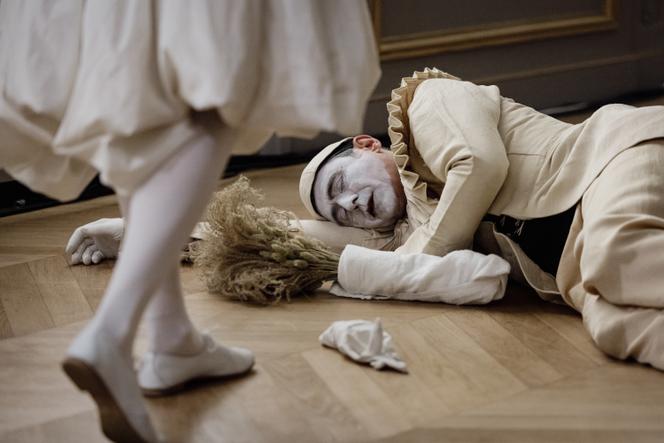
Paris’s Odéon-Théâtre de l’Europe is currently hosting two strikingly different productions. One, a silent play titled Le Voile de Pierrette, directed by Marie-José Malis and based on a work by Arthur Schnitzler, and the other, a dialogue-heavy piece called The Work, conceived by Susanne Kennedy and Markus Selg. The contrast is stark: Le Voile de Pierrette eschews technology and unfolds in the intimate setting of the Petit-Odéon, while The Work embraces modern tools—video, avatars, and immersive design—and utilizes the expansive stage of the Ateliers Berthier.
Despite their differences, both productions share a common ambition: to delve into the depths of the unconscious. While this journey proves captivating, it isn’t without its risks, particularly the potential to lose the audience along the way. That’s precisely what happens at the Ateliers Berthier, but not at the Petit-Odéon.
A meticulously performed silent pantomime, a story of thwarted love, three actors heavily made up in white, Pierrot’s wide, expressive eyes, Pierrette’s mute cry, and Harlequin’s sinister grin: Le Voile de Pierrette feels like a relic from an archaic era of performance, where primal impulses haven’t been tempered by the constraints of the superego. Marie-José Malis stages this unique work at the Petit-Odéon, its anachronistic quality creating a powerful rupture in contemporary theater. The production is a reminder of the enduring power of classic storytelling in a modern world.
Il vous reste 75.1% de cet article à lire. La suite est réservée aux abonnés.
