
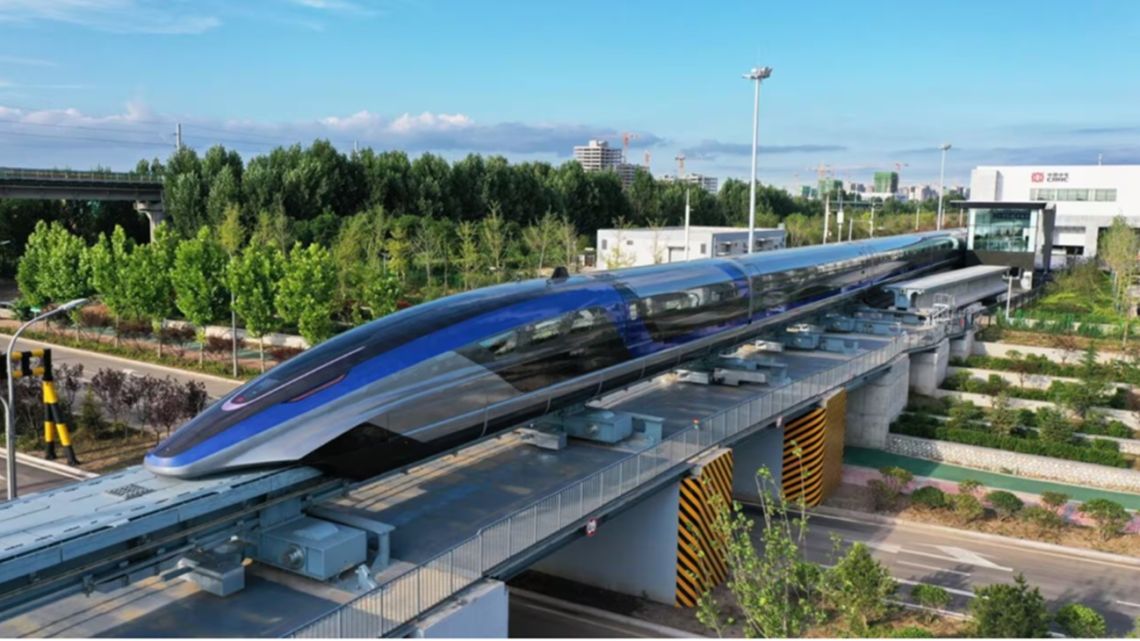
An aspiring proposal to link Buenos Aires and São Paulo with an ultra-high-speed train is gaining traction, promising to dramatically reshape travel and trade in the Southern Cone. The proposed line, utilizing magnetic levitation (Maglev) technology and potentially vacuum-tube infrastructure, aims to cut travel time between the two megacities to just one hour-a fraction of the current two-to-three hour flight. Developed by China’s CASIC, the project represents a critically important leap in ground transportation, though substantial engineering and financial hurdles remain.
A proposed ultra-high-speed (UHV) train, leveraging magnetic levitation technology, aims to revolutionize travel between Buenos Aires and São Paulo, potentially reducing journey times to just one hour. The innovative rail project relies on two key electromagnetic principles – propulsion and levitation – to eliminate rolling friction, lifting the train structure a few centimeters above the track.
Currently, air travel between the two cities takes between two and three hours, while driving is a significantly longer undertaking. This new mode of transportation could be a game-changer for business, tourism, and logistics across the Southern Cone, offering a compelling alternative to existing options.
This doesn’t sit well with authoritarians
The exercise of professional and critical journalism is a fundamental pillar of democracy. That’s why it bothers those who believe they own the truth.
If successful, the train would surpass the average speed of commercial aircraft, which, according to Aviación Mundial ATO, a pilot and aviation professional training academy, averages around 860 km/h, significantly reducing travel times.
The project represents not only a significant technical challenge, but also an ambitious engineering undertaking and a paradigm shift in ground transportation. Developing UHV systems, however, presents several key obstacles.
Reaching speeds of 1,000 km/h in a terrestrial environment introduces critical fluid dynamics challenges. At this velocity, aerodynamic drag becomes the primary impediment, increasing with the square of the speed. Utilizing a tunnel with reduced atmospheric pressure can mitigate air resistance, enabling the maintenance of extreme speeds with lower energy consumption.
Constructing infrastructure for an ultra-high-speed Maglev train requires substantial investment. The creation of a dedicated levitation track – or a system of low-pressure tubes – spanning thousands of kilometers represents the largest cost component. Such large-scale infrastructure projects often face funding and logistical hurdles.
Additional challenges include ensuring robust safety controls, evacuation procedures, and maintenance systems in the event of incidents. Specialized infrastructure also necessitates the construction of appropriate stations and access points, as well as public acceptance of this new travel alternative.
The Electromagnetic Principles Behind the Ultra-High-Speed Maglev Train
–Magnetic Levitation: The train “floats” above the track due to the repulsion between magnets positioned on both the rail and the vehicle. Once exceeding 150 km/h, physical contact is eliminated, removing mechanical friction and enabling faster acceleration than conventional rail systems.
– Low-Pressure Tunnels: By operating within a tube with reduced atmospheric pressure, air resistance is significantly decreased, facilitating the achievement of extreme speeds with lower energy consumption.
The Maglev UHV differs fundamentally from conventional high-speed trains, such as France’s TGV or Spain’s AVE, which reach speeds of up to 320 km/h.
A new model developed for drones could pave the way for aerial vehicle inspections in the future.

The development, known as T-Flight, is the work of the China Aerospace Science and Industry Corporation (CASIC). This train combines magnetic levitation with operation in low-pressure or partial vacuum tunnels.
The project represents the “frontier of transport engineering,” moving beyond high-speed rail into the realm of controlled hypersonic systems.
Sebastián Beato believes Argentina is preparing for the adoption of electric vehicles.
Magnetic Levitation Allows the Train to “Float” Above the Track
Magnetic levitation enables the train to “float” above the track through the repulsion of powerful magnets installed on both the vehicle and the rail. This eliminates physical contact at speeds exceeding 150 km/h, suppressing conventional mechanical friction and allowing for accelerations and speeds unavailable to traditional rail systems.
PM/DCQ
