
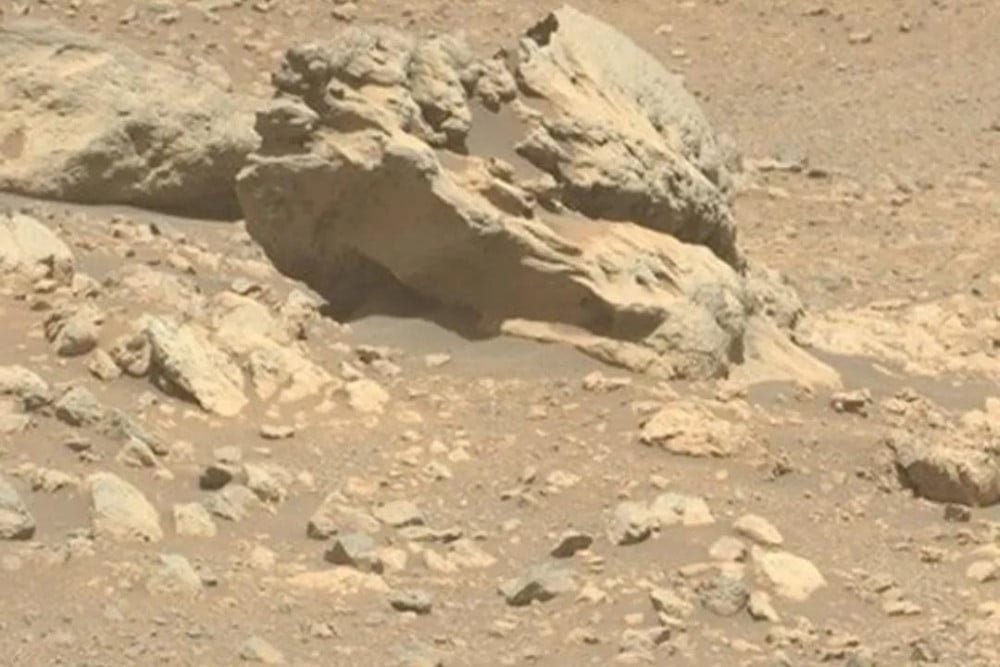
NASA’s Perseverance rover has made a potentially groundbreaking finding on Mars: a rock formation believed to have originated outside of our solar system. Teh find, dubbed “Phippsaksla,” represents a rare prospect to study interplanetary material and offers new clues about the early history of our solar system [[1]]. this marks a notable moment in the rover’s exploration of Jezero crater – a region scientists believe once held a large lake billions of years ago [[2]] – and builds on decades of robotic missions to the red planet [[3]].
NASA’s Perseverance rover has stumbled upon a peculiar rock formation on Mars that scientists believe may have originated from elsewhere in the solar system. The discovery, made on September 19th, marks a significant moment in the mission’s ongoing exploration of the red planet and offers a rare glimpse into the potential for interplanetary material to be scattered across the cosmos.
The rock, dubbed “Phippsaksla,” immediately stood out to the Perseverance team due to its unusual shape and composition. Since landing in Jezero Crater in early 2021, the rover has identified several unique geological features, including formations resembling spiderweb rocks, small skull-like structures, and turtle-like formations. However, Phippsaksla is considered one of the most striking finds to date.
The rover’s previous discoveries have already hinted at the possibility of ancient microbial life on Mars, with the identification of strange nodules within samples rich in organic materials. But until now, all rocks analyzed by Perseverance were believed to be native to Mars.
Phippsaksla was located in an area of Jezero Crater known as Vernodden during the rover’s 1629th sol. The rock measures approximately 80 centimeters in height and quickly captured the attention of the mission’s science team.
“This rock was identified as a target of interest because of its apparent sculpted shape and upright stance, which is quite different from the surrounding terrain, which is generally low, flat, and fragmented,” explained Candice Bedford, a geochemist and mineralogist at Purdue University, in a NASA statement.
Initial analysis reveals that Phippsaksla has a high concentration of iron and nickel – a combination rarely found in Martian rocks, but common in iron-nickel meteorites. This finding strengthens the hypothesis that the rock likely formed far from Mars before eventually impacting the planet’s surface millions or even billions of years ago. The discovery underscores the potential for studying such materials to reveal insights into the early solar system.
This isn’t the first time NASA rovers have encountered extraterrestrial rocks on Mars. The Spirit, Opportunity, and Curiosity rovers also discovered meteorites during their respective missions. Interestingly, Perseverance hadn’t yet identified a similar meteorite within Jezero Crater, despite the crater’s comparable geological age to Gale Crater, where Curiosity is currently exploring.
The finding highlights the ongoing value of robotic exploration in expanding our understanding of planetary formation and the potential for life beyond Earth. Mars continues to yield new clues about its past, and the Perseverance rover remains at the forefront of this exciting scientific endeavor.
