
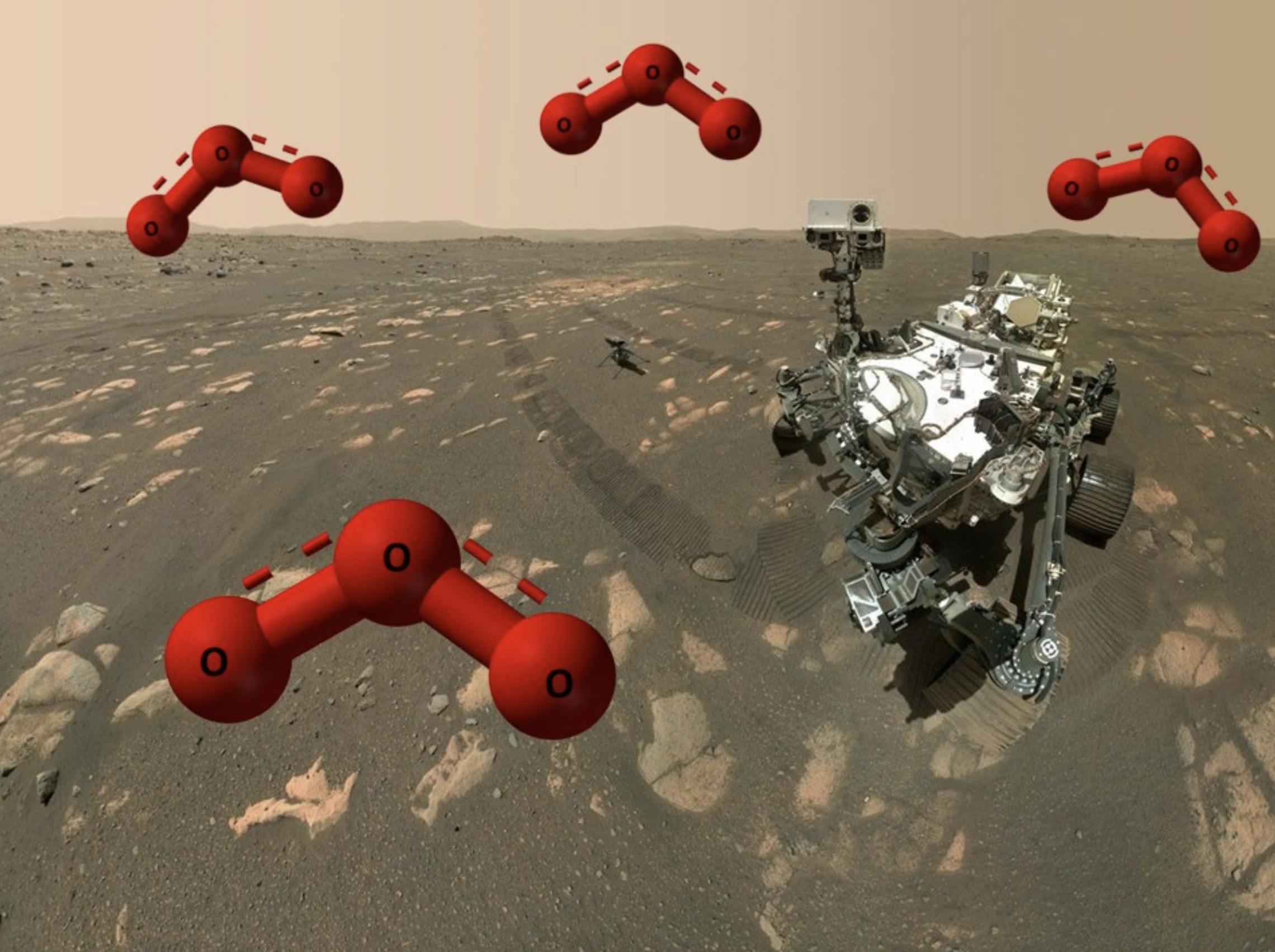
New data from NASA’s Perseverance rover is challenging existing understandings of the Martian atmosphere. In a first-of-its-kind study, researchers have detected and measured ozone levels on the surface of Mars, revealing a surprising concentration and distribution of the gas. The findings, gathered from Jezero Crater, could have significant implications for assessing the planet’s potential for past or present life and necessitate a reevaluation of current atmospheric models.
NASA’s Perseverance rover has delivered the first-ever surface-level measurements of ozone on Mars, revealing a surprising concentration and distribution of the gas in the planet’s atmosphere. The findings, led by researchers at the Spanish National Research Council (CSIC), challenge existing models of Martian atmospheric chemistry and could reshape our understanding of the planet’s habitability.
Until now, characterizing ozone levels in the lower Martian troposphere – the atmospheric layer closest to the surface where most weather phenomena occur, including dust storms – has been a significant challenge. Previous measurements from orbiting spacecraft lacked the sensitivity to detect ozone concentrations near the ground, and deploying dedicated instrumentation to the Martian surface proved difficult.
The Mars 2020 mission, which launched the Perseverance rover in July 2020, aimed to overcome these hurdles. Landing in Jezero Crater seven months later, Perseverance carried the Mars Environmental Dynamics Analyzer (MEDA), a suite of instruments including a dedicated ozone detector. This detector utilizes UV photometric observations to measure the total abundance of ozone, paving the way for more sophisticated measurement techniques in the future.
Observations from the detector in Jezero Crater registered between 0.3 and 0.4 Dobson Units (UD), a measurement where 1 UD equates to 0.01 mm of ozone thickness in the atmospheric column. While significantly lower than Earth’s ozone levels (approximately 300 UD), the Martian measurements align with data from orbiting satellites and exceed predictions from current numerical models.
Researchers combined these surface measurements with previous space-based observations to map ozone distribution in the lower troposphere. The data indicates that the majority of Martian ozone resides below 20 kilometers in altitude – a stark contrast to Earth, where 90% of ozone is found in the stratosphere, extending up to 50 kilometers. Furthermore, ozone levels below 20 km were found to be 3 to 4 times higher than model predictions.
“The data obtained casts doubt on current knowledge about the chemistry and atmospheric composition in the lower atmosphere of Mars,” said Alfonso Saiz López, a researcher at the Institute of Physical-Chemical Research (IQF-CSIC) and a co-author of the study. “It’s possible that aerosols in the atmosphere, such as Martian dust, are related to this unexpected increase in ozone, or that an unknown chemical process is occurring near the planet’s surface,” added Daniel Viúdez Moreiras, a CSIC researcher at the Center for Astrobiology (CAB) and the study’s lead author.
The findings underscore the need for systematic observations of chemical species from the Martian surface, complementing data gathered by orbiters. Future missions will require advanced instrumentation to validate the ozone observations made by the Mars 2020 mission and further unravel the complexities of the Martian atmosphere.
“Considering the latest discoveries made by both surface and orbital missions, as well as various modeling efforts, the results suggest the need for a more in-depth study of Martian atmospheric chemistry,” the researchers concluded. This research highlights the importance of continued exploration and analysis to refine our understanding of the Red Planet’s environment.
Screenshot
