
KrodersLV continues its ongoing series spotlighting emerging Latvian theater talent with a new interview featuring actor matīss Kučinskis. The series, now in its tenth year, offers a unique look into the journeys of recent graduates from Latvian universities as they navigate the competitive world of professional theater. This installment focuses on Kučinskis, a graduate of the Latvian Academy of Culture, and delves into his path from a promising young athlete to a rising star currently performing at the national Theater of Latvia.
A Conversation with Actor Matīss Kučinskis as Part of the “Actor Speaks” Interview Series
Since 2014, KrodersLV has collaborated with students and recent graduates from various Latvian universities to present an interview series featuring the newest class of dramatic theater actors in Latvia – emerging artists who have recently entered the theater world as qualified performers.
Interviews with the 2010 graduating class from the University of Klaipėda, known as the “Liepāja Course” – many of whom still work at the Liepāja Theatre – as well as the 2014 graduating class from the Mikhail Chekhov Riga Russian Theatre, and the graduating classes of the Latvian Academy of Culture from 2011, 2013, 2015, 2017, 2019, 2021, and 2022 are already available in the KrodersLV archive. These interviews feature actors who have secured positions in various repertory theaters or work as freelance artists, performing in both state and non-governmental theater productions. The first graduating class from the University of Liepāja, the “Liepāja Theatre Actor Course” (2021), is also represented, with all graduates finding work in their profession – the majority at the Liepāja Theatre, and one graduate at the Liepāja Puppet Theatre.
Despite a free market and the lack of guaranteed employment contracts, competition remains consistently high during actor auditions. Therefore, this series aims to explore the allure, prestige, and reality of the acting profession through the individual experiences of young Latvian actors, asking, to paraphrase Hamlet, WHAT DOES THE THEATER MEAN TO THEM, AND WHAT DO THEY MEAN TO IT?
This installment focuses on the graduating class of 2025 from the Latvian Academy of Culture – the so-called Elmārs Seņkovs course – who made a strong impression in the Academy’s student theater productions. Many are already working in Latvia’s largest repertory theaters in Riga and Valmiera, while others are still finding their place in the Latvian theater scene.
We met with Matīss Kučinskis on a Monday in September, a day free from rehearsals. He recently starred in the premiere of “Indulis and Ārija” and had just begun rehearsals for “Bastards,” where he plays a significant role. This conversation delves into key moments in Matīss’s life, both as an actor and as a person.
How are you feeling today?
Good, I have a day off.
What would your ideal day off look like?
I don’t get to spend much time at home with my mom and sister, so I think my ideal day would be going somewhere with them, having dinner, and spending a little time together.
Looking at information about you online, it appears you were seriously involved in sports in the past. How did you transition from sports to theater?
I played soccer in high school, and for a while, floorball – it was a mix of both, but I ended up sticking with soccer. However, I’ve always been interested in more. I watched Disney Channel, and I was really fascinated by the young actors there. Being an actor seemed appealing, but at the time, I didn’t do anything to make that dream a reality – I didn’t join theater clubs because it “wasn’t cool.” I stuck with soccer.
Everything changed in 12th grade when Krišjānis Salmiņš from the Valmiera Theatre directed our school’s talent show. He staged “Liliom,” and I was cast in the lead role – which is funny, considering he directed that play and now I’m at the National Theatre. It was a very interesting process. 12th grade wasn’t about math, English, or exam preparation; it was about learning the script, memorizing lines. I was so captivated that school became secondary, even tertiary. Many people didn’t believe I could pull it off, because I was the type to start something and quickly abandon it. But I did it, and I felt a sense of accomplishment. We performed the play, people enjoyed it, and I got a certain satisfaction from it.
Then I considered applying to the Latvian Academy of Culture, but there wasn’t an intake that year. When I told my grandparents – my grandmother and grandfather, who are very important to me – that I wanted to become an actor, they advised me to first get “a normal profession,” and then I could “act.” I enrolled in the Sports Academy, studied there for a year, and it was terrible. I felt completely out of place. Then there was a situation where I had been kicked out of high school, wasn’t in Valmiera anymore (I’m from Valmiera), and didn’t feel at home in Riga either, and on top of that, I was studying in a place where I didn’t want to be.
After that, I dropped out of the academy, and that’s when COVID started. Perfect… I went to the Culture College, but not for acting, because I thought if I was going to study acting, it would be at the Academy. I enrolled in multimedia production, studied there for a year, it was okay, but nothing special, I still didn’t feel completely fulfilled. The following summer was the audition for Elmārs Seņkovs’s course, but it was the COVID year, and we had to submit a video of ourselves reciting prose. I didn’t even really know what prose was at the time (laughs), and at first, I thought I wouldn’t even submit anything. But a friend from high school convinced me: “You’ve always wanted this – at least try!” It was the last day to submit videos, and I didn’t even submit a piece of prose; I submitted a video of myself performing a poem I had written, reciting it as if it were a song. I thought, “It is what it is.” When the results came out, it turned out I had 100% and had advanced!
The next day, I had to go to Riga and prepare prose, poetry, and a song. I found the prose online – the first thing that came up – I took the same poem I had recited in the video, and for the song, I chose “Rudens” by Prāta Vētra (“Brain Storm”). The committee didn’t even ask for the prose; I recited the poem, and then they asked me to sing. I noticed that other applicants were very shy, so I decided I had to stand out. While singing “Rudens,” I walked up to Zane Daudziņa, looked her in the eye, and sang (sings): “Kad barojām pīles…” Then I advanced, and in the final round, we were told we had been accepted. It was a very good feeling, because finally, in life, I had achieved what I had wanted. That’s a summary of my journey from sports to the academy (laughs).
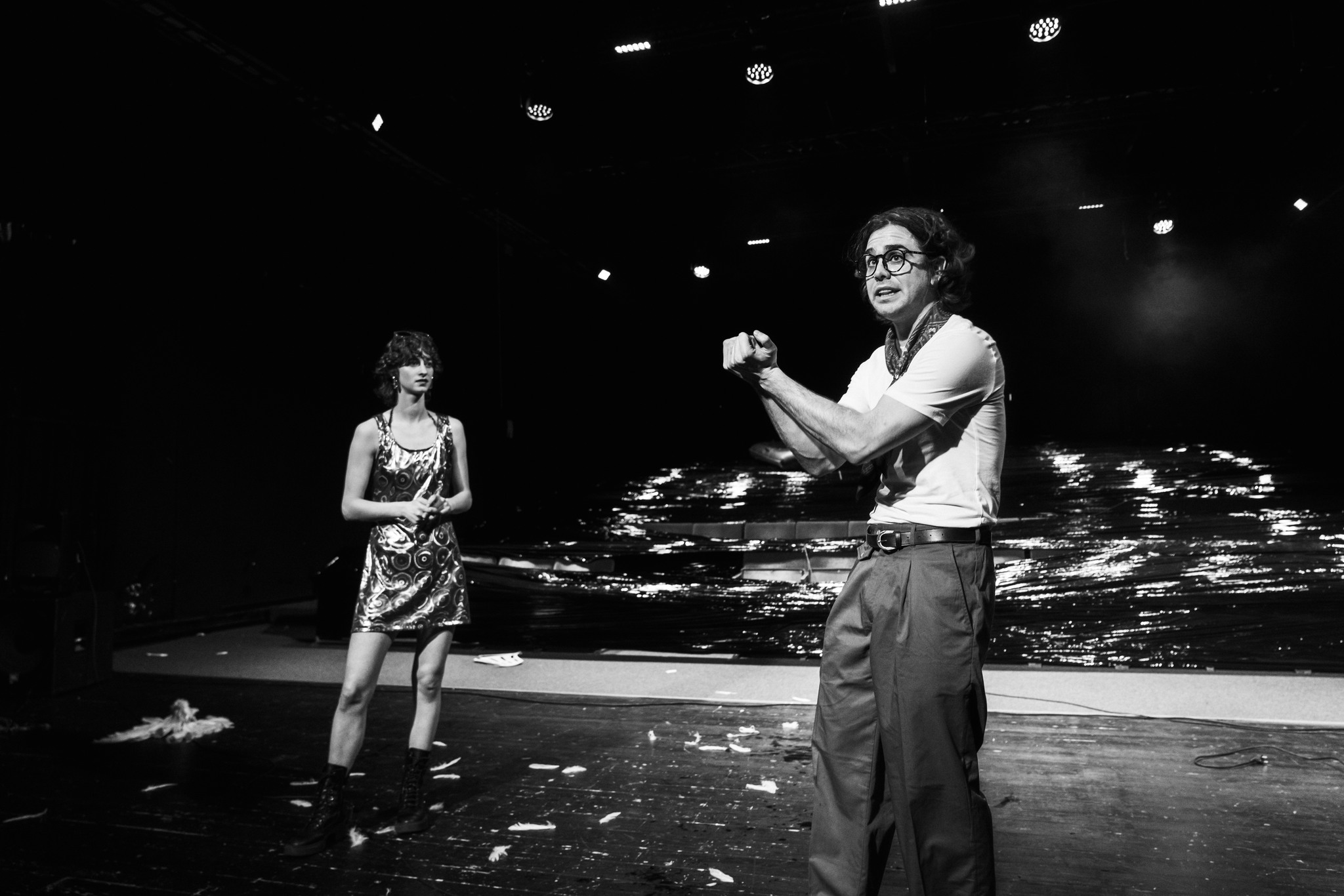
Did the skills and knowledge you gained in sports help you with your studies?
Of course, first and foremost, teamwork. We were also told at the academy that sports go hand in hand with theater. In soccer, you’re aware of your position, how you fit into the team, and in theater, you need to know how you fit into a particular production, what your role is.
Your studies were in a hybrid format?
We started in person, but then another COVID wave hit, and we worked through Zoom. We had a lot of pointless assignments to film, like how you unscrew a lens container, put the lens in, or any other actions, and then do the same thing without the object. We also focused on observation; we had to go film people and then re-film them, preferably in the same place, as accurately as possible, as if we were those people. We went with our classmates to look for observations and talk, which made us more aware of the world. In a way, it was very valuable.
What was the most valuable thing you gained from your studies, and what did it teach you about yourself?
It’s going to be cliché, but new friends, like-minded people. I can’t be compared – how I came into the academy and how I left it are completely different. We analyzed situations a lot, why things happen in life, why people act the way they do. It sounds strange, but you learn to filter the room, filter people. You also learn to hear yourself more, why I want or don’t want something. Even after the academy, I’m still thinking about who I am.
Which teachers provided more valuable insights and lessons about acting?
Of course, I worked the most with Elmārs [Seņkovs]. But in my first year, Pēteris Krilovs also taught me. There was an exercise where I walked into a room, was very upset about something, showed something. After the exercise, Pēteris said to everyone else who was watching: “Matīss thinks we’re all really stupid. He thinks we won’t understand if he just plays, instead of showing.” Then I felt like a fool myself. There was another exercise where my friend’s kitten was hit by a car, and we were taking the kitten to Riga to the vet, the doctor arrived and said the kitten had to be put down. We were playing it, playing it, but Pēteris pointed out that it could be shown very simply through physicality. We couldn’t do it, so Pēteris came up with his shoulders raised, waiting for the doctor’s answer, and after the answer, he simply lowered his shoulders. From the outside, it made everything clear to us.
Elmārs, on the other hand, “broke” me on the side of good when it came to text analysis, justifying every text. We did Blaumaņa’s “Raudupiete,” and I had a dialogue with a partner. The partner says something, it’s fine, I say my line, and Elmārs: “Stop! I don’t believe it.” And so it was with every line of mine. I didn’t understand what he wanted from me, it took a long time, but in the end, he “broke” me for the better. And a huge thank you to him for that. Then I began to understand that theater is not just the text; it’s the thought, and not just for the text, but for the character as well. We were also told that there would be many teachers, but we take something from each one, everyone has to create their own truth, because teachers only give you tools. The academy teaches you the alphabet, and then in theater, you just learn to put words and sentences together.
_1.jpg)
Speaking of your time as a student, which of the roles has stayed with you the most?
The role of Bendžamins in “Moceklis.” It was my first play, my first big role, and it was very difficult for me. It took me a long time to open my chakras, I couldn’t shake off my ingrained stereotypes. Elmārs really encouraged us to think for ourselves and offer how you want to shape the character. I waited a long time for Elmārs to offer me something, but Elmārs only offered a hand when I offered something myself. I associate it with climbing a mountain. You make a hole in the mountain, Elmārs can put his hand in there, pull you up, and then you both climb together. We had two casts for this play, and Aleksandrs Bricis played “Moceklis” in parallel; I felt like I was falling behind because the workload was so great for a role that I didn’t know where to start. Then I just sat down and wrote what happens with my character in each scene, and tried to create a character arc. That was my first so-called black work. I also thought about what props Bendžamins might have. I came up with the idea that my character writes Bible verses on his hands. We were observing young people at school, and I saw boys writing on their hands; it seemed like a kind of passion… This role was hard, I even had dreams where God came to me and yelled at me… This role made me realize that an actor’s black work is very important and that the creation of a role doesn’t end with the end of rehearsals, but continues on the way home and when you wake up in the morning.
Let’s move on to the National Theatre. You received an offer to work at the National Theatre while you were in your third year, right?
Yes, at the end of my third year.
Before that, had you thought about which theater you would like to join?
Yes, when I came to Riga, I really wanted to get to the Dailes Theatre. I think that’s what everyone wants… But during my studies, I realized that I would go to whoever really wanted to accept me into their collective, because I’m a team player. I like being part of a team, a place, a space… And I think I would be loyal to the team that chose me. It’s cozy here [at the National Theatre].
Do you remember the moment you received the offer to work here?
I got a phone call. I was at “Zirgu Pasta,” we were rehearsing a play. An unknown number called, I answered, and the [National Theatre] director invited me for coffee. I was very stunned in a good way, I didn’t know where to look. Then I went and sat down at the table where the others were, and I couldn’t contain my excitement. I told them the director had called and invited me for coffee… Everyone was happy, everyone in our class was very happy that someone had been hired [to work].
How do you feel at the National Theatre? Do you feel a sense of belonging here, considering you hadn’t planned on getting here?
Yes, it was strange at first. In my second year, Elmārs brought us here to the rehearsal room to rehearse “Moceklis” and “Māceklis,” and, as I said, the process was very difficult. At first, this place was associated with the feelings I had at that time, and those weren’t the best feelings. But time has passed, and now I really feel good here.
Which role from those you currently have feels the most “yours”?
Uģis [in “Indulis and Ārija”].
Why?
It was my first encounter with Indra Roga, my first encounter with Rainis. The process was so emotionally saturated with information coming our way. And Uģis is a very important character… I remember that during our studies, we were told that there are those who have played Indulis, those who have played Ārija, those who have played Uģis… These are some of the roles that people remember. I took this task very personally. Uģis is white is white and black is black, but that’s not all there is to him. I tried to connect him to my life, which is about searching for a father figure, about trying to equate yourself to a male figure. Later you get hurt, but Uģis continues to hold on to Indulis. For me, it’s a perpetual search for belonging.
_1.jpg)
I also wanted to talk about Uģis. Do you read reviews?
Yes, sometimes. I don’t like it, but, yes. I want to dismiss it, but I’m young, I’m interested in what others think. I don’t take it personally, but I get emotionally upset about a lot of things. I’m a dreamer, I want everything to be okay.
Henrieta Verhoustinska wrote in her review of the play: “Matīss Kučinskis sees Uģis as a seducer, as a self-thinking young man who has chosen to trust his authority – Indulis. He has a lot of playfulness and vitality.” [1] Do you agree with her?
Generally, yes. He has a lot of vitality, naiveté. Uģis is simply pure. I don’t know if such pure souls still exist in modern times. The play also has a line where Indulis says about Uģis: “A half-child, half-young man, as clear as water, / Flows like a stream in a meadow, / Like my conscience once did.” (Rainis “Indulis and Ārija”) After the play, Jānis Siliņš (theater scholar, head of the E. Smiļģa Theater Museum – Z.Z.L.) wrote to me, which he had never done before – he said that Uģis was very specific today. Then I felt a sense of peace in my heart. I haven’t spoken to Māra Ķimel yet, but it’s important to me to know her thoughts as well. Līga Ulberte also said kind words, and that reassured me. It’s always important what our course “puppet” – Elmārs – thinks, and he also gave positive feedback after this play, which always cheers me up.
Let’s talk about the play “Bastards.” What is it about? What is your role?
I’m Niks Pērle. I don’t know how much I can say (the interview took place before the premiere of the new production on November 14, 2025 – Z.Z.L). The action takes place in an elite school, where young people are raised according to specific principles, get good grades. There’s a specific system, routine, strictness, values. Niks Pērle, my character, is the best, the most highly rated on the scale, and he has an interesting relationship with his father. Niks is looking for his father’s approval, he wants his father to see him. This character in the play is about the search for freedom, self-discovery, exploration, acceptance, and not being afraid. There are so many circumstances in the world around us that sometimes prevent us from being ourselves, prevent us from expressing our opinion. I think it’s about not suppressing your personality, about not being afraid to be against the system, which sometimes tends to “press” us into what they want.
There’s a strong tradition at the National Theatre for young actors to choose their godparents. Have you found a godfather for yourself?
I have a theater godmother. I don’t know if that’s customary, but I have a theater godmother, Laura Siliņa. We started working together during my studies, but we still meet and talk about theater. Laura is my kindred spirit, and also a very good friend, she helps me a lot.
In what genre would you like to work?
I would really like to try playing theater, so I can let loose. I’m already crazy, so what will a crazy person do (laughs)?
What do you see for your future?
In the future, I want to still be at the National Theatre. I want to play in good productions. Be happy. Be among good people.
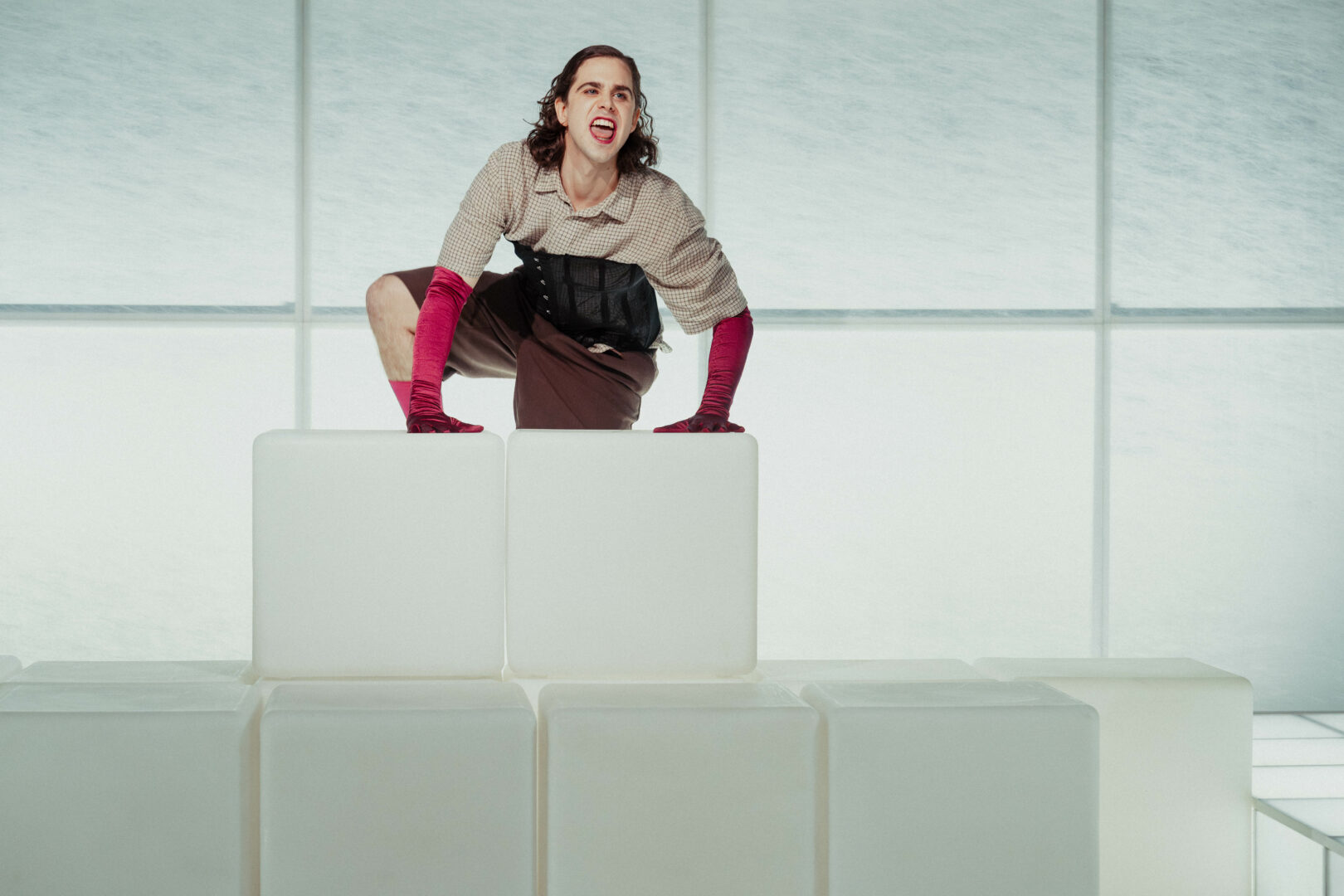
To conclude the conversation, I’ll ask a couple of quick questions. Your favorite quote from a work? The first thing that comes to mind?
Treplev’s line comes to mind (from Anton Chekhov’s “The Seagull” – Z.Z.L.): “Life must be shown not as it is, and not as it should be, but as it can be imagined in dreams.”
The best compliment you’ve received as an actor?
You smell good (laughs).
What do you do to “unwind” after an intense performance?
A cold beer.
If a viewer wants to thank you after a performance, what would you like them to bring – flowers or something else?
Wine. Red.
