

A 14th-century fresco in Kosovo is prompting debate after observers noted striking visual similarities between figures depicted alongside a Crucifixion scene and the recently studied interstellar object 3I/ATLAS. While art historians traditionally interpret the figures as symbolic representations of the sun and moon, some suggest the artwork may represent a previously undocumented observation of an unusual celestial phenomenon. the unexpected connection is fueling discussion as scientists continue to analyze 3I/ATLAS, nicknamed the “Zombie Comet” for its unexpected survival of a close solar encounter.
A 1350 fresco discovered in Kosovo depicts two winged objects in the sky alongside a Crucifixion scene, bearing a striking resemblance to modern representations of the interstellar object 3I/ATLAS. The unexpected visual parallel is sparking debate about whether the medieval artwork could represent a historical observation of an unusual celestial phenomenon.
While art historians generally interpret the figures as symbolic representations of the Sun and Moon witnessing the religious event, the objects’ aerodynamic design – including what appear to be directional jets or trails – has led some to suggest a previously undocumented observation. The discovery comes as scientists continue to study 3I/ATLAS, a comet that defied expectations by surviving a close encounter with the sun.
The Unusual Similarity in the Visoki Dečani Crucifixion
The artwork, a fresco of the Crucifixion painted around 1350 in the Visoki Dečani Monastery in Kosovo, features two oval or almond-shaped objects in the upper corners of the scene, flanking the central depiction. Traditionally, art historians have identified these as symbolic representations of the Sun and Moon, acting as witnesses to the biblical event.
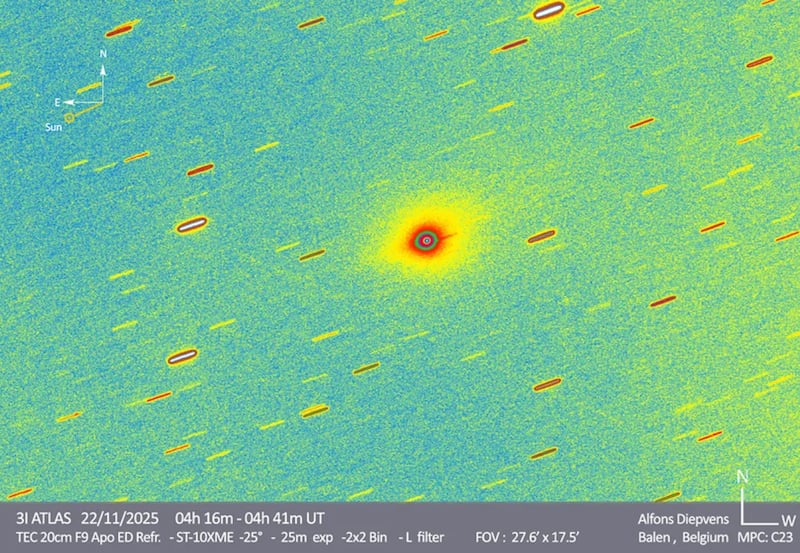
However, observers have noted a compelling alignment between the morphology of these objects and modern images of 3I/ATLAS. Key similarities include:
- Shape and Contour: The objects possess an enclosed and elongated structure with defined contours, differing from the typical disk or spherical shapes found in medieval art.
- Directional Projections: Each object exhibits projections resembling jets or gas trails, mirroring the “anti-tail” observed in 3I/ATLAS by astronomer Avi Loeb.
- Figures Within: Each of these “vehicles” contains a seated figure inside, suggesting a pilot or navigator.
Read also: ‘Zombie Comet’ 3I/ATLAS Defies Cosmic Death: Its Interstellar Core Survived Disintegration
Historical Interpretation vs. Observed Reality
The core of the debate lies in interpretation. Art historians maintain the depiction is purely symbolic and allegorical, representing celestial bodies reacting to the biblical event. However, those analyzing the similarities suggest the design more closely resembles a recorded observation. They question why the Moon or Sun would be depicted as an aerodynamic “vehicle” with a pilot and propulsion jets – a feature uncommon in medieval religious iconography.
Read also: Mystery 3I/ATLAS: Why Doesn’t the Interstellar Comet Break Apart?

The artist’s intent is crucial: the precision of the lines and posture suggest an intentionality that goes beyond symbolic necessity, more closely resembling the structures seen in high-resolution images of 3I/ATLAS today. This discovery underscores the ongoing effort to understand the origins and nature of interstellar objects visiting our solar system.
Read also: ‘Alien Spies?’ Harvard’s Hypothesis About Object 3I/ATLAS and Its Destination in Jupiter
A Mirror Through Time
This visual coincidence adds to the debate surrounding the origin of 3I/ATLAS. While the correlation is purely visual and subject to the interpretation of pareidolia, proponents of the technological hypothesis believe the appearance of a similar morphology in such an ancient context fuels the idea that these interstellar objects may have been visiting our solar system throughout history.

The lack of similar depictions in other medieval artworks adds to the mystery surrounding the fresco, prompting observers to consider whether it represents something an artist observed in the sky nearly 700 years ago.
