
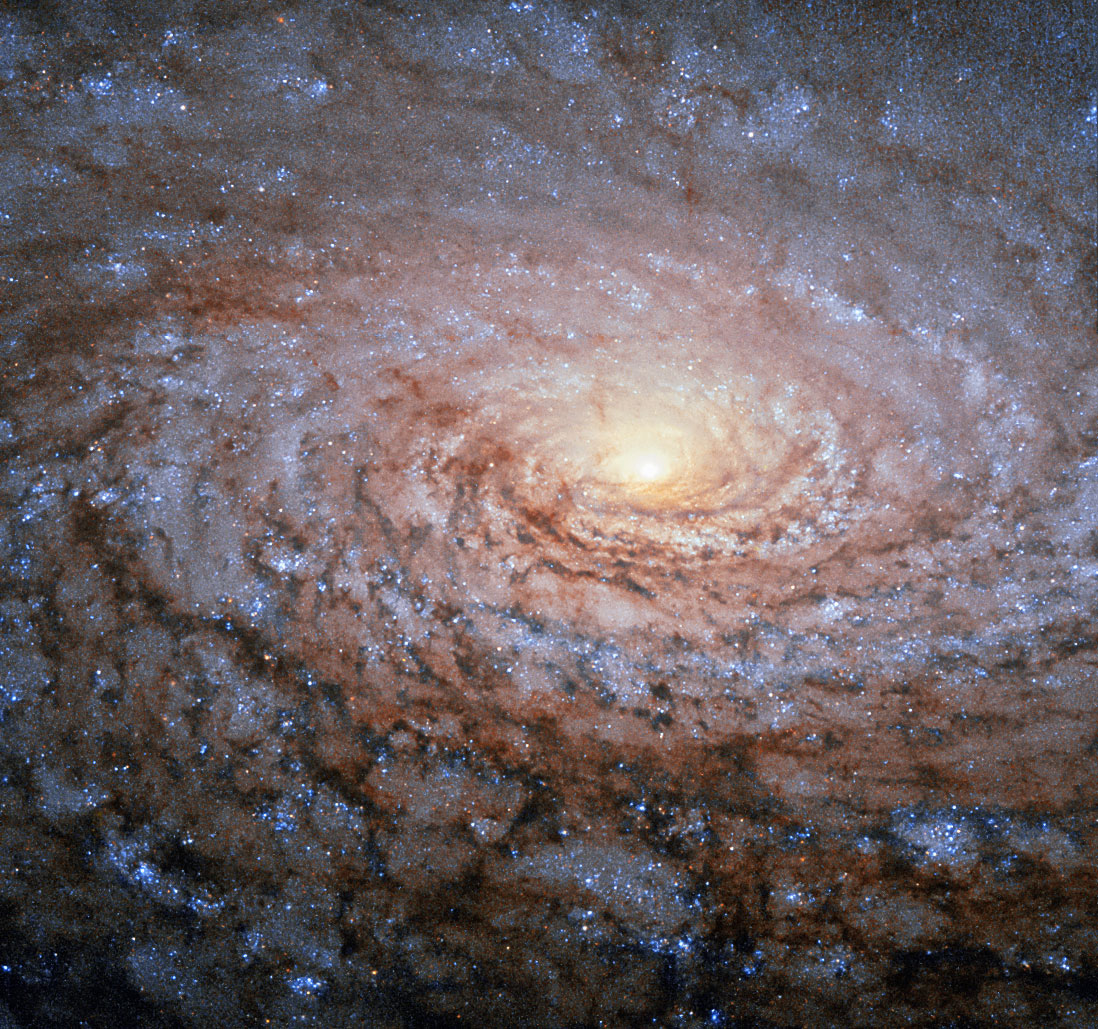
For astronomy enthusiasts and stargazers, the spiral galaxy known as Messier 63 offers a striking sight in the night sky. Located in the constellation Canes Venatici, this celestial object is commonly referred to as the Sunflower Galaxy due to the distinctive pattern of its spiral arms, which resemble the arrangement of seeds in a sunflower’s center.
First discovered by French astronomer Pierre Méchain on June 14, 1779, Messier 63 was later included as the 63rd entry in Charles Messier’s famous catalog of deep-sky objects, published in 1781. The galaxy lies approximately 27 million light-years from Earth, according to recent observations from the Hubble Space Telescope.
Classified as a flocculent spiral galaxy, Messier 63 lacks the well-defined, grand spiral arms seen in other galaxies like the Whirlpool Galaxy. Instead, its structure features many fragmented, patchy arms where active star formation occurs. These regions glow brightly due to the presence of young, blue-white stars, a characteristic clearly visible in Hubble imagery.
The galaxy spans an apparent size of 12.6 arcminutes by 7.2 arcminutes and has a visual magnitude of 8.5, making it visible through modest telescopes under dark skies. It belongs to the M51 Group, a collection of galaxies dominated by the nearby Whirlpool Galaxy (Messier 51).
Long-exposure images have revealed a faint stellar stream extending about 14 arcminutes from the galaxy’s core, suggesting past gravitational interactions. Such features provide valuable clues about galactic evolution and the dynamic history of galaxy groups.
Whereas primarily of interest to astronomers, the study of galaxies like Messier 63 contributes to our broader understanding of how stars form and how galactic structures evolve over time—processes that ultimately shape the universe we inhabit.
