
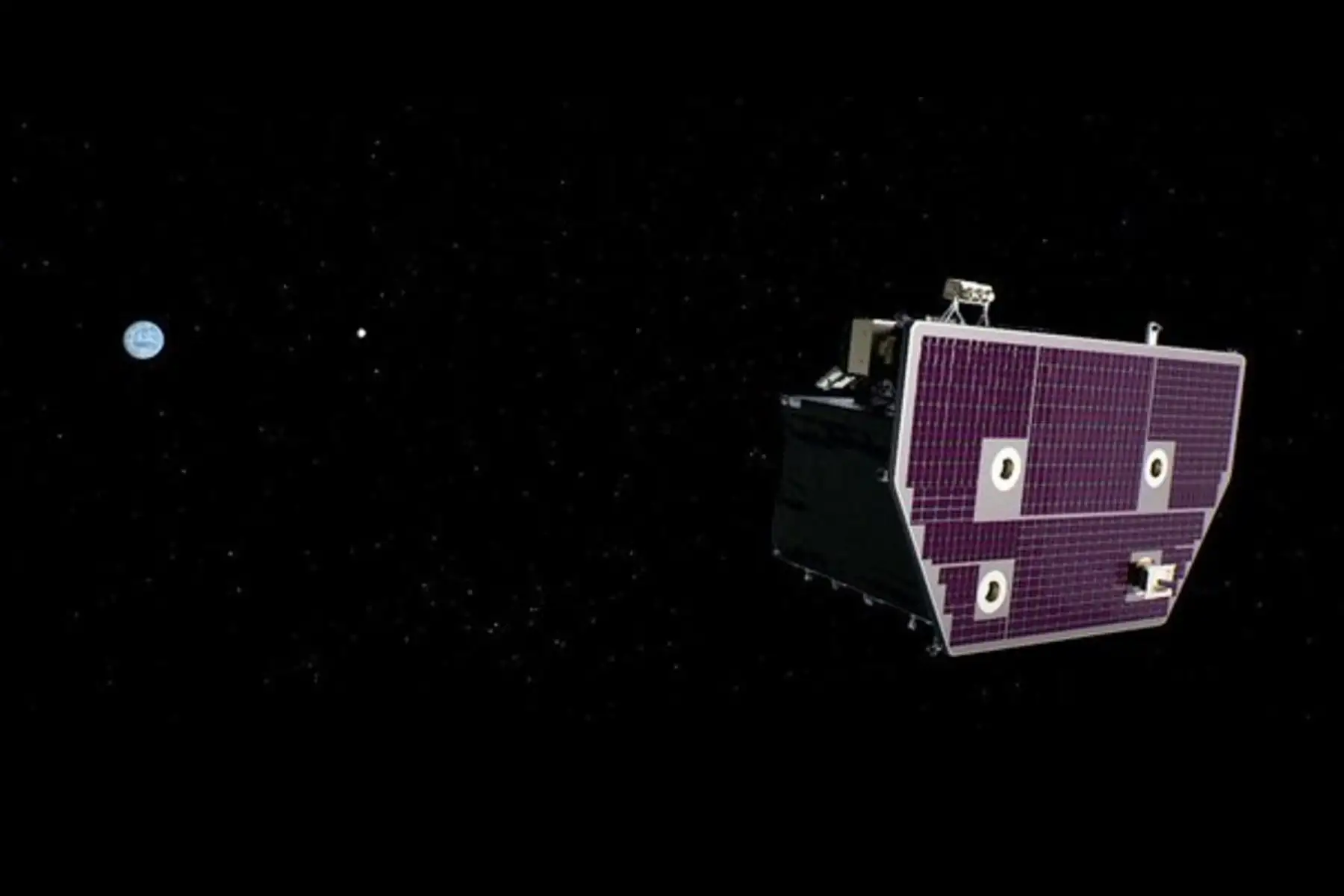
The spacecraft launched from NASA’s Kennedy Space Center on September 24, 2025, and reached its target orbit on January 8 at the L1 Lagrange point of the Sun-Earth system. From this strategic position, approximately 1.5 million kilometers (932,000 miles) from Earth in the direction of the Sun, it maintains a constant view of the exosphere.
NASA’s Carruthers Geocorona Observatory has begun its 2-year science mission. ???
From ~1 million miles away, the spacecraft is capturing the UV glow from Earth’s outer atmosphere. The data will help us understand how hydrogen (and water) from Earth escape to space. ??????
More:… https://t.co/PkSa22pK9Z
— NASA Solar System (@NASASolarSystem) March 2, 2026
In this region, hydrogen atoms emit an intense ultraviolet glow known as the geocorona when illuminated by solar radiation. To capture this phenomenon, the Carruthers Geocorona Observatory is equipped with two ultraviolet imaging instruments: a wide-field and a narrow-field imager. Both will allow for detailed records that cannot be observed with the naked eye.
The observatory’s mission
Over the next two years, the space mission will monitor how the exosphere expands and contracts in response to changes in solar activity. This will build the most comprehensive record to date of Earth’s outermost atmospheric layer.
These observations will help to understand how the upper atmosphere responds to space weather, including solar storms and fast streams of solar wind. These phenomena can affect satellites, communications, navigation signals, and other space systems essential for modern life. Understanding these interactions is crucial as our reliance on space-based infrastructure grows.
The exosphere is also the region where Earth slowly loses water to space. High-energy radiation can break down water vapor into hydrogen and oxygen. The lighter hydrogen rises into the exosphere, and some atoms gain enough energy to escape Earth’s gravity altogether.
Studying this process will allow for a comparison of Earth’s atmospheric loss with that of Mars, a planet that lost its surface water over billions of years due to a lack of a global magnetic field. This comparison will provide clues about how planets retain or lose water and how long they can maintain habitable conditions.
The observatory is named after scientist George R. Carruthers, whose ultraviolet instrument aboard the Apollo 16 mission captured the first image of the geocorona from the Moon in 1972. The current mission continues that legacy with more advanced technology and continuous observations from deep space.
???? ¡Descarga en Google Play la renovada app de Andina! https://t.co/tsQ0Psvp80
?? Integra videos, podcasts informativos y otros contenidos multimedia
??? Funciones extra: lectura en voz alta, búsqueda por voz, modo oscuro y más. ¡Ya disponible! pic.twitter.com/lgWCtjpdSk
— Agencia Andina (@Agencia_Andina) January 26, 2026
(FIN) NDP/ SPV
JRA
Publicado: 2/3/2026
