
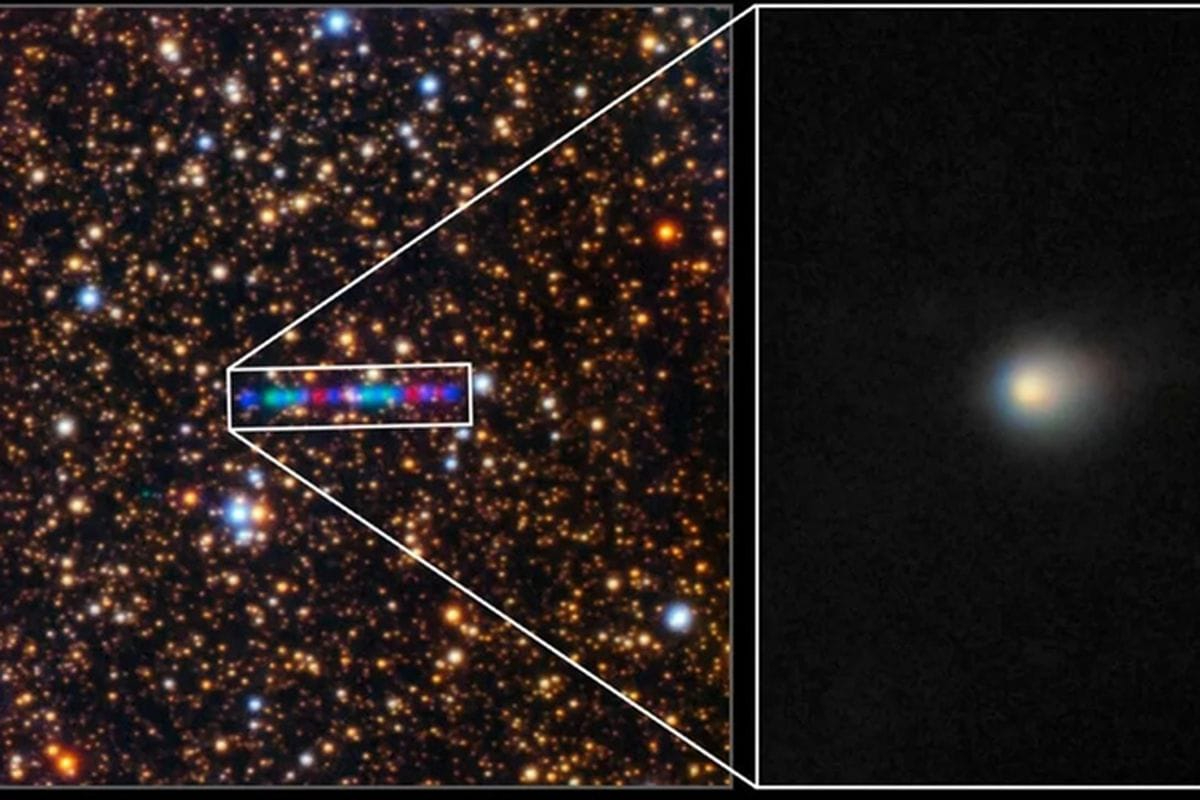
NASA’s space telescope SPHEREx has confirmed the presence of complex organic molecules in the interstellar comet 3I/ATLAS. The discovery stems from detailed infrared observations conducted in December 2025, shortly after the comet reappeared from behind the Sun.
According to reports, SPHEREx’s instruments recorded data across 102 infrared wavelengths. Analysis of the resulting spectra revealed the presence of water vapor, carbon dioxide, dust, and complex organic molecules – key components in the formation of life’s building blocks.
A Third Interstellar Object
3I/ATLAS is known as the third confirmed interstellar object to enter our solar system, following ʻOumuamua and 2I/Borisov. The comet was first detected in July 2025 by the ATLAS monitoring system.
Its trajectory is hyperbolic, indicating that the comet will pass through the solar system only once before returning to interstellar space. This limited timeframe presents a unique opportunity for scientists to study its characteristics. The detection of organic molecules in interstellar comets provides valuable insights into the potential for life beyond Earth and the origins of the chemical building blocks necessary for its development.
Increased Activity After Perihelion
Comet 3I/ATLAS reached its closest approach to the Sun (perihelion) in October 2025, at a distance of approximately 1.4 astronomical units. This proximity triggered intense activity, including bursts of gas and dust from its surface.
Follow-up observations in December showed a significant increase in brightness. Material ejected from the comet’s nucleus formed a coma, a luminous gas envelope that can extend hundreds of thousands of kilometers. In some instances, the carbon dioxide envelope exceeded 348,000 kilometers.
Detected water vapor indicates the sublimation of ice due to exposure to solar heat. Released dust reflects infrared radiation, while complex organic molecules appear in specific spectral bands.
Uncovering Ancient Material
The organic molecules discovered are complex carbon chains similar to biological precursors. These compounds are considered fundamental materials involved in the chemical processes leading to the formation of life.
This material had been frozen in the interstellar environment. As the comet passes near the Sun, heat triggers the release of elements stored for billions of years, providing a rare opportunity for scientists to study them directly. Comparing the composition of 3I/ATLAS to comets originating within our solar system reveals differences in ice proportions and material content, suggesting that interstellar objects like 3I/ATLAS retain a more primitive composition.
Source: mixvale.com.
