
San Diego-Based Nautilus Secures $28 Million to Develop Blended-Wing Airliner
Nautilus, a San Diego-based aviation startup, is aiming to disrupt the commercial airline market with a novel generation of fuel-efficient passenger aircraft. The company is among several pursuing advanced designs intended to significantly reduce fuel consumption and emissions, hoping to capture a substantial market share within the next 10 to 20 years and challenge established industry leaders like Airbus and Boeing.
Aleksey Matyushev, co-founder and CEO of Nautilus, announced Tuesday that the company has secured $28 million in funding led by Draper Associates, a firm managing over $2 billion in investment funds. Nautilus has too added a former Boeing executive to its board of directors and anticipates further key hires in the near future.
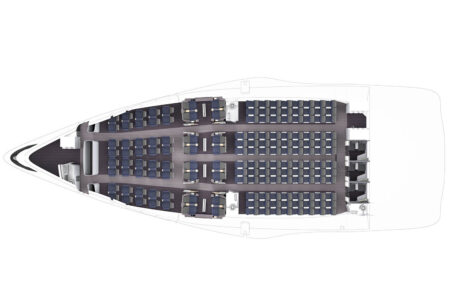
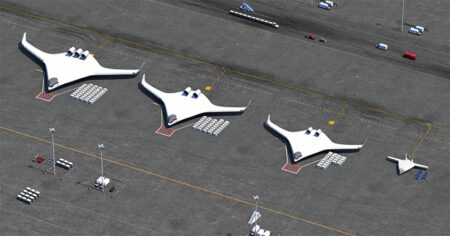
The funding comes shortly after Nautilus unveiled the designs for its Kona cargo aircraft and the Horizon, a blended-wing body aircraft designed to carry 200 passengers. The company’s initial concept stemmed from observing the limitations of current air cargo operations, where planes often don’t reach maximum weight capacity. “The explosion of Amazon and e-commerce gave us the idea to make a new aircraft that wouldn’t be limited by weight before reaching its full cargo potential, as happens today with many planes that move more cargo by volume than by weight,” Matyushev explained.
During a presentation at the company’s facilities, Matyushev stated that Nautilus intends to become “the next Boeing” and is building “a board of directors worthy of that ambition.” Among the company’s investors is former Boeing CEO Dennis Muilenburg, through his investment firm New Vista Capital.
Matyushev also suggested that Airbus and Boeing lack ambition, given their substantial order backlogs—covering years of production—and the significant costs associated with designing, developing, certifying, and building a new aircraft, which can reach billions of dollars. “There are no incentives to innovate,” he stated, estimating the cost of a new passenger aircraft at $7 billion and a cargo plane like the Kona at $250 million.
Nautilus expects the Kona to accept flight in 2028, with the Horizon following in 2029, and potential entry into service by 2030. The Horizon is based on a two-deck design, with the lower deck dedicated to cargo and the upper deck for passengers, offering a cabin 40 percent wider than that of a Boeing 737 or Airbus A321.
Matyushev reported that the company has secured purchase agreements for 580 aircraft, valued at $23 billion, with airlines including Ameriflight (U.S.), Nolinor (Canada), and SpiceJet (India).
The company also addressed competition, stating that “the more successful they are, the more successful we will be,” and suggesting that companies like JetZero, which has agreements with Delta, United, and the USAF, are not direct competitors as their blended-wing body design targets a different market segment.
Nautilus has set an initial production target of five aircraft per month and is currently seeking a location for its first factory, a 25,000-square-meter facility that will eventually expand to 325,000 square meters and employ up to 11,000 workers.
Matyushev acknowledged the challenges ahead, emphasizing the need for a location with strong transportation links and a skilled workforce. “You need local support; typically, you arrive in a city where carbon fiber has never been manufactured before,” he said.
