
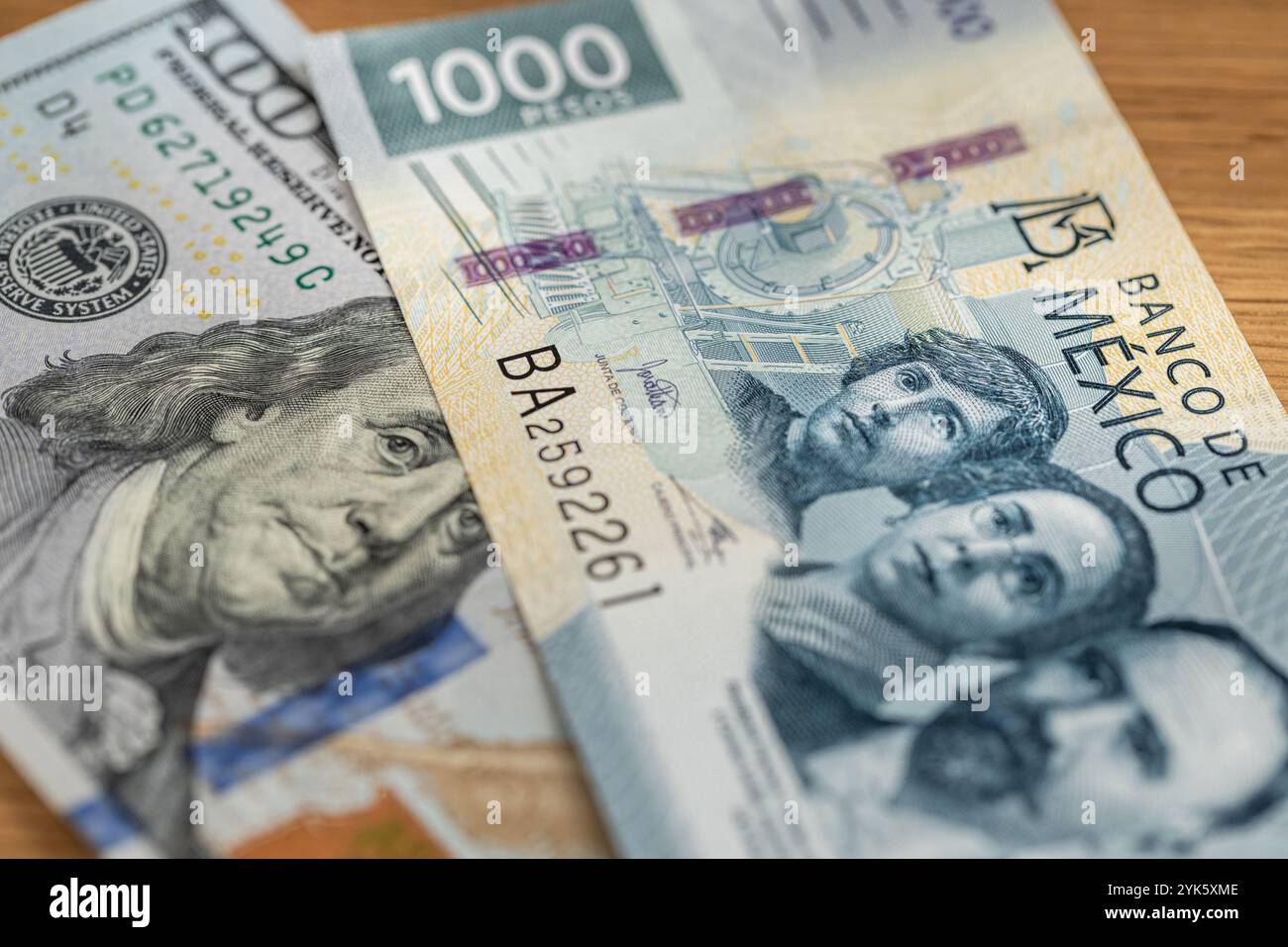
Mexico’s peso steadied in a narrow trading range on Tuesday, April 28, 2026, as investors worldwide braced for a pivotal Federal Reserve decision on interest rates later in the week. The currency’s modest movements reflected a broader wait-and-see approach across emerging markets, where central bank policies in the U.S. And beyond continue to dictate sentiment.
The Mexican peso closed at 17.4160 per U.S. Dollar, marking a slight decline of 0.23% from the previous session. While the drop was marginal, it underscored the currency’s sensitivity to external monetary shifts—particularly those from the Fed, whose upcoming announcement has become a focal point for traders. Analysts noted that even small fluctuations in the peso’s value can ripple through Mexico’s economy, influencing everything from import costs to inflation expectations.
Meanwhile, the Mexican Stock Exchange (BMV) mirrored the cautious tone, ending the day with a 1.06% loss. The benchmark IPC index slipped to 67,269.29 points, its second consecutive decline, as global markets digested a mix of geopolitical tensions and economic data. The BMV’s retreat aligned with broader sell-offs in Latin America and Asia, where investors appeared to be reducing risk exposure ahead of the Fed’s decision.
Market observers described the peso’s performance as a “stabilization within a key range,” with traders hesitant to make bold moves until the Fed’s policy direction becomes clearer. The currency has traded between 17.30 and 17.50 per dollar in recent sessions, a band that analysts view as critical for near-term stability. Any breakout from this range could signal either a renewed bout of volatility or a shift in investor confidence.
The Fed’s upcoming rate decision has taken on outsized importance in 2026, as central banks worldwide grapple with stubborn inflation and uneven economic growth. For Mexico, a rate cut in the U.S. Could ease pressure on the peso by reducing the yield gap between dollar-denominated assets and those tied to the Mexican currency. Conversely, a hawkish hold or surprise rate hike could trigger capital outflows, particularly from emerging markets where higher U.S. Rates often lure investors seeking safer returns.
Adding to the uncertainty, oil prices hovered near $100 per barrel earlier in the week following reports that the United Arab Emirates had exited OPEC. While the peso is less directly tied to oil than in past decades, Mexico’s status as a major energy exporter means that crude price swings can still influence investor sentiment and government revenue projections.
Despite the day’s mixed results—the peso’s slight dip and the BMV’s decline—some analysts suggested the market’s reaction was relatively muted given the stakes. “Investors are playing it safe,” one trader noted, “but there’s a sense that the real fireworks could arrive after the Fed’s announcement.” For now, Mexico’s financial markets appear to be in a holding pattern, waiting for clearer signals from the world’s most influential central bank.
The coming days will likely bring sharper movements, particularly if the Fed’s decision deviates from expectations. Until then, the peso and the BMV are expected to remain closely tethered to global risk sentiment, with traders keeping a watchful eye on both monetary policy and geopolitical developments.
