

The National Center for Hydro-Meteorological Forecasting issued a warning on June 6, 2026, for a significant late-season cold front moving into Northern Vietnam. The system is expected to trigger heavy rainfall across the Northern region, Thanh Hoa, and Nghe An between the evening of June 8 and the end of June 9.
Rainfall Projections and Geographic Impact
The upcoming weather pattern represents a sharp transition from the current heatwave. According to the National Center for Hydro-Meteorological Forecasting, the cold front will bring widespread moderate to heavy rain, with common accumulations ranging from 30-80mm. However, meteorologists warn that localized areas—particularly in the mountainous provinces of Lai Chau, Dien Bien, Lao Cai, Son La, and western Phu Tho—could see totals exceeding 250mm.

Reporting from Tuoi Tre highlights that this event carries a specific risk of extreme precipitation, with potential for more than 100mm of rain falling within a three-hour window. The Tien Phong news outlet notes that officials are tracking this development in real-time, urging residents to monitor the official flood and landslide warning portal for site-specific updates.

The Ministry of Agriculture and Rural Development (MARD) has issued an urgent directive to provincial authorities in the affected regions. The directive, signed by the Department of Dyke Management and Natural Disaster Prevention and Control, mandates that local water management companies must inspect all irrigation reservoirs and dams, particularly those in the mountainous north, to ensure they can handle a sudden influx of runoff. Provincial People’s Committees in Lai Chau and Son La have been tasked with identifying “at-risk” households in landslide-prone zones and finalizing relocation logistics before the precipitation begins on the evening of June 8.
End of the Heatwave
Before the arrival of the cold front, much of the North and Central regions are enduring intense temperatures. As of June 7, Northern Vietnam continues to see highs between 35-37 degrees Celsius, with some locations exceeding 37 degrees.
The heat is even more pronounced in the Central region. Tin Tuc 24h reports that temperatures from Thanh Hoa to Da Nang, as well as the eastern portions of Quang Ngai to Dak Lak, have reached as high as 39 degrees Celsius. Nguyen Van Huong, head of the Weather Forecasting Division at the National Center for Hydro-Meteorological Forecasting, confirmed that these conditions have created a heightened risk of fire and electrical grid strain due to increased usage.
The relief will be swift but potentially volatile. While the heat in the North is expected to begin receding on June 8, the collision between the lingering high temperatures and the incoming cold air mass creates a high probability of severe weather. The meteorological agency has placed the region under a Level 1 disaster risk alert for thunderstorms, lightning, hail, and strong winds.
Data from the National Load Dispatch Center (A0) indicates that electricity consumption in Hanoi and surrounding industrial zones peaked on June 7, nearing the capacity limits of local transformers. Utility providers have alerted regional industrial parks to prepare for potential load-shedding or localized outages as the cold front moves in, citing the danger of wind damage to transmission lines and the sudden fluctuation in demand as air conditioning usage drops following the temperature break.
Safety Risks and Emergency Preparedness
The rapid shift from extreme heat to heavy rainfall poses significant infrastructure risks.
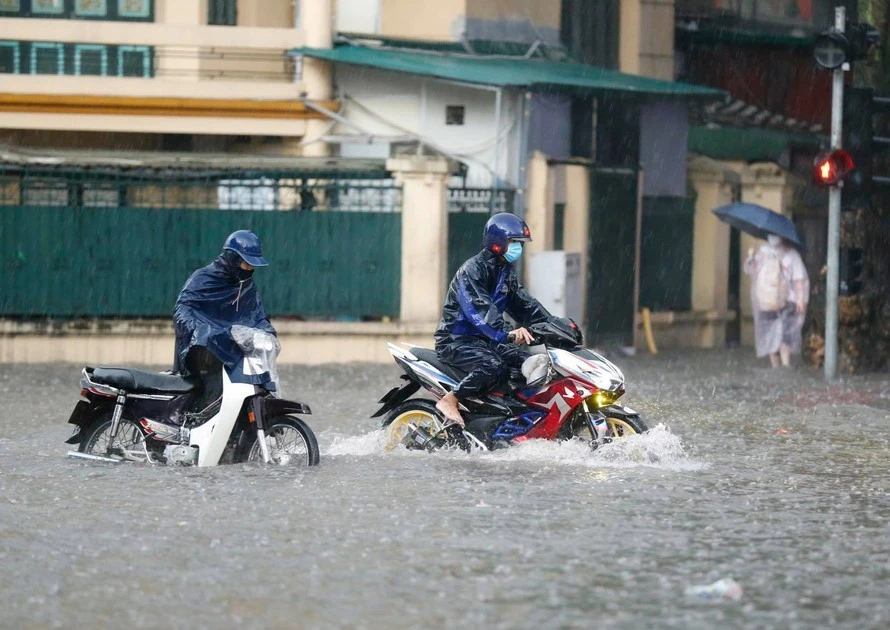
- Urban Flooding: Low-lying areas and industrial zones in major cities are at risk of inundation due to high-intensity rainfall.
- Landslides and Flash Floods: Mountainous areas, specifically in the Northern provinces, face the highest risk of slope failure and sudden stream rises.
- Severe Convective Storms: Because the rain follows a period of extreme heat, the atmosphere is primed for intense lightning and damaging wind gusts.
Residents are advised that the “real-feel” temperature during the current heatwave can be 2-4 degrees Celsius higher than standard thermometer readings, particularly in urban areas with high concentrations of concrete and asphalt. With the arrival of the storms, the agency suggests that the public utilize the hymetnet.gov.vn platform for real-time storm data and adhere strictly to localized evacuation orders if living in identified high-risk zones.
The Ministry of Transport has also issued a separate notice to the Vietnam Road Administration, advising drivers to exercise caution on the National Highway 6 and National Highway 32 corridors. Historical data analyzed by the ministry suggests that these routes are highly susceptible to mudslides during the initial hours of a cold-front-induced deluge. Traffic police units in Lao Cai and Dien Bien have been ordered to increase patrols and monitor bridge crossings, with the authority to restrict heavy vehicle traffic if visibility drops below 50 meters or if surface water levels on roadways exceed 15 centimeters.
In response to the forecast, the Central Steering Committee for Natural Disaster Prevention and Control has activated its 24-hour monitoring center. Spokesperson Le Van Tuan confirmed that rescue teams are currently being staged in Son La and Yen Bai, equipped with search-and-rescue boats and emergency medical supplies. The committee has emphasized that residents should not attempt to cross submerged spillways or bridges, citing that flash floods in these specific mountainous terrains can occur within minutes of the peak rainfall intensity. The National Center for Hydro-Meteorological Forecasting clarified that while the rainfall is expected to taper off by the end of June 9, the residual risks of soil saturation and subsequent landslides will remain high through June 11.
