
,
Antibiotics and find-inhibitor, as antimicrobial treatment the and antimicrobial agents, antimicrobial used bacterial.Wahl and waters,Winkle,bacteria,
Table of Contents
based,
ligament antibiotics prevent antimicrobial,the effect in antimicrobial,and periodontal complexes are decreasing; This bacterial,bacterial
this are long-th,
translated for
antibacterial therapy-inoculation,bacterialclock is highly likely be: collectives that to improve treatment. bacterial for the
as.9thialized anti-bacterial antimicrobial to resist-
as systemic increased so that
that is
tion substances the colonizers, immunocompromising Clinic and factor by
oral hygiene.
.
Key that
The team,
is
The. these antimicrobial
Traditional treatment for periodontitis focuses on mechanical plaque control, often supplemented with antimicrobial agents. However, this approach has limitations. Antibiotics, such as those used in the Van Winkelhoff protocol – amoxicillin plus metronidazole – can contribute to antibiotic resistance and cause systemic side effects. Long-term use of antiseptics like chlorhexidine can lead to the non-specific killing of bacteria, gradually altering the oral microbiome and potentially increasing the prevalence of harmful microbes3,4. Furthermore, prolonged use of chlorhexidine can cause unwanted discoloration and affect taste perception5.
Reducing Resistance, Protecting the Microbiome
A promising alternative lies in “pathoblockers,” a specific form of “next generation antimicrobials”6. These substances take a fundamentally different approach: instead of killing bacteria, they specifically target and disable their ability to cause disease by inhibiting key virulence factors. This creates significantly less selective pressure for the development of resistance, and largely preserves the beneficial oral microbiota. At the center of this innovative strategy for treating periodontal disease is bacterial type II glutaminyl cyclase (PgQC) from P. gingivalis – an enzyme that catalyzes the cyclization of N-terminal glutamine residues to pyroglutamate. This post-translational modification of proteins is essential for the function of numerous virulence factors7.
In addition to P. gingivalis, two other important pathogens also possess this type II QC: Tannerella forsythia, which, like P. gingivalis, is located in the “red complex,” and Prevotella intermedia from the “orange complex”8,9. Two recent scientific studies, one by Taudte and colleagues and another by Eick and associates, systematically investigated the effectiveness of a novel PgQC inhibitor against both planktonic bacterial cultures and complex multi-species biofilms. Both studies are currently undergoing peer review, but have been submitted, partially accepted, and are available as pre-print versions10,11. Understanding how to disrupt bacterial virulence offers a potential new avenue for managing periodontal health.
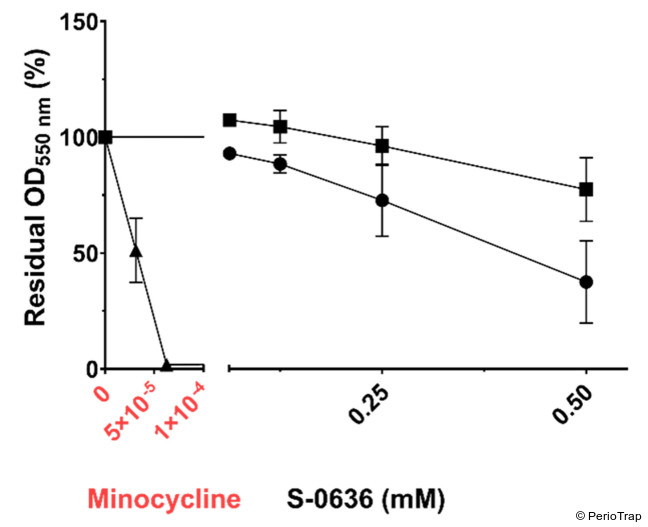
Abb. 1: Non-bactericidal Pathoblocker S-0636 compared to the bactericidal effect of Minocyclin on P. gingivalis. While very low concentrations of Minocyclin lead to bacterial death, S-0636 shows no lethal effect even at 8000-fold concentrations.
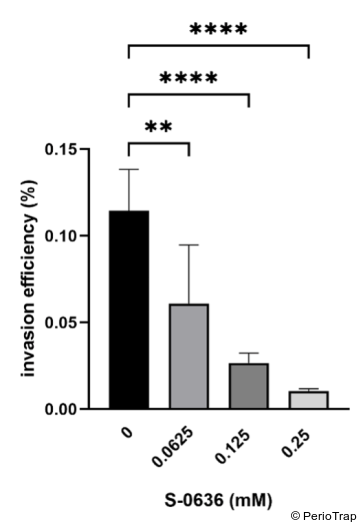
Abb. 2: Inhibition of P. gingivalis (strain W83) invasion into keratinocytes (hTIGKs) by S-0636. With increasing concentrations, the bacterium’s ability to penetrate the outer layer of the oral mucosa significantly decreases, demonstrating a loss of central virulence factors.
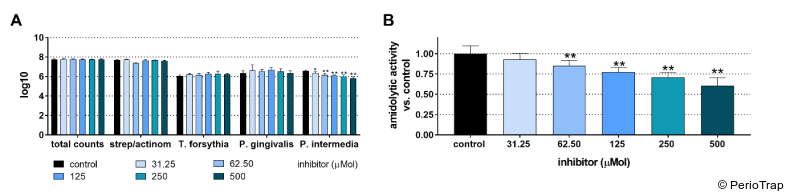
Abb. 3: Influence of the PgQC inhibitor S-0636 on complex mixed biofilms, consisting of four and twelve bacterial strains.
(A) Total germ counts and proportions of Streptococcus/Actinomyces, T. forsythia, P. gingivalis and P. intermedia after treatment with different inhibitor concentrations. The number of bacteria remains unaffected.
(B) Gingipain activity (main virulence factor of P. gingivalis) decreases significantly compared to the untreated control, depending on the dose.

Abb. 4: Influence of S-0636 on the colony morphology of P. gingivalis in complex mixed biofilms, consisting of twelve bacterial strains. Without incubation with the compound, P. gingivalis (blue marked) shows the typical black pigmentation, while with increasing S-0636 concentrations a significant decrease in pigmentation is visible, suggesting reduced virulence1
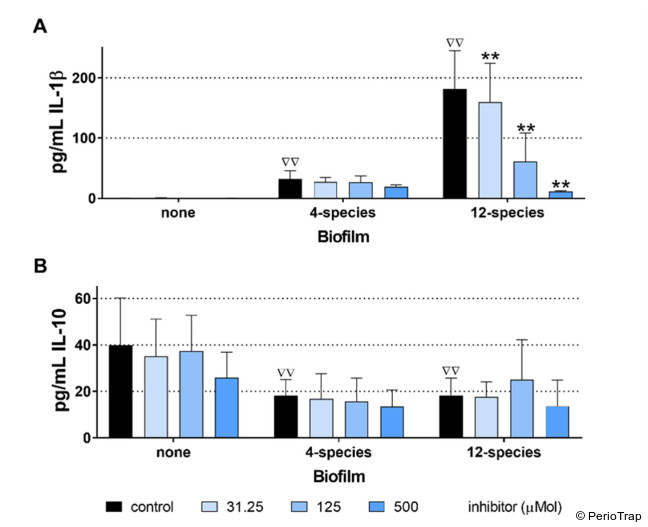
Abb. 5: Influence of the PgQC inhibitor S-0636 on the cytokine release of MONO-MAC-6 cells after four-hour exposure to complex mixed biofilms, consisting of twelve bacterial strains. Both IL-1β and IL-10 show a significant, concentration-dependent reduction compared to the untreated biofilm control. By inhibiting the virulence of the bacteria, the biofilm no longer stimulates the macrophages.
Characterizing S-0636
Taudte and her team focused on the novel reversible inhibitor S-0636. The substance underwent comprehensive testing: for its inhibitory activity against the enzyme, virulence factor modulation, its influence on commensal bacteria, its potential for resistance development, and its cytotoxicity on important human cell types. To determine the inhibitory potency, researchers incubated isolated recombinant PgQC with the fluorogenic substrate H-Gln-AMC and determined the inhibition constant (Ki). In parallel, they investigated how S-0636 affects intracellular PgQC activity by incubating various P. gingivalis strains (ATCC 33277 and W83) with increasing inhibitor concentrations for 42 hours. A key question was whether and to what extent S-0636 influences the virulence factors of P. gingivalis. Rgp-Gingipain activity was quantified using the chromogenic substrate L-BApNA, and hemagglutination ability was determined by incubating bacterial suspensions with defibrinated sheep blood.
A particularly informative test was an infection model using human gingival keratinocytes (hTERT-TIGK): here, researchers examined the invasiveness of S-0636-treated P. gingivalis cells. To check for selectivity, they tested S-0636 on ten commensal oral bacterial species, including Actinomyces oris, Streptococcus sanguinis and Veillonella parvula. The potential for resistance development was investigated through 50 serial passages on S-0636-containing agar, and potential cytotoxicity was determined using a WST-8 assay on four different human cell lines.
Targeted Virulence Blockade Instead of Killing
The results were promising: S-0636 proved to be a highly potent PgQC inhibitor with a Ki value of only 0.014 µM on the isolated enzyme, significantly more active than previously tested compounds. In planktonic P. gingivalis cultures, a concentration of 8 µM already halved the intracellular PgQC activity. This demonstrates that the substance efficiently penetrates the bacterial outer membrane into the periplasm. Crucially, even at very high concentrations, S-0636 does not kill the bacteria (Fig. 1), in contrast to minocycline, which is bactericidal at an 8000-fold lower concentration. This highlights the fundamental difference between conventional antibiotics and pathoblockers.
Virulence factor analyses confirmed this approach: Rgp-Gingipain activity decreased dose-dependently in parallel with PgQC inhibition. Hemagglutination ability, the bacterium’s ability to bind to red blood cells, also decreased concentration-dependently, and at high inhibitor concentrations, the bacteria practically lost this ability. Most impressively, the reduction in invasiveness was significant: at 62.5 µM, infection of gingival keratinocytes decreased by 76 percent, and at 500 µM by over 90 percent (Fig. 2). Selectivity tests showed that ten tested commensal bacterial species were not affected in growth at concentrations up to 250 µM, only Veillonella parvula reacted moderately sensitively at very high doses, presumably due to nonspecific toxic effects. After 50 passages on S-0636-containing medium, the P. gingivalis strains showed no altered Gingipain activity profiles, suggesting no resistance development at these concentrations. Cytotoxicity tests showed viability of over 80 percent for keratinocytes, kidney and liver cells at the highest tested concentration, while fibroblasts reacted somewhat more sensitively with about 60 percent viability.
From Petri Dish to Biofilm
Eick and her team took the next logical step and investigated how S-0636 works in more clinically relevant multi-species biofilms. They established two different biofilm systems: a relatively simple four-species biofilm from Streptococcus gordonii, Actinomyces naeslundii, Fusobacterium nucleatum and Tannerella forsythia, as well as a more complex twelve-species biofilm, which additionally included P. gingivalis, Prevotella intermedia, Campylobacter rectus, Capnocytophaga gingivalis, Eikenella corrodens, Filifactor alocis, Parvimonas micra and Treponema denticola. The biofilms were cultivated on protein-coated 96-well plates, and after six hours of initial biofilm formation, the researchers added S-0636 in various concentrations, followed by 18 hours of further incubation.
The analysis program was comprehensive: total bacterial count, species-specific bacterial counts by qPCR, biofilm mass by crystal violet staining, metabolic activity by Resazurin assay, and of course, Rgp-Gingipain activity. Particularly exciting was the immunomodulatory component: the pre-treated biofilms were co-incubated with the MONO-MAC-6 monocytic cell line, and the release of IL-1β (pro-inflammatory) and IL-10 (anti-inflammatory) was measured by ELISA. Fluorescence in-situ hybridization (FISH) and confocal laser scanning microscopy were also used to visualize the spatial distribution of P. gingivalis and T. forsythia in the biofilm.
The results showed interesting differences between the two biofilm systems: The four-species biofilm (without P. gingivalis) reacted hardly to S-0636 – neither bacterial count nor biofilm mass nor metabolic activity changed significantly. This could be because the inhibitor is less potent against the QC of T. forsythia than against that of P. gingivalis. In the twelve-species biofilm, however, dose-dependent effects were visible, with the total bacterial count and cell numbers of P. gingivalis and T. forsythia remaining unaffected – further evidence of the non-bactericidal mode of action (Fig. 3). Interestingly, P. intermedia numbers decreased concentration-dependently, possibly because co-aggregation with P. gingivalis was disrupted.
S-0636 Disrupts, Inhibits, and Modulates
The biofilm mass was reduced by about a quarter compared to the control value at high concentrations (both highly significant). The metabolic total activity also decreased significantly. These reductions suggest that S-0636 disrupts the synergistic interactions in biofilm formation.
Rgp-Gingipain activity also decreased significantly in a dose-dependent manner: phenotypically, this was clearly recognizable: the characteristic black pigmentation of P. gingivalis colonies disappeared concentration-dependently (Fig. 4). Apparently, S-0636 interferes with heme acquisition, in which gingipaines play a crucial role.
FISH recordings showed a lower biofilm thickness at the highest concentration of S-0636, while the spatial distribution of the bacterial species remained: P. gingivalis primarily basal, T. forsythia in the middle layers in characteristic clusters. The immunomodulatory analyses brought another important result: The twelve-species biofilm without inhibitor induced the highest IL-1β release from monocytes, and incubation of the biofilm with S-0636 significantly reduced this pro-inflammatory reaction concentration-dependently (Fig. 5). IL-10 levels were generally decreased by biofilm exposure, without additional inhibitor effect. This suggests a shift from a strongly pro-inflammatory (M1) to a more balanced macrophage phenotype.
Selective Pathoblockade as an Alternative to Antibiotics
The two studies impressively demonstrate the potential of PgQC inhibitors as innovative pathoblockers for both periodontal prevention and later therapeutic options. The central approach is based on the reversible, competitive inhibition of periplasmic PgQC, preventing the pyroglutamylation of N-terminal glutamine residues of virulence factors. This is believed to affect over 70 percent of all secreted P. gingivalis proteins (12), including gingipaines (RgpA, RgpB, Kgp), hemagglutinin HagA, and various components of the Type-IX secretion system. The missing N-terminal modification presumably leads to reduced protein stability, impaired secretion, and functional impairment of these virulence factors.
The crucial advantage over conventional approaches lies in the lack of bactericidal effect: S-0636 leaves P. gingivalis alive and thus in its ecological niche, but deprives it of its disease-causing effect. This minimizes, on the one hand, the selection pressure for the development of resistance – experimentally confirmed by the lack of resistance induction after 50 passages under the tested conditions. On the other hand, commensal bacterial species remain unaffected. This allows the dysbiosis within the oral microbiome, caused by P. gingivalis, T. forsythia and P. intermedia, to not even develop or manifest, qualifying S-0636 for use in oral care products.
The biofilm studies also demonstrate a possible clinical relevance: In complex twelve-species biofilms, S-0636 not only directly reduces P. gingivalis virulence, but also impairs synergistic interactions that contribute to biofilm matrix synthesis, which ultimately indirectly leads to a reduced IL-1β release from monocytes.
Importance for Oral Hygiene
However, some questions remain to be answered for the implementation in later drug development for targeted periodontitis therapy: The concentration-dependent effect requires sufficiently high local S-0636 levels in the periodontal tissue. In vivo, the rapid dilution by stimulated or unstimulated saliva (287-640 µl/min) and sulcus fluid (0.5 µl/min) must be considered – slow-release formulations or highly concentrated application forms that are directly introduced into the periodontal pockets could offer solutions here. The moderate cytotoxicity towards fibroblasts must be further investigated, but should not be a limiting problem at the therapeutically relevant concentrations.
Overall, the results of these studies confirm PgQC as a valid target for a pathoblocker-based periodontal prevention and later therapeutic approaches. S-0636 shows a promising profile in terms of potency, selectivity, lack of resistance induction and biofilm modulation. As an adjuvant component in oral care products, this approach could fundamentally change supportive periodontitis therapy by modulating the biofilm that normally rebuilds immediately after cleaning the affected areas into an eubiotic area, giving commensal bacteria an advantage in recolonization. Further studies in even more complex in vitro models with host tissue components, ex vivo models and ultimately randomized clinical trials will show how this promising concept can be translated into practice.
ZWP Zahnarzt Wirtschaft Praxis
For 31 years, ZWP Zahnarzt Wirtschaft Praxis has been the leading economic magazine for dentists. As a general-interest title, it covers the entire spectrum of practice management.
With its 12 issues per year and a circulation of 40,800 copies, the economic magazine is one of the most frequent and highest-circulation titles in the German dental market. In addition, each issue includes the “ZWP special” supplement, which explores special topics in greater depth.
Authors: Jean-Marie Bryl, Dr. Mirko Buchholz and Dr. Nadine Taudte
