
Qualcomm is bolstering its mobile processor lineup with the release of two new chips designed to meet diverse market demands. The company unveiled the Snapdragon 6s 4G Gen 2,aimed at extending the life of 4G technology,and the Snapdragon 4 Gen 4,bringing 5G connectivity to more affordable smartphone options. These launches reflect a strategic move by Qualcomm to address both continued demand for 4G devices-notably in emerging markets-and the increasing prevalence of 5G networks globally, with shipments of the new chips expected in 2025.
Qualcomm is quietly expanding its chipset offerings with two new processors: the Snapdragon 6s 4G Gen 2 for 4G devices and the Snapdragon 4 Gen 4, a new entry-level 5G solution. The move comes as 5G connectivity becomes increasingly standard in smartphones, but demand for more affordable 4G options remains strong, particularly in emerging markets.
Despite the rapid adoption of 5G, Qualcomm anticipates a continued market for 4G smartphones, especially in the entry-level segment and regions where 5G infrastructure is still developing. The introduction of these chips reflects a strategic effort to address diverse market needs and extend the lifespan of 4G technology.
The Snapdragon 6s 4G Gen 2 boasts a CPU clocked up to 2.9 GHz, representing a reported 51% performance increase over the previous generation. Its Adreno GPU is also said to be 20% faster, supporting displays with resolutions up to 1080p+ and refresh rates of 120Hz.
Built on a 6nm process – a step up from the 11nm process used in the previous generation – the chipset supports up to 8GB of LPDDR4X RAM at speeds up to 2.133 MHz and UFS 2.2 internal storage. It also features USB 3.1 connectivity and Qualcomm’s Quick Charge 3 technology, which the company claims can deliver an 80% charge in 35 minutes, though testing parameters weren’t specified.
The Snapdragon 6s 4G Gen 2 also features a triple 12-bit ISP capable of simultaneously processing images from three cameras (13MP+13MP+5MP) or two cameras (16MP+16MP) with zero shutter lag. It supports HEIC photo and HEVC video recording, capped at 1080p at 60fps. Connectivity includes a 4G LTE modem with download speeds up to 390 Mbps and upload speeds up to 150 Mbps, along with Wi-Fi 5 (ac, dual-band) and Bluetooth 5.2 with aptX Adaptive.
For positioning, the chipset offers dual-band GPS, alongside GLONASS, Galileo, BeiDou, QZSS, and NavIC. Qualcomm’s sensor-assisted positioning technology is also included, aiming to improve accuracy in automotive and pedestrian navigation scenarios.
Snapdragon 4 Gen 4: Bringing 5G to Entry-Level Devices
The Snapdragon 4 Gen 4 brings 5G connectivity to more affordable smartphones, featuring a sub-6GHz Rel. 16 (SA and NSA) modem capable of download speeds up to 2.5 Gbps and upload speeds up to 900 Mbps. However, like its 4G counterpart, it utilizes Wi-Fi 5 (ac, dual-band) and Bluetooth 5.1 with aptX for local connectivity, and offers the same positioning support as the Snapdragon 6s 4G Gen 2.
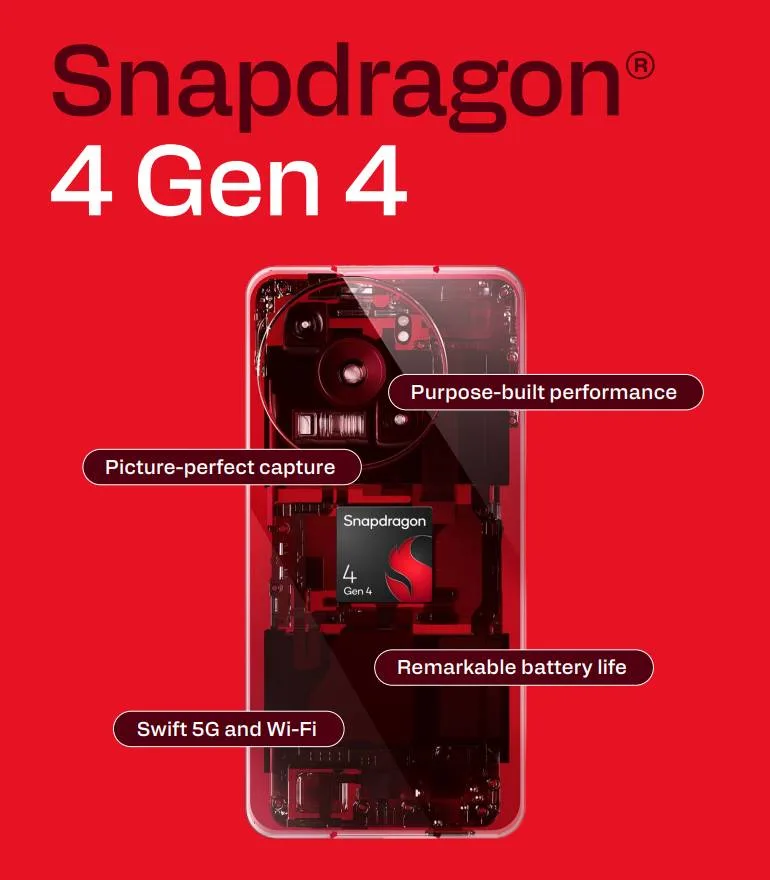
Manufactured using a more modern 4nm process, the Snapdragon 4 Gen 4 features an octa-core CPU with two Kryo cores clocked up to 2.3 GHz and six cores clocked up to 2.0 GHz. Its Adreno GPU supports displays up to 1080p+ with a 120Hz refresh rate.
The chipset supports both LPDDR4X and faster LPDDR5 RAM (3.200 MHz), as well as UFS 3.1 (2-lane) storage. It connects via USB 3.2 Gen 1 and supports Qualcomm’s Quick Charge 4+ technology, promising a 50% charge in 15 minutes.
Like the 6s 4G Gen 2, the Snapdragon 4 Gen 4 can handle a 108MP camera, but features a dual 16MP ISP with zero shutter lag. Video recording is limited to 1080p at 60fps. Notably, neither of the new chipsets supports AV1 video decoding.
Smartphones powered by the Snapdragon 6s 4G Gen 2 and Snapdragon 4 Gen 4 are expected to become available next year, according to GSMArena. This dual launch strategy underscores Qualcomm’s commitment to serving a broad spectrum of the mobile market as 5G adoption continues to evolve.
