
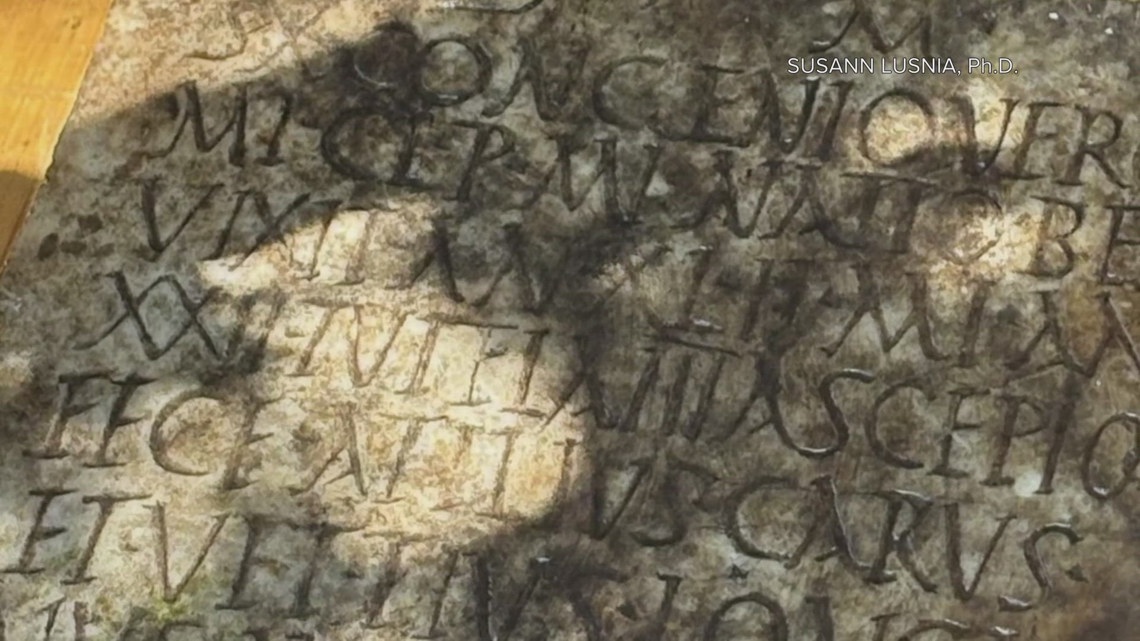
2nd-Century Roman Tombstone Discovered in New Orleans Backyard, Sparks International Investigation
A nearly 2,000-year-old marble tombstone, missing from an Italian museum since World War II, has been unearthed in a New Orleans backyard, prompting an international effort to return the artifact to its rightful home.
The discovery occurred last spring when Dr. Daniella Santoro and her husband were clearing overgrown vines from their Riverbend property. “And he calls me in I hear him saying he’s like, “Oh, I found a really cool stone.” Not in a million years did I think it was actually authentic,” Santoro, a cultural anthropology professor at Tulane University, recalled. Recognizing the ancient Roman abbreviations and names etched into the marble, Santoro enlisted the expertise of Dr. Ryan Gray, an archaeologist at the University of New Orleans, and Dr. Susann Lusnia, a classical studies expert at Tulane.
Dr. Lusnia’s research quickly revealed the tombstone belonged to a member of the Roman Imperial Navy dating back to around 100 AD and had been missing from a museum in Civitavecchia, Italy – known in Roman times as Centumcellae – since it was bombed during the war in 1943. The recovery highlights the vulnerability of cultural heritage during times of conflict. “That shiver in your spine and it’s just kind of like, “Oh my God this is, this is an actual Roman thing,” said Dr. Lusnia. She contacted the Italian museum and visited over the summer, confirming her findings. “We’re pretty sure this is your inscription, and it belongs in your museum, and we don’t know how it ended up here. We’d like to see that you get it back,” Dr. Lusnia told museum officials.
The stone has been handed over to the FBI’s art crimes unit for official repatriation. The circumstances surrounding its journey to New Orleans remain a mystery – possibilities range from a wartime souvenir taken by a veteran to illicit trade on the international art market. Dr. Santoro emphasized the crucial role of academic expertise in identifying the artifact, stating, “And the internet, all of AI, all that at my fingertips, could not have located and understood and identified this object if it was not for them.” You can learn more about cultural property crime here.
A repatriation ceremony is planned at the museum in Italy for the summer of 2026, officials said.
