
“There are dozens of communes with fewer than 500 residents and over 1,200 with less than 2,000 inhabitants. The vast majority of these cannot support themselves with their own funds,” historian Dorin Dobrincu revealed in a recent interview, following extensive study of administrative organization reform.
- “Administrative reform” is a difficult term to discuss, but it could impact the daily lives of 19 million Romanians. A new interview attempts to shed light on the complexities of the issue.
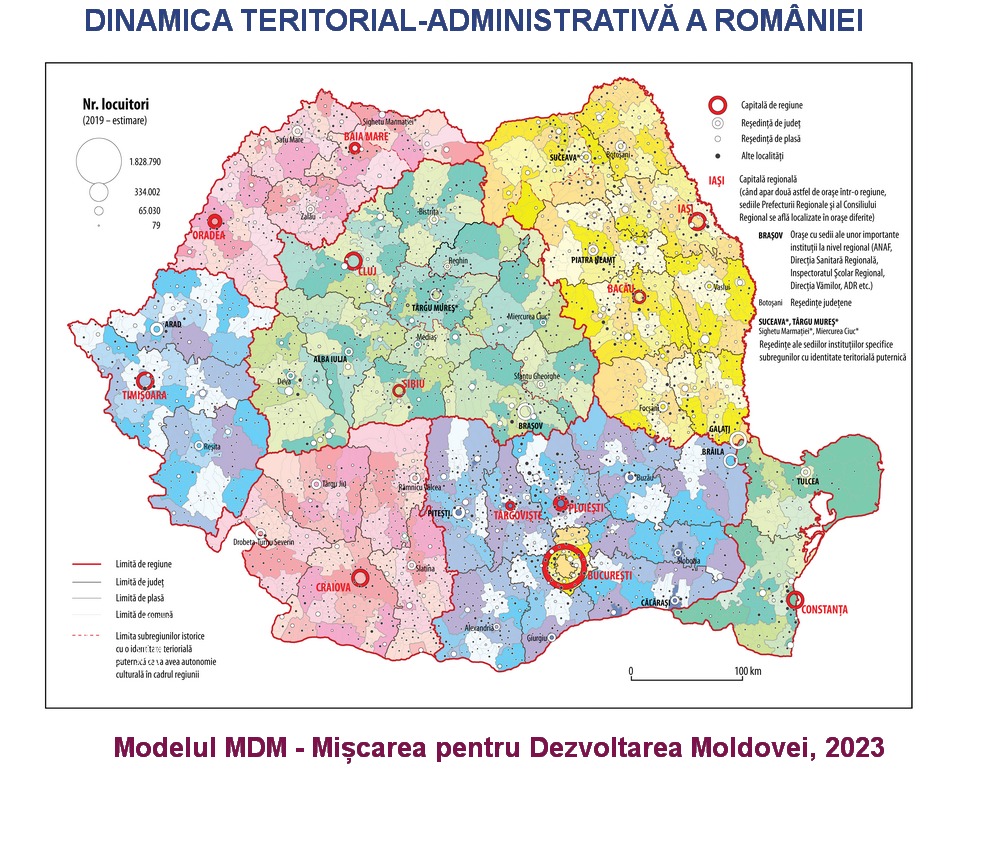
- Regionalizing Romania wouldn’t involve abolishing counties and creating higher structures to coordinate “strategic matters,” Dobrincu argues.
- A potential model is the Polish system, a multi-level administrative-territorial structure: voivodeships (equivalent to a region), powiates (an intermediate level between region and municipalities or communes), and communes (urban or rural).
Historian Dorin Dobrincu is a coordinator of the work “Regionalization. Towards a Model of Good Governance in Romania.” He maintains that a true reform in local administration means more than just cutting costs, as Prime Minister Ilie Bolojan is doing, and includes measures like merging communes or rethinking the responsibilities of county councils. “I admit it’s not straightforward to change a rigid system dominated by clan interests,” the historian added.
Despite Creating Cities, Urban Population Remains the Same
– Mr. Dobrincu, how did Romania end up with cities of 6,000 inhabitants, like Tălmăciu in Sibiu County?
– Dorin Dobrincu: Romania has inflated urbanization statistics, but hasn’t truly urbanized recently designated localities or even some older cities. It’s like putting a sign saying “City” on a village. You raise taxes and pretend that infrastructure, non-agricultural jobs, better public services, transportation, culture, and utilities automatically appear. It’s a veritable Potemkin village in administrative terms.
For a locality to be considered a city, it needs a high population density and be a center for social, cultural, and economic activities, especially non-agricultural ones. The law generally requires a minimum of 5,000 residents.
In the 1990s and 2000s, many communes were transformed into cities in an attempt to increase urbanization figures, even if only statistically.
Despite this, the urban population of Romania was 52.2% at the last census (2021), with the rural population at 47.8%. We’ve remained close to the 1989 level. Romania ranks among the lowest in the European Union, which averages around 75% urbanization.
Some Cities Want to Revert to Commune Status
An fascinating phenomenon is emerging: the desire of administrations and populations in certain cities, which gained status two decades ago, to return to commune status. The reasons are financial.
These localities either don’t see benefits from urbanization—which is often only on paper—or those benefits are too tiny, and taxes are much higher. One case, the locality of Băneasa in Constanța County, was declared a city in 2004 and reverted to commune status in 2008.
Metro Losses Are Covered by the Entire Country
– Bucharest has always had certain advantages compared to other localities: among the cheapest public transport and heating in the country. Are these anomalies or logical, given that Bucharest contributes the most to the Romanian economy?
– The advantages given to Bucharest, in contrast to the rest of the country, aren’t logical, but rather privileges. Many of the benefits aren’t supported by local resources but by funds from the central budget. The metro is a well-known case, administered by the Ministry of Transport, with permanent financial gaps covered by everyone’s money.
“A Monocentric Economic Model Is Not Healthy for Romania”
– Currently, the Capital and Ilfov County concentrate most of Romania’s economy, with incomes much higher than in other counties. What are the roots of this situation?
– The capital has been favored by all the political regimes the country has known. The concentration of power, the centralism that has dominated domestic policies, the numerous institutions headquartered in Bucharest, and the influx of people with money—much of it originating elsewhere—have created many opportunities, attracting more and more residents.
Bucharest’s economy now produces a large portion of Romania’s GDP. Although, I don’t believe this monocentric economic model is healthy for Romania, quite the opposite.
Disproportionate public investment in Bucharest is visible. This isn’t just about the metro and highways, where the capital has often been prioritized. It’s also been seen in administrative, cultural, and sports infrastructure.
“Many of Bucharest’s Sectors and the New Ilfov County Have Been Captured by Political-Economic Clans”
To give an example, more stadiums have been built with public funds in the last decade than in entire regions where none have been built. As is known, public investment often attracts and favors private investment.
There are significant business, real estate, and waste processing interests in the Bucharest-Ilfov area. Networks of political and economic influence—often bordering on illegality—have been established over time. These groups have a worrying amount of influence over Romanian politics, including where and how public investments are made and how money is allocated from the national or local budgets.
“One of the Problems with Administration in Romania Is Its Organization Based on Clans”
– We have a prime minister talking about reforming local administration, which mainly involves reducing positions, following the model he applied in Oradea. Do you suppose This represents the best solution?
– It’s well known that there’s a general overstaffing of schemes in local administration. The same is true in central administration, where there are numerous institutions with bloated staff or dealing with unnecessary tasks, missing their purpose. A reform of local administration is needed.
One of the problems with administration in Romania is its organization, to a large extent, based on clans, similar to major parties.
In many town halls and county councils, you find members of extended families and close associates occupying various positions, draining local administrations.
How Political Mimicry Has Taken Hold in Romania: Inheriting Mayoralties
Other things also seriously affect local administration, such as the election of mayors in a single round, the result of an agreement between mainstream parties over a decade ago.
There’s also the inheritance of the mayoral position within families, from communes, like in Mihai Eminescu, Botoșani County, to the capital, in Sector 5. We’re seeing a mimicry of politics in Romania, not just in small and medium-sized communities.
“Don’t Spend More Than You Produce and Eliminate Waste”
The current prime minister has extensive experience leading a town hall and then a county council. The need to reduce public spending or at least keep it under control seems to be understood. It’s essential not to spend more than you produce and eliminate waste.
We need not only to cut spending—which has sometimes been done without in-depth analysis, affecting essential sectors—but also other measures. The prime minister seems to understand some of these, such as reforming the public administration and pension systems, including eliminating special pensions, starting with those of magistrates.
However, others don’t seem to be on the prime minister’s radar, either since of a lack of understanding or because of strong resistance within the parties and administration. I admit it’s not easy to change a rigid system dominated by clan interests.
“There Are Dozens of Communes With Fewer Than 500 Residents”
– What would a reorganization of local administration in Romania involve?
– Currently, Romania has 3,228 administrative-territorial units (ATUs). Of these, 320 are cities (including 103 municipalities, including Bucharest, which has a special status), and 2,862 are communes.
Regarding communes, more than 1,200 of them have fewer than 2,000 residents. There are also several dozen communes with fewer than 500 residents, including one case (Bătrâna, Hunedoara County), often cited, with fewer than 100 residents.
In the vast majority, communes cannot support themselves with their own funds, requiring transfers from the state budget. Administrative reform involves a discussion of revenues and expenditures, but it involves more than that.
First, a consolidation of communes is needed. This requires identifying the best solutions at the local level. In addition to reducing spending and eliminating positions created solely to reward political clients, it’s necessary to increase administrative capacity, ensure the needs of local communities—health, education, and culture, communications—are met.
Many rural localities are disadvantaged by their geographical position, being far from major transportation routes and cities. This explains the sharp depopulation, so administrative measures must be carefully considered to avoid harming people who are already disadvantaged.
In the coming days, HotNews will publish the second part of the interview with Dorin Dobrincu on the burning issue: administrative reform.
