

New VR Game ‘Wildlife Doctor’ Offers Immersive Animal Healthcare Experience
A new virtual reality game, “Wildlife Doctor,” developed by A440, is offering players a unique and immersive experience simulating the role of a field veterinarian treating wild animals.
The game, designed exclusively for the Pico 4 Ultra and compatible with its Motion Tracker accessory, focuses on the practicalities of emergency animal care rather than strict realism. A recent demonstration at the Tokyo Game Show featured scenarios involving the treatment of a gazelle with a leg infection and a larger elephant requiring more extensive care. Players utilize tools such as cleaning fluids, anti-inflammatories, and ointments, physically reaching for them and maneuvering around the virtual animals to administer treatment. The experience aims to convey the scale and physical demands of working with these creatures in a crisis.
The gameplay emphasizes physical interaction within the VR space, requiring players to stand and move to reach supplies and treat wounds, enhancing the feeling of being a medic in the field. The game incorporates a “vitals bar” that declines with mistakes, adding a time-pressure element reminiscent of the Trauma Center series, but with a distinct focus on animal healthcare. This type of immersive VR experience has the potential to broaden the appeal of simulation games beyond traditional gaming audiences.
Developers are planning to expand the game with additional treatment types and a more developed storyline. A440 has not yet announced a firm release date beyond availability on the Pico 4 Ultra. Officials stated they are hopeful the game will find an audience despite its exclusive platform.
I’ve never thought about what it would be like to be an on-the-field safari doctor. Nor would I say Wildlife Doctor is a particularly accurate recreation of the experience of caring for wild elephants and the like in times of danger. That doesn’t mean A440 hasn’t crafted a rather intriguing experience, turning that unique healthcare scenario into a more unique VR experience.
An easy comparison point for Wildlife Doctor would be as a VR animal-infused take on Atlus’ Trauma Center series, though that would oversimplify exactly what is on offer based on our brief demo at the recent Tokyo Game Show. Designed exclusively for the Pico 4 Ultra with support for the device’s Motion Tracker accessory, it isn’t aiming to make the experience 100% accurate to the real work of a veterinarian. Rather, it’s trying to get you involved in the scale and work necessary in emergency response on these animals.
A440’s booth on the show floor, to its credit, was designed to bring out the immersion of the experience. The floor was lined with artificial turf with small plastic animals nearby, requiring us to take off our shoes and sit down before putting on the headset. Though the final game will support the Motion Tracker, this demo didn’t require it or take advantage of it, instead solely using the standard controllers for operation.
Without any story context in this early stage, we were thrown directly into the action. This demo features two animals to treat, one serving as a tutorial without the stresses of a timeline or the chance of things going wrong, while the other takes place under the pressure of potential failure. The first animal is a gazelle with a graze and infection on their leg, so I sat down and got to work.
Beside me is an array of tools: a fluid to clean the wounds, an anti-inflammatory, a needle, and an ointment. Other tools were locked at that point to keep things simple. These tools are all placed at floor level alongside the animal, but the wound was a considerable distance from the tools due to its size. This is done for realism and proves effective, rather than simply selecting these items from a menu.
First up, I must collect the water to clean the wounds, then pick up the needle to fill it with the anti-inflammatory and inject it into the animal. This soothed the pain in the animal enough for me to grab the ointment and rub it carefully across the wound, before finally using another injection to resuscitate the animal so it can go about its day. With the animal cured, I even have a chance to heal things before moving on.
A striking thing within VR when healing the animal is its scale and the way you truly feel like part of the care experience. This approach requires more space than a game where you can just sit on a sofa or chair and play from a stationary position. However, reaching into the tools and climbing around the animal makes me feel like I am genuinely caring for the animal instead of simply clearing objectives.
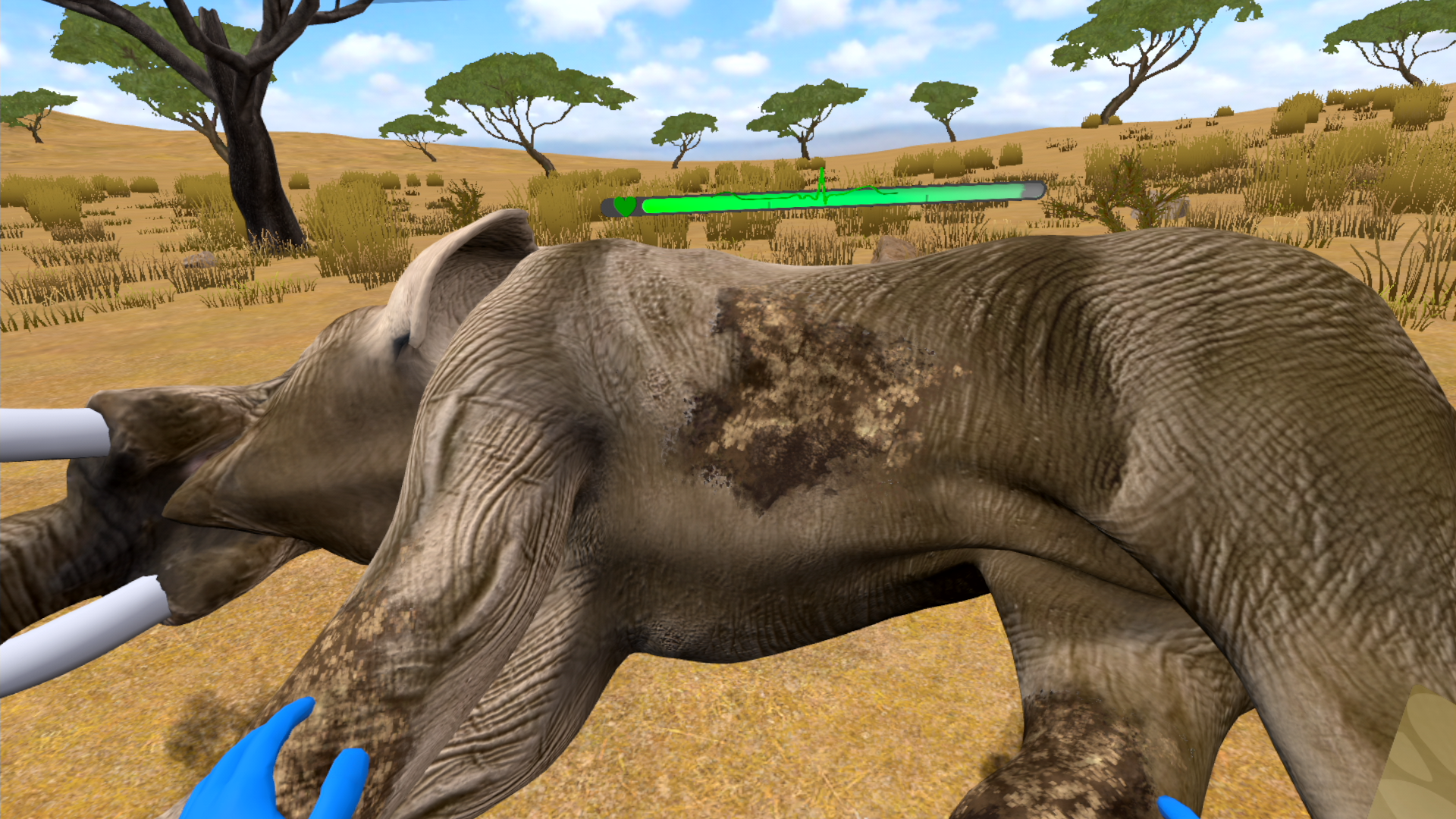
This is emphasized by the more complex task of caring for this far larger elephant. Aside from an additional injection, the actual treatment process is the same, though I’m still forced to adjust my approach considerably to treat the larger animal. Size makes it impossible to sit in one spot and care for the animal, instead requiring me to physically stand and move between my supplies and the wound for treatment, truly making me feel like a medic on the field.
It’s the sort of area VR excels in; while the Trauma Center comparison made previously still applies here (more so now the time limit is in play in the form of a ticking vitals bar above the creature, where mistakes cause this to decline faster), merely the act of being involved and moving around a 3D creature is the tension needed to keep me invested.
Our demo unfortunately ended there, but I’ve come away impressed by the overall experience. As new types of treatment besides the cleaning and disinfecting of flesh wounds are introduced, alongside a more fleshed-out contextual story, there’s a lot to enjoy here. The question remains whether it can take advantage of the Motion Tracker effectively in the full release and whether it will find the audience it deserves when sold exclusively on the Pico 4 Ultra, but I hope it can. I’m ready to treat a wild giraffe next, either way.
