
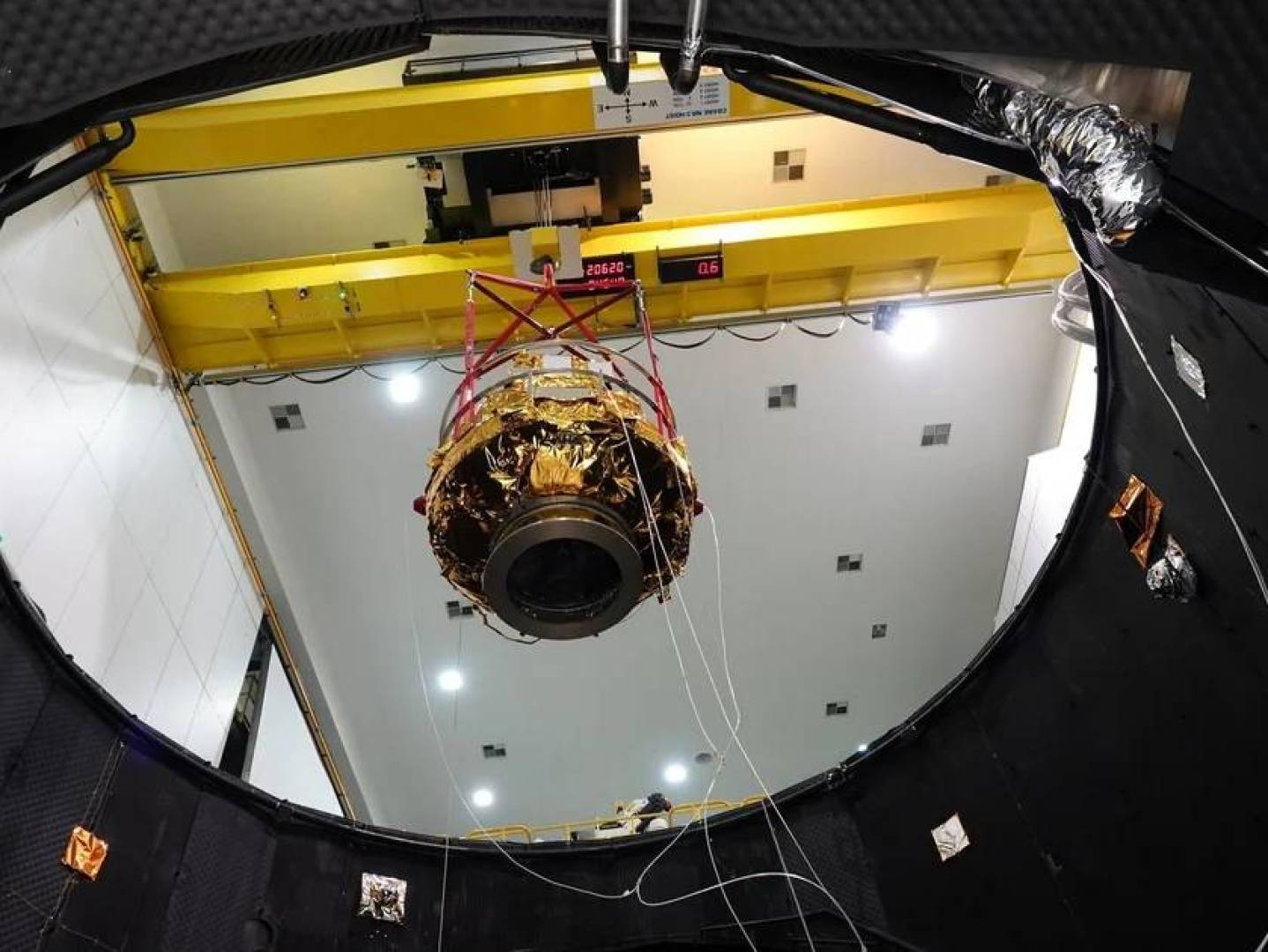
The European Space Agency has given the green light for the Smile satellite to proceed toward a launch window between April 8 and May 7, 2026, representing a crucial step in international space weather forecasting. Developed in collaboration with the Chinese Academy of Sciences, Smile will study the dynamic interaction between Earth’s magnetosphere and solar wind – phenomena increasingly important to protect vital infrastructure as we become more reliant on space-based technologies. Following rigorous testing completed this September at ESA‘s ESTEC facility, the satellite is now preparing for shipment to French Guiana for its launch aboard a Vega-C rocket.
The European Space Agency (ESA), in collaboration with the Chinese Academy of Sciences, has announced the readiness of the Smile satellite for launch between April 8 and May 7, 2026. This mission marks a first-of-its-kind effort to observe how Earth responds to sudden bursts of solar wind and radiation from the sun – a critical area of study as our reliance on space-based infrastructure grows.
Smile will combine X-ray and ultraviolet cameras with particle and magnetic field sensors to create a comprehensive and dynamic picture of the interaction between Earth’s magnetosphere – the planet’s protective shield – and solar activity. Understanding this interaction is key to predicting and mitigating the effects of space weather.
Smile Satellite Launch Readiness
Smile Satellite Launch Readiness (Image source: European Space Agency)
Following ten months of assembly, integration, and testing at ESA’s ESTEC facility in the Netherlands, the satellite completed all technical qualification and flight acceptance reviews in September 2025. The mission is now poised for final preparations before its journey to the launch site.
Key milestones achieved during the preparation phase include:
Successful completion of all reliability tests, demonstrating the satellite’s ability to withstand vibration and extreme temperatures.
Confirmation of high accuracy in measurements from the onboard cameras and sensors.
The satellite will be transported to French Guiana by sea from Amsterdam on a 12-day voyage.
Launch is scheduled to occur using a Vega-C rocket, with the final launch date to be determined in early 2026.
Smile Mission Objectives
Smile builds upon the legacy of ESA’s Cluster mission, which studied Earth’s magnetic field for 24 years before concluding in 2024. The new mission aims to provide even more detailed insights into the complex processes governing space weather.
The primary objectives of the mission are:
To clarify how the magnetosphere interacts with solar particles.
To understand how particles that comprise “space weather” are redistributed.
To improve the ability to assess the impact of solar storms on:
The upper atmosphere
Satellites
Communication networks
Sensitive technological systems on Earth
This data will be essential for enhancing forecasts of space weather conditions that could affect critical infrastructure.
Magnetism and Durability Testing
Tests conducted between July and September 2025 demonstrated that the Smile satellite is designed to withstand the harsh environment of space. These tests validate the satellite’s robustness and ensure the integrity of its scientific instruments.
Key test results include:
Full success in magnetic tests, ensuring no interference with measurement devices.
Excellent tolerance to extreme temperature variations experienced in space.
Confirmation of the integrity of scientific instruments during extended operation.
The Smile project represents a significant scientific step toward understanding how Earth’s magnetic shield protects the planet from powerful solar emissions. The data collected from this mission will provide an unprecedented view of space weather and its impact on our planet.
