
Intense solar activity continues as sunspot region AR4366 unleashes a barrage of flares, including several of the most powerful X-class variety, prompting ongoing monitoring from space weather forecasters [[1]]. While the flares have been significant, current data indicates that the resulting coronal mass ejections are not expected to trigger a major geomagnetic storm; though, the Sun remains highly active and capable of shifting conditions rapidly [[2]]. A weak G1 geomagnetic storm is anticipated to impact Earth’s poles Thursday and Friday, February 5-6, potentially causing minor disruptions to radio communications and navigation systems [[3]].
A significant cluster of sunspots, designated AR4366, is currently dominating the Sun’s visible disk, and has been the source of intense solar flare activity in recent days. Scientists have recorded over 40 flares emanating from this active region, with more continuing to occur.
Notably, seven of these flares registered as the most powerful class, X-class, with one reaching a magnitude of X8.1 – making it the third most potent flare observed in the current solar cycle. Despite the intensity of these events, researchers have observed that the associated coronal mass ejections (CMEs) have been relatively contained. The majority of plasma released has been pulled back down to the Sun’s surface by magnetic forces, rather than being ejected into space.
The potential for dramatic auroral displays, similar to those seen a few weeks prior, was initially high, as X-class flares typically trigger substantial CMEs. However, the limited ejection of plasma means that conditions are not aligning for a widespread geomagnetic storm.
As a result, forecasters predict only a weak geomagnetic storm, categorized as a G1 event, is expected to impact Earth’s magnetic poles between Thursday and Friday, February 5-6. This level of activity is unlikely to produce visible auroras across much of the Northern Hemisphere.
While a widespread aurora borealis over Poland is not anticipated, observers along the Baltic Sea coastline may have a slight chance of witnessing a “photographic aurora,” though this remains improbable. The Sun’s activity is being closely monitored as it demonstrates the complex interplay between solar flares and space weather.
Despite the subdued CME activity, sunspot AR4366 remains favorably positioned relative to Earth and could continue to produce flares, including potential CMEs, over the next few days. However, predicting the timing and direction of any future ejections remains challenging.
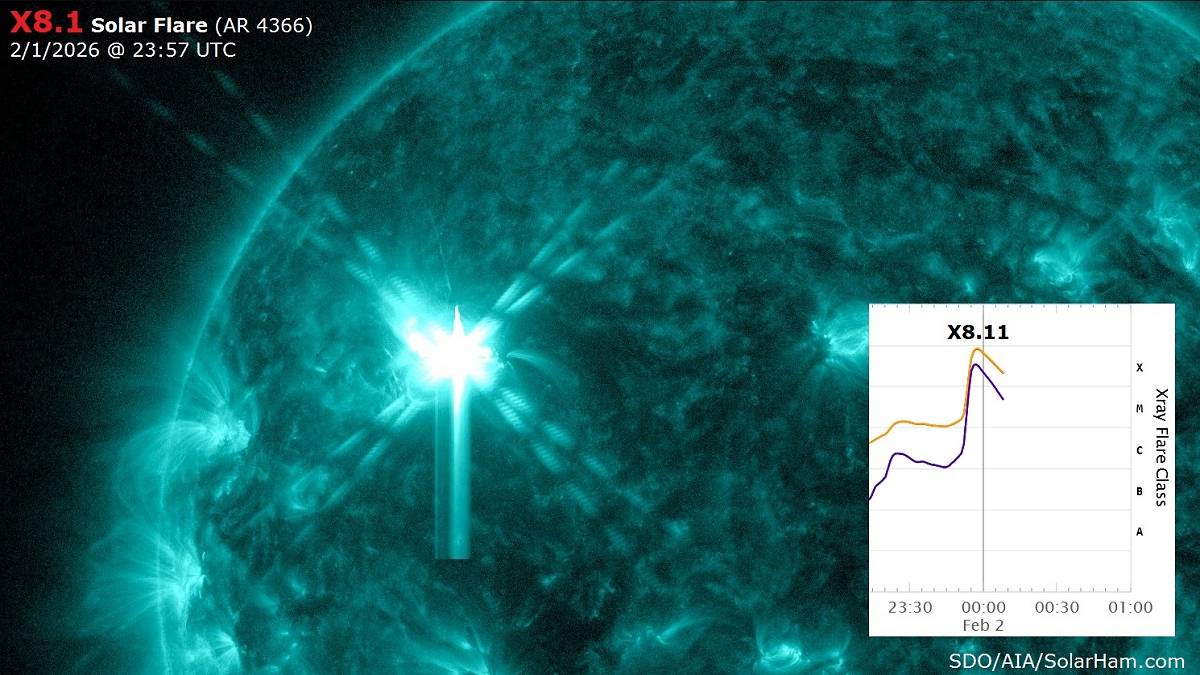 The largest flare observed on the Sun in recent days. Photo: solarham.com
Historically, sunspots have sometimes unleashed their most significant activity as they rotate towards the western edge of the solar disk, leaving observers disappointed. Residents of far northern latitudes, however, are virtually guaranteed to see auroral displays even during weaker geomagnetic storms.
Source: TwojaPogoda.pl
