
In January 1988, a stunning theft shook the Dakar Rally as a leading Peugeot 405 T16 was stolen overnight, threatening the race lead of Ari Vatanen adn sparking a bizarre incident involving a ransom demand. The audacious crime,which unfolded in Bamako,Mali,went beyond a simple mechanical failure and exposed vulnerabilities within the iconic off-road event. this story details not onyl the frantic search for the vehicle and negotiations with potential kidnappers, but also the lasting impact the incident had on security measures at the Dakar Rally, transforming it into the heavily-guarded spectacle it is today.
On January 18th, rally driver Ari Vatanen awoke with a strong feeling of confidence. After two grueling weeks of competition, he held a nearly two-hour lead, and victory in the Dakar Rally seemed all but assured. However, when mechanics arrived at the secured vehicle park early that morning, they found an empty space where his Peugeot 405 T16 should have been. The million-dollar Peugeot, a masterpiece engineered by Jean Todt, was gone.
“Where is the car?” The question reverberated through the team’s camp. Jean Todt, then head of Peugeot Talbot Sport (and later Ferrari and the FIA), a man known for his composure, felt a surge of panic. This wasn’t a mechanical failure or an accident; it was a theft. Someone had simply driven off with the fastest vehicle in the race.
Photo: Peugeot Sport
The Peugeot 405 Turbo 16 was a factory-built vehicle that stood out during the Dakar Rally.
As the news spread through the rally bivouac, events unfolded like a scene from a spy novel. A message arrived to Peugeot team leadership demanding a ransom of 25 million francs. The Dakar Rally, previously viewed as a contest between humans and nature, had become a hostage in a criminal underworld.
Imagine the scene: Jean Todt, seated in a dusty tent, holding a phone and attempting to negotiate the return of the race car with individuals who understood they held France in a precarious position. Vatanen, a man of deep faith and calm, sat nearby in silence. “I felt like a part of me had been stolen,” he later recalled. This incident highlights the vulnerabilities even high-security events can face, and the potential for disruption beyond sporting competition.

While the message spread through the bivouac, a series of events unfolded that resembled a spy thriller. A message was delivered to Peugeot team management, demanding a ransom of 25 million francs. The Dakar Rally, until then perceived as a pure contest between man and nature, became a hostage to the criminal underworld.
Consider the situation: Jean Todt, sitting in a dusty tent, holding a phone and attempting to negotiate the return of the race car with people who knew they held an entire nation at risk. Vatanen, a man of deep faith and composure, remained silent. “I felt like someone had stolen a piece of me,” he would later remember.
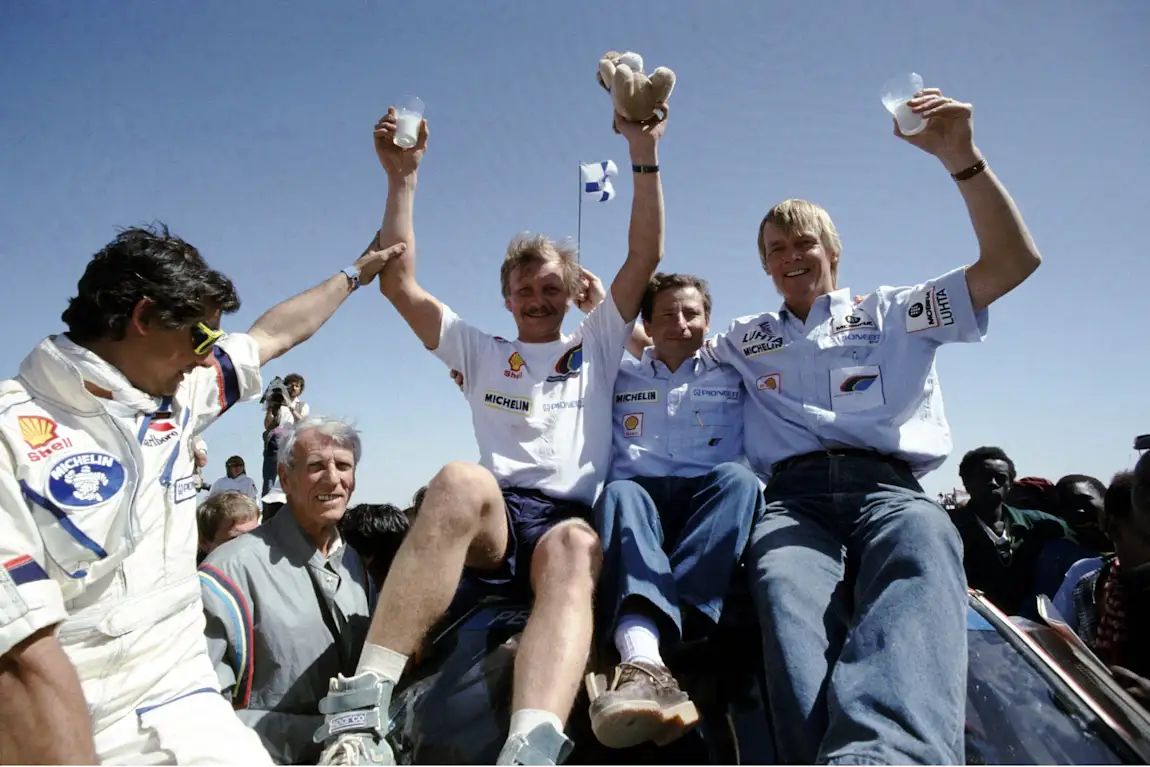
Photo: Peugeot Sport
Juha Kankkunen was able to win the race for Peugeot, but never forgot to mention that he didn’t feel like the true victor.
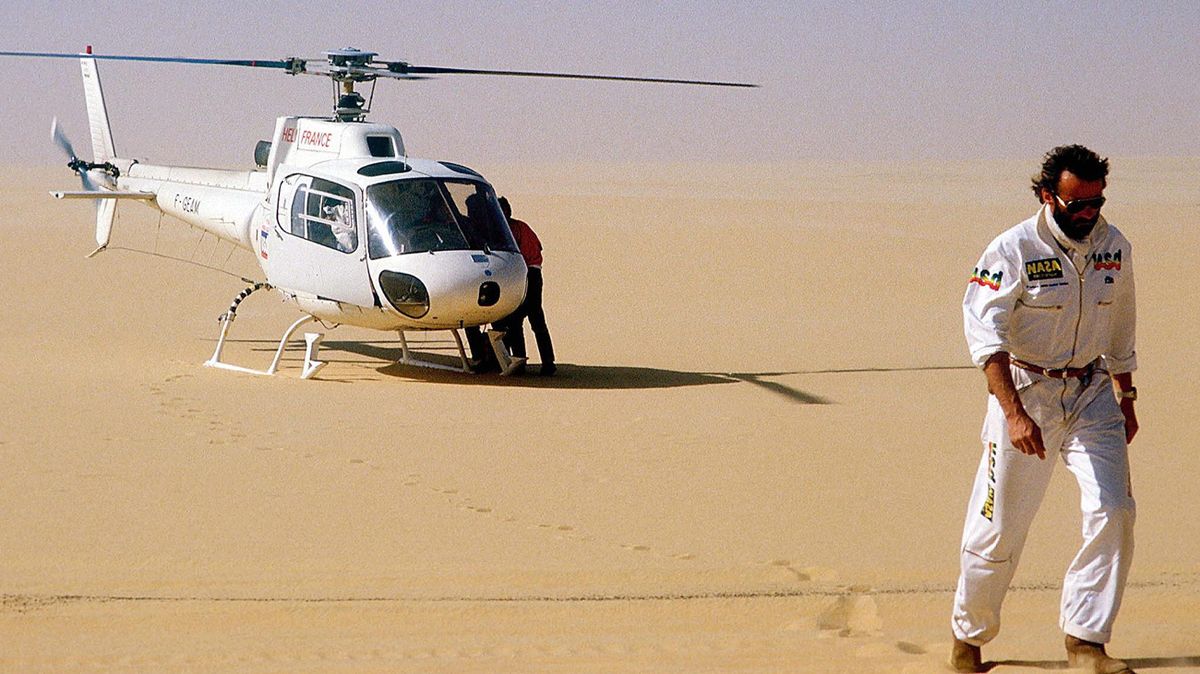
The Dakar Rally, at that time, was a symbol of French national pride, and the theft of the Peugeot was seen as an attack on the state. Local police, the military, and intelligence services were all involved. Helicopters circled over Bamako as Peugeot executives debated whether to pay the ransom.
As negotiations continued, time ticked away in the bivouac. FIA rules were uncompromising. If the car didn’t start the next stage on time, it would be disqualified. Todt attempted to convince race officials that this was an act of “force majeure,” citing safety concerns, the political situation, and unforeseen circumstances. But sporting regulations didn’t recognize a provision for “stolen cars.” Organizers, led by René Metge, found themselves in a difficult position. The rules were clear: the car had to be at the start of the stage on time, or face disqualification.
Around 8:30 a.m., when Vatanen’s start time had long passed, news arrived: “The car has been found!” It was parked on the outskirts of town, near a sorghum field. The kidnappers likely realized they couldn’t get away with such a conspicuous vehicle, or were frightened off by the massive search operation.
Vatanen was at the car within minutes, and the engine started on the first try. He bypassed any warm-up procedures, rules, and sped through the city to reach the starting line. He arrived late, but in the context of two weeks of racing across the desert, the delay seemed negligible. However, according to the rules, it was fatal.
The scene at the starting line was heartbreaking. Vatanen, prepared to fight for the win, received a red card.
Jean Todt was furious. He filed a protest that would be debated for months after the race concluded. Peugeot did celebrate a victory with Juha Kankkunen driving the second vehicle, but it was a bittersweet triumph. Kankkunen later admitted, “That victory belonged to Ari. I was just the one who brought the rest of the team to the finish.”
The events of 1988 permanently changed the Dakar Rally. Previously, the bivouac was an open space where local children could touch the vehicles from Europe. After the theft, fences began to appear around the cars and motorcycles. Security increased, and the race became enclosed in its own bubble, a state that continues today. Accreditation, access control, security perimeters, and military presence are now commonplace. Gaining access to the bivouac, if you aren’t part of the race, is virtually impossible. This shift reflects a broader trend toward increased security measures at large-scale sporting events.
The story of the stolen Peugeot remains one of the greatest mysteries in motorsport history. Who actually stole it? Was it about the money, or did competitors play a role? Or was it a political matter?
Ari Vatanen returned to the Dakar and eventually won. But a sense of sadness always lingered in his voice when he spoke about Bamako.
Ten years later, terrorists attacked Czechoslovakian teams on the border of Mauritania and Mali. They captured crews from two Tatra trucks, gunfire erupted, and the drivers faced a grim fate. Ultimately, the terrorists stripped them to their underwear, shot out the tires of one truck, and drove off with the other. But that’s another story…
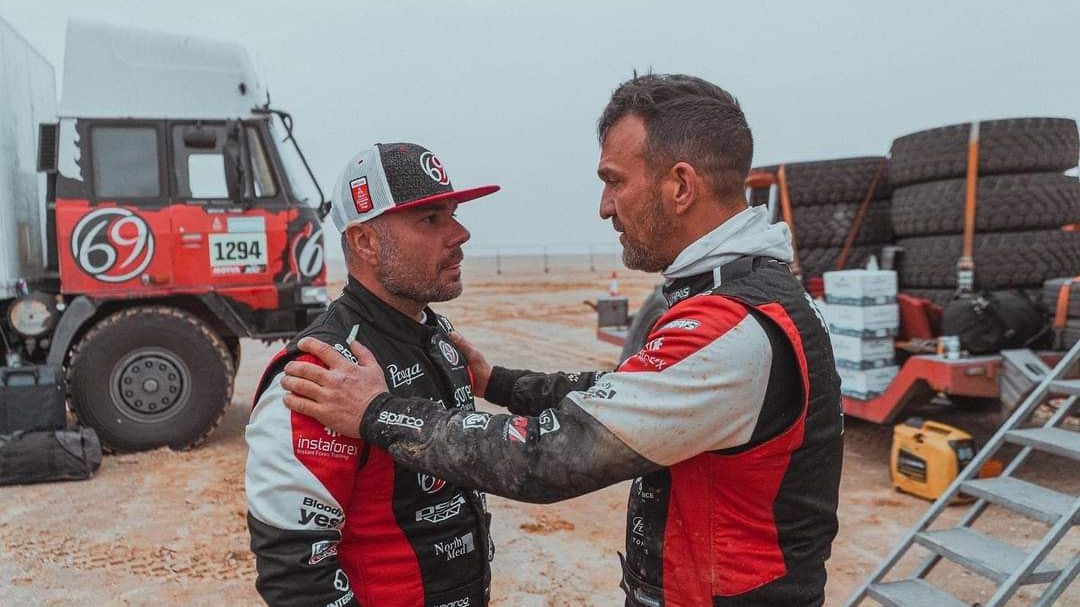

Today, with modern Dakar featuring GPS systems and heavy police security due to the threat of terrorist attacks, it’s hard to imagine someone stealing a race car. But in reality, it’s simpler than you might think. Racing cars don’t have central locking systems, because they don’t even have door locks. You flip the main switch, activate the fuel pumps, and press the start button. Clutch in, pull the sequential gearbox lever, and you’re off. Anyone who has seen it done once could likely manage it.
Petr Brynda, a chief mechanic for the Orlen Jipocar team here at Dakar, has insight into this. In 2003, he was the chief mechanic for a team racing a Fabia cup car at the Barum Rally. “On Sunday evening after the race, I went to pick up the car from the parc fermé, and it wasn’t there. I thought the driver had collected it, but he looked at me like I was joking. The reality was that someone had simply figured out how everything started, jumped in, and drove off. The car was found on Tuesday morning, and the guy was driving it normally on the roads around Zlín, fortunately without damaging it. Since then, cars have only been released from the parc fermé with a ticket you receive during technical inspections.”
Few people remember the story of the stolen Peugeot today, and frankly, stealing a race car doesn’t make much sense. They are unsellable, and there’s nowhere to drive them. And the cars are parked with their teams, making a theft in the middle of the night unlikely. Perhaps… But let’s not even imagine that!
