
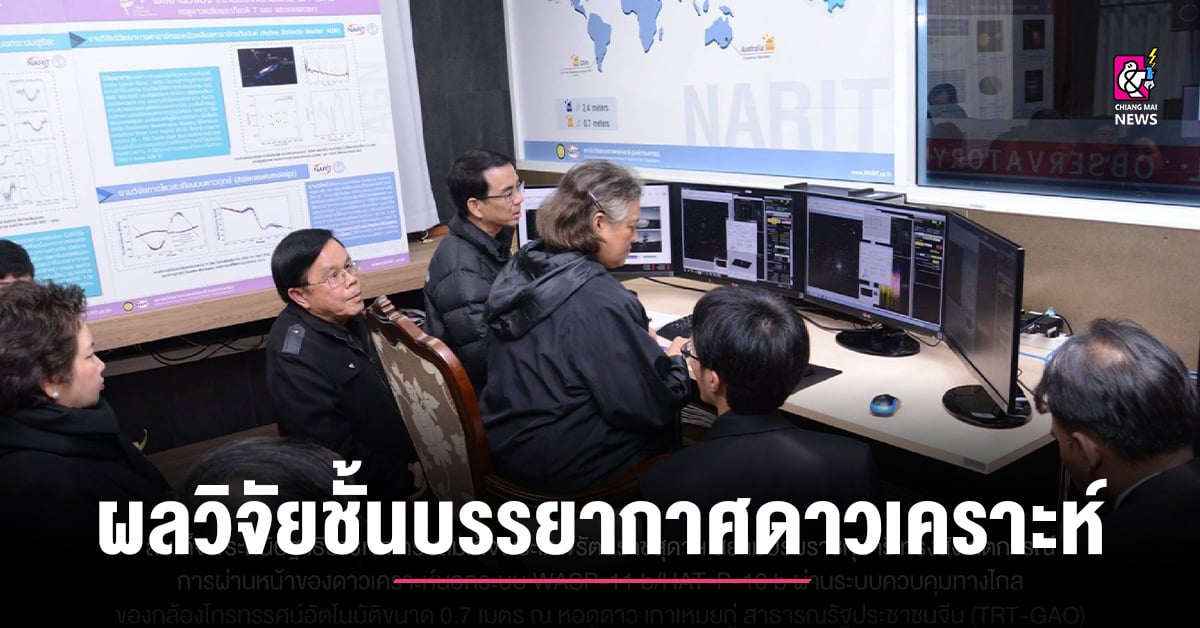
After more than a decade of meticulous observation, astronomers at Thailand’s National Astronomical Research Institute of Thailand (NARIT) have unveiled groundbreaking findings on the atmospheres of exoplanets—planets orbiting stars beyond our solar system. The research, conducted using telescopes based in Thailand, marks a significant milestone in the country’s growing role in global space science and underscores the power of long-term data collection in unraveling cosmic mysteries.
The study, which spanned over 10 years, leveraged advanced observational techniques to analyze the atmospheric compositions of distant worlds. By tracking subtle changes in light as these exoplanets passed in front of their host stars, researchers were able to detect key chemical signatures, offering clues about their potential habitability and the dynamic processes shaping their environments. Such insights are critical as scientists refine their search for Earth-like planets and assess the conditions that might support life beyond our solar system.
“This research demonstrates the importance of sustained observation in astronomy,” said a NARIT spokesperson. “The data we’ve gathered not only advances our understanding of exoplanetary atmospheres but also highlights the capabilities of Thailand’s astronomical infrastructure.” The findings were made possible by the Thai National Observatory, equipped with state-of-the-art instruments designed to capture high-resolution spectroscopic data—a testament to the country’s investment in cutting-edge space research.
While exoplanet studies have traditionally been dominated by large international collaborations, NARIT’s work signals a shift toward greater regional contributions to astrophysics. The project aligns with broader efforts to democratize space science, enabling smaller nations to participate in high-impact research that was once the exclusive domain of a handful of space agencies. For Thailand, the study represents a leap forward in its ambition to become a hub for astronomical innovation in Southeast Asia.
The implications of the research extend beyond academia. As private companies and governments ramp up plans for lunar bases and Mars missions, understanding the atmospheres of distant planets could inform future exploration strategies. The techniques developed by NARIT’s team could be adapted for other applications, such as monitoring Earth’s own atmospheric changes or studying the behavior of stars and galaxies.
Despite the challenges of long-term observational projects—including the require for consistent funding, technological upgrades, and international collaboration—the payoff is clear. “Every dataset we collect adds another piece to the puzzle,” the spokesperson added. “Over time, these pieces come together to reveal a bigger picture of our universe.”
As the field of exoplanet research continues to evolve, NARIT’s work serves as a reminder of the value of patience and precision in science. With new telescopes and instruments on the horizon, astronomers are poised to uncover even more secrets of the cosmos—one observation at a time.
For now, the team’s findings stand as a testament to the power of persistence in scientific discovery. As technology advances and more nations join the quest to explore the universe, collaborations like this one will be essential in pushing the boundaries of what we know about the cosmos—and our place within it.
